
Do Perfume, Lotion and Sunscreen Damage Crystal Bracelets?
The stone is rarely what suffers. A product-by-product account of what perfume, lotion and sunscreen do to bead polish, steel wire and clasp seams.
In this field note
Getting dressed puts four or five products on the same patch of skin within about ten minutes, and a bracelet usually goes on somewhere in the middle of that sequence.
Order turns out to matter more than product. None of it dissolves quartz — very little dissolves quartz — but the film left behind is what dulls a bead over a year, and the clasp is where it accumulates first.
Do perfume and lotion actually damage crystal beads?
Not the stone. Quartz is chemically stable against everything in a bathroom cabinet, and a bead could sit in perfume for a year without changing. Feldspar and garnet are nearly as indifferent.
Three other things do change. The polished surface of softer or glassier stones loses a little brightness as films build up and are wiped away repeatedly. The seam of the clasp collects residue that then traps grit. And on strands where any adhesive is used at a fitting, solvents are a genuine problem. The damage is cumulative and slow, which is why it is usually noticed as a general dullness rather than an event.
What is in these products that matters?
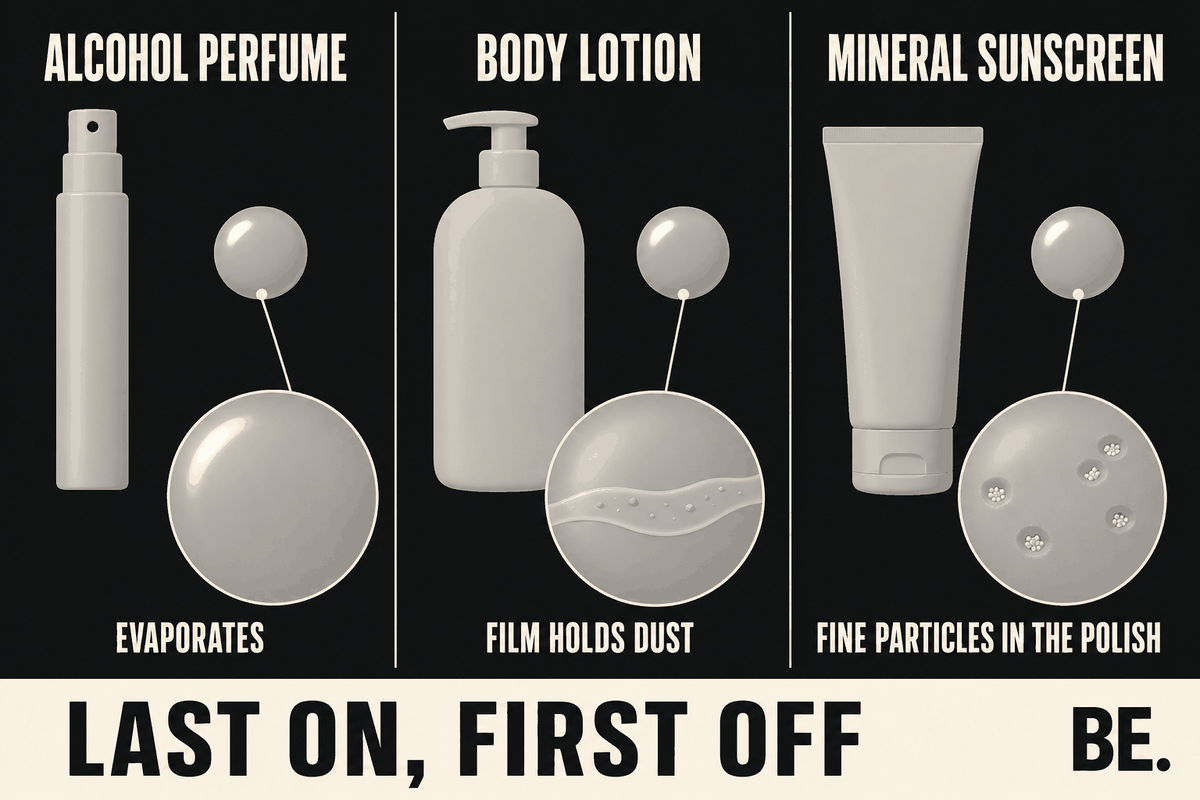
Four ingredient groups do nearly all the work. Ethanol, the carrier in most perfumes and all hand sanitiser, evaporates fast but dries out anything organic it meets on the way. Oils and emulsifiers in lotion leave a film that is sticky enough to hold dust. Fragrance compounds are chemically inert against stone and simply add to the film.
The fourth group is the one people do not expect. Mineral sunscreen works by suspending zinc oxide and titanium dioxide particles on the skin, and those particles are hard, fine and angular. Trapped between a bead and a sleeve, they act on a polished surface much as an extremely fine abrasive compound would. This is not corrosion and it is not permanent damage in any single instance; it is a slow loss of brightness that shows on glassy surfaces long before it shows on quartz.
Which stones tolerate it and which do not?
Read the table by the last column. The quartz family shrugs everything off. The stones that show it are the ones with a softer polish, a cleavage plane near the surface, or a glass finish that reads every film.
| Product | What matters in it | Effect on the bead | Effect on wire and clasp | Habit |
|---|---|---|---|---|
| Alcohol perfume | Ethanol | Dulls softer polishes over time | Can creep into the clasp seam | Spray first, dry fully |
| Body lotion | Oils and emulsifiers | Film that holds dust | Traps grit in the fitting | Wipe after wearing |
| Chemical sunscreen | Organic filters | Surface film | Low | Wipe daily in summer |
| Mineral sunscreen | Zinc oxide, titanium dioxide | Fine haze on glassy polishes | Grit in the clasp | Apply and dry before wearing |
| Hand sanitiser | 70 percent ethanol | Dries the surface | Low | Avoid pooling at the fitting |
| Hairspray | Polymers and solvent | Sticky film, hard to remove | Gums the clasp | Bracelet on last |
| Nail polish remover | Acetone | Low on quartz | Dissolves adhesive | Never near the fitting |
Moonstone, prehnite, obsidian and kyanite are the four in the BE. range that reward the habits in the last column. Quartz in any of its varieties does not really need them, though the clasp still does.
What is the last on, first off rule?
Jewellery goes on after everything else and comes off before anything else. Perfume, moisturiser, sunscreen and hairspray all get applied and given a minute to dry, and only then does the bracelet go on. It is then the first thing removed in the evening, before hand cream or a shower.
It is a single habit that prevents most of what this page describes, and it costs nothing. The reason it works is that almost all the residue transfers while a product is still wet. Once it has dried on skin, very little of it moves onto a bead.
How do you get residue off beads safely?
- Dry microfibre first. Most of a lotion film lifts without any water at all.
- Then a barely damp cloth with plain water, working around each bead rather than along the strand.
- Dry completely, including the clasp seam, before putting it away.
- No ultrasonic cleaners, no steam, no washing-up liquid on porous stones.
Which stones tolerate water at all, and for how long, varies more than most people assume, and getting it wrong matters more than the residue does. That is set out stone by stone in the can I shower with my crystal bracelet, with the full cleaning method for each in the care chart. Sweat during exercise is a different chemistry again, and belongs with the gym, sauna and beach guide.
Does sunscreen leave a film that will not come off?
It leaves one that resists ordinary wiping, which is not the same thing. Zinc and titanium particles are small enough to settle into the microscopic pits of a polished surface and into the bead hole, and a dry cloth passes over them rather than lifting them out.
Two places show it. Dark stones show a pale bloom, because the particles themselves are white. And bead holes go grey, which is visible on a strand held up to light and invisible on the wrist. Repeated damp cleaning over a few sessions clears most of it, and a summer habit of applying sunscreen before the bracelet goes on prevents nearly all of it. Where a bead has genuinely lost some brightness over years of wear, that is surface history rather than a fault — the same argument the sunlight guide makes about colour.
Frequently asked questions
Q1.Should I take my bracelet off before spraying perfume?
Yes, and put it on afterwards once the perfume has dried. Ethanol does nothing to quartz but can work into a clasp seam, and almost all residue transfers while a product is still wet. Last on, first off prevents most of it.
Q2.Does sunscreen damage crystal beads?
Mineral sunscreen leaves the most stubborn residue. Zinc oxide and titanium dioxide particles settle into the pits of a polished surface and into the bead hole, showing as a pale bloom on dark stones and grey bead holes. Applying it before the bracelet goes on avoids it.
Q3.Will hand cream or body lotion harm my bracelet?
Not the stone, but the film it leaves holds dust, and dust is what dulls a polished bead over time. A dry microfibre wipe after wearing removes the film before it accumulates.
Q4.Is hand sanitiser bad for crystal jewellery?
It is mostly harmless. The ethanol evaporates within seconds and quartz is indifferent to it. The thing to avoid is letting sanitiser pool around the clasp fitting, where repeated wetting and drying leaves deposits.
Q5.How do I clean product residue off crystal beads?
Dry microfibre first, since most of a lotion film lifts without water. Then a barely damp cloth with plain water, working around each bead. Dry the clasp seam completely before storing. No ultrasonic cleaners and no steam.
Q6.Which crystals are most sensitive to cosmetics?
Moonstone, prehnite, obsidian and kyanite. Two have cleavage near the surface, one is volcanic glass that reads every film, and all four take a softer polish than quartz. The quartz family is effectively indifferent.
References
- Wikipedia — Sunscreen
- Wikipedia — Titanium dioxide
- Wikipedia — Zinc oxide
- Mindat — Quartz mineral data
- Nassau, K. (1994). Gemstone Enhancement, 2nd ed. Butterworth-Heinemann.
Field Notes.
One stone at a time: its geology, and how to read quality. The Stone Buying Checklist comes with your first email.
By subscribing you agree to receive emails from BE. Unsubscribe anytime.
Sent. Check your inbox.