
Does a Crystal Bracelet Need to Touch Your Skin?
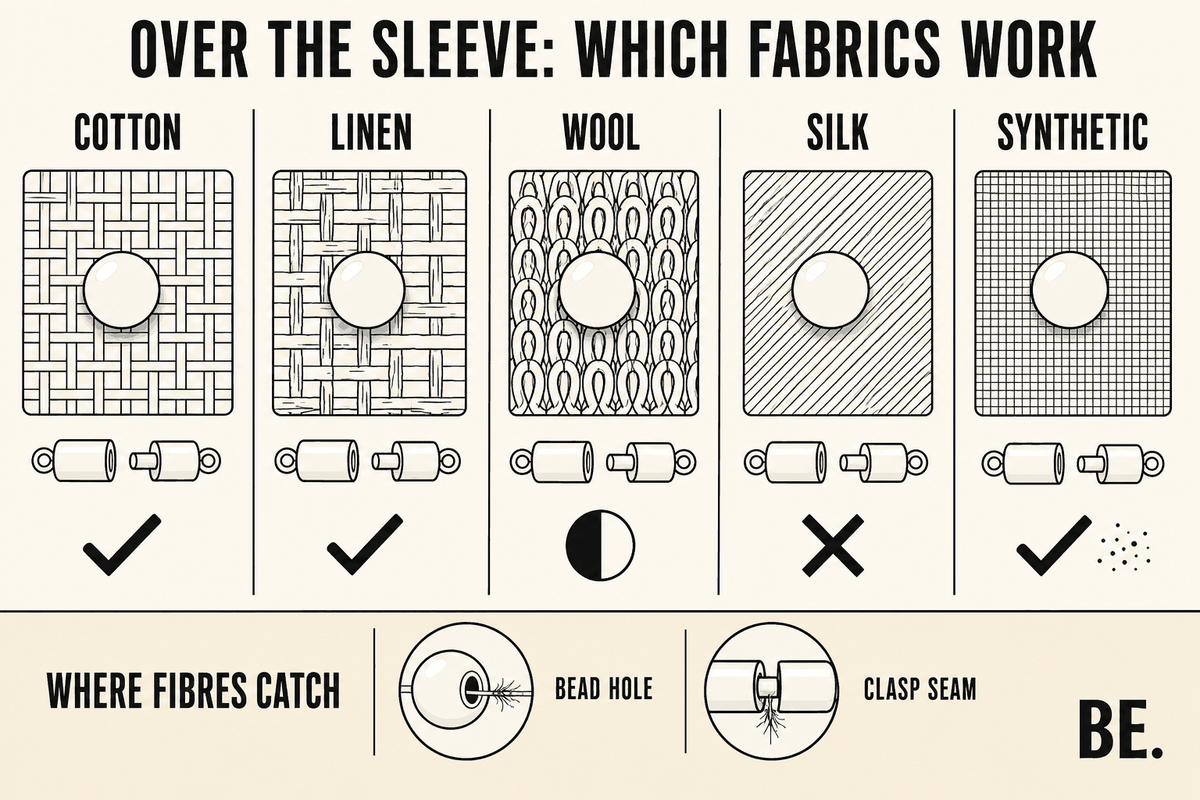
Against skin is the normal way. Over a sleeve needs thought, because fabric decides it — linen and wool catch, cotton does not, silk is the real risk.
In this field note
Cold mornings raise a question that never comes up in summer, which is whether a bracelet belongs over the sleeve or under it.
The answer is usually under, for the sensible reason that skin is smooth and fabric is not. But over the sleeve is a real look, and whether it survives the day depends almost entirely on what the sleeve is made of.
Does a crystal bracelet have to sit against skin?
No. Against skin is simply the default because it is comfortable and it stays put. Nothing about a mineral requires contact, and there is no measurable difference in what a stone does either way. Whether stones affect the body at all is covered in Do Crystals Affect the Human Body?.
What is left is a practical question that turns out to be more interesting: what happens between a polished bead and a woven fabric, all day, for months. The answer varies enormously by fibre, and it is the sort of thing nobody mentions until a favourite jumper has a pulled thread in it.
Which fabrics can a bracelet be worn over?
Cotton, comfortably. Linen and wool, with a caveat. Silk, reluctantly. Synthetics, at the cost of looking dusty. The variable is not softness but structure: how loosely the yarn is spun and how easily a single fibre can be lifted out of the weave.
| Fabric | What it does to the strand | What the strand does to it | Verdict |
|---|---|---|---|
| Cotton | Little; smooth enough to pass over beads | Nothing | Wear over freely |
| Linen | Coarse fibres work into bead holes | Little, weave is tight | Fine on a fitted sleeve |
| Wool and knitwear | Fibres wrap the clasp seam | Pilling where beads sit | Over a cuff, not a knit |
| Silk | Nothing to the strand | Pulled threads at bead holes | Under the sleeve |
| Cashmere | Fine fibres shed onto the strand | Pilling, and it shows | Under the sleeve |
| Polyester and nylon | Static holds dust on the beads | Nothing | Wear over, wipe more often |
| Leather and suede | Nothing | Burnished marks where beads rub | Over a jacket cuff only briefly |
Two rows carry most of the risk. Silk snags because a bead hole has an edge, however finely finished, and a single lifted filament is a visible fault in a way that a pull in cotton is not. And knitwear pills where beads sit, which shows up as a small rough patch on a sleeve after a season.
Why does the clasp catch more than the beads?
Because the beads are spheres and the clasp is not. A polished sphere presents no edge in any direction and rolls across a weave. A clasp has a seam, a lip and usually a small step where the two halves meet, and each of those is a place a fibre can lodge.
The practical fix is to rotate the clasp to the underside of the wrist, where it meets a cuff rather than the open weave of a sleeve. This is worth doing regardless of fabric, because the same seam that catches fibres also collects lint, and a clasp packed with wool fluff stops sitting flush. A magnetic clasp makes this easy in a way a fixed fitting does not: it can be opened, cleared and closed again in seconds without taking anything apart.
Why does a stone feel cool against skin, and does that change over fabric?
A stone feels cool because it conducts heat away from skin far faster than skin can replace it. Quartz conducts roughly twenty-five times better than skin does, so the first contact pulls warmth away quickly and registers as cold. The stone is not cold; it is simply an efficient path out.
| Material | Thermal conductivity, W/m·K | Feels cool on first contact? |
|---|---|---|
| Silver | About 429 | Strongly |
| Quartz | About 7.7 | Yes |
| Feldspar, as in moonstone | About 2 | Mildly |
| Obsidian, volcanic glass | About 1.4 | Mildly |
| Human skin | About 0.3 | Not applicable |
| Acrylic or resin bead | About 0.2 | No |
Two useful consequences. Over a sleeve the effect disappears entirely, because fabric is an insulator and there is no path for heat to take. And that last row is a field test: a plastic bead sold as quartz gives itself away in about two seconds against a cheek, because it cannot carry heat away and warms instantly. The other tests worth knowing are in the real versus fake guide.
What does skin leave on a bead over time?
Sebum and salt, in small quantities, continuously. Neither harms quartz, which is why a strand worn daily for years looks much as it did. What they do is accumulate in the two places a cloth does not reach: the bead hole and the clasp seam.
Worn over fabric the residue is different rather than absent — lint and fibre instead of oil, gathering in the same two places. Either way the maintenance is the same and it is minimal: a dry wipe regularly, a barely damp one occasionally, and full drying before storage. Cosmetics are a separate and more demanding chemistry, covered in the perfume and sunscreen guide.
When is it better to take the bracelet off altogether?
When there is going to be sweat. Heavy perspiration puts salt onto the strand faster than it can evaporate, and salt is mildly abrasive once it dries and crystallises in a bead hole. It also sits in the clasp seam, where it does more harm than it does to any stone.
Exercise, saunas and hot beaches are therefore the times to leave a strand at home rather than to wear it over a sleeve. That has its own answer, stone by stone and activity by activity, in the gym, sauna and beach guide. For everything else, under the sleeve on skin, or over cotton, covers almost every day of the year.
Frequently asked questions
Q1.Does a crystal bracelet need to touch your skin?
No. Against skin is simply the usual way to wear one because it is comfortable and stays in place. Nothing about the mineral requires contact, and the question of what stones do at all is answered separately and honestly elsewhere on this site.
Q2.Can I wear a crystal bracelet over a sleeve?
Yes, and the fabric decides whether it works. Cotton is fine, linen and wool are acceptable over a fitted cuff, and silk and cashmere are better avoided because bead holes lift threads. Synthetics build static that makes beads look dusty.
Q3.Will a bracelet snag my jumper?
The clasp will before the beads do. A polished bead is a sphere with no edge, while a clasp has a seam and a lip where fibres lodge. Rotating the clasp to the underside of the wrist, against a cuff rather than open knit, prevents most of it.
Q4.Why does a crystal bracelet feel cold?
Because quartz conducts heat away from skin about twenty-five times faster than skin conducts it back. The stone is at room temperature; it simply removes warmth quickly, which registers as cold. Worn over a sleeve the effect disappears.
Q5.Do sweat and skin oils damage crystal beads?
Not the stone. Quartz is unaffected by either. They accumulate in the bead hole and the clasp seam, which is where a strand actually needs cleaning. Heavy sweat during exercise is worth avoiding, because dried salt is mildly abrasive.
Q6.Why does a plastic bead not feel cold?
Because acrylic conducts heat roughly forty times worse than quartz, so it cannot draw warmth away and reaches skin temperature almost immediately. Holding a bead against a cheek for two seconds is one of the quicker ways to spot an imitation.
References
- Wikipedia — Thermal conductivity
- Wikipedia — List of thermal conductivities
- Mindat — Quartz mineral data
- GIA Gem Encyclopedia — Quartz
- Clauser, C. and Huenges, E. (1995). Thermal Conductivity of Rocks and Minerals. American Geophysical Union.
Field Notes.
One stone at a time: its geology, and how to read quality. The Stone Buying Checklist comes with your first email.
By subscribing you agree to receive emails from BE. Unsubscribe anytime.
Sent. Check your inbox.