
Why Is My Bracelet Loose? Fit Troubleshooting
A steel-wire bracelet does not gradually stretch loose. Check wrist measurement, selected size and desired movement first, then inspect the clasp, terminals and wire for damage.
In this field note
“Loose” sounds like one symptom, but it describes two very different situations. One is a bracelet that has always moved farther along the hand than expected. The other is a strand whose behaviour changed suddenly because a fitting or the wire was damaged. The first is normally a sizing decision. The second is a reason to stop wearing it.
This guide is specifically about a bead bracelet built on jewellery-grade steel wire and finished with a magnetic clasp. Steel wire keeps a fixed working length in normal wear; it may kink, fray at a terminal or break under damage, but it does not slowly become longer with wear.
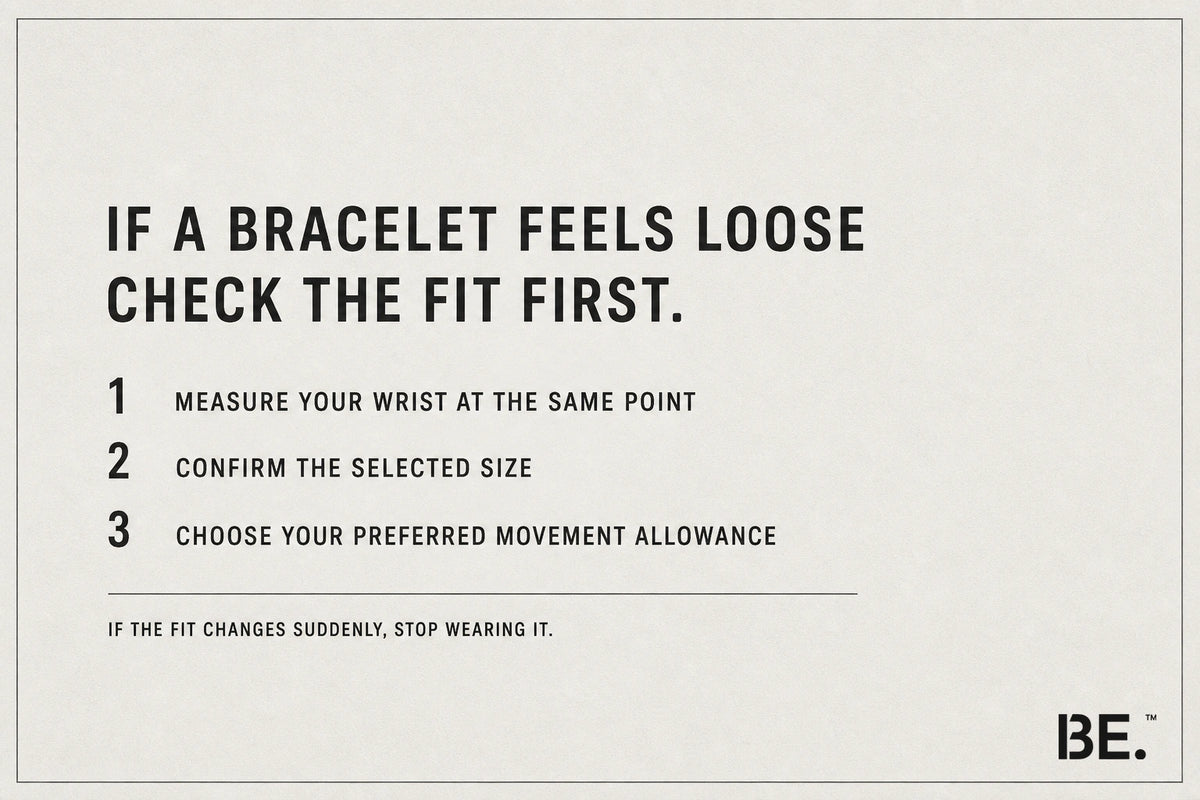
Why can a steel-wire bracelet feel loose from the first wear?
A bracelet that is loose on day one was almost certainly made or selected with more internal circumference than that wrist and that wearer prefer. The most common cause is measuring the wrist loosely, then adding another comfort allowance when choosing the size. The two allowances compound. A second cause is copying the outer length of an existing bracelet without accounting for bead diameter.
Large beads occupy more space on the inside of a circle than small beads. Two bracelets can have the same end-to-end measurement yet feel different around the wrist. The useful numbers are the close skin measurement and the finished bracelet’s internal fit, not the circumference traced around the bead exteriors.
Fit preference matters too. A close fit stays behind the wrist bone; a relaxed fit turns and moves; a loose fit can pass over the widest part of the hand. None is automatically a fault. The fault question begins when the delivered size differs from the ordered size, or when the construction shows visible damage.
Is the size too large, or was the wrist measured differently?
Measure the wrist again with a soft tape or a narrow strip of paper placed against the skin, directly where the bracelet is worn. Do not pull tight enough to indent the skin and do not leave a finger beneath the tape. Repeat at the same time on two days. Heat, exercise, hydration and the position of the hand can make a small temporary difference, so a single hurried reading is not a reliable comparison.
Next, compare that skin measurement with the size selected at checkout. Do not compare it with the outside edge of the bead strand. If the bracelet was ordered with a generous allowance and it has felt loose since arrival, the construction has not “relaxed”; the chosen fit is simply more mobile than expected. Use the bracelet size calculator to separate wrist measurement, bead size and preferred allowance.
Photograph the closed bracelet lying naturally in a circle beside a ruler. This gives customer support a repeatable reference without pulling the wire straight or stressing the clasp. A forceful end-to-end measurement can deform a strand and does not reproduce how it sits on the body.
Can steel jewellery wire stretch and become loose?
Not in the gradual, recoverable sense implied by “stretch”. Beading wire is made from fine steel strands protected by a polymer coating. Its normal job is to flex around the wrist while maintaining its length. If enough force is applied, the more realistic outcomes are a permanent kink, coating damage, individual broken strands, terminal movement or complete breakage.
That distinction changes the diagnosis. A bracelet that feels one size larger but shows no change in its circular outline is more likely being judged at a different wrist position or against a different fit expectation. A bracelet with a new gap beside a terminal, a sharp wire end or a clasp half that can slide relative to the strand has a construction fault and should not be tested by pulling.
A cracked bead can also change spacing without the wire becoming longer. A fragment may fall away, two beads may no longer sit face to face, or a damaged drill hole may expose the wire. The material issue and the fit issue then overlap, but the safe response remains the same: remove the bracelet and document the condition.
Which checks are safe to do at home?
Use observation, not force. Close the magnetic clasp and confirm that its two halves meet evenly. Rotate the strand slowly under strong diffuse light. Look at the short sections beside both terminals, the spaces between beads and every drill hole. A healthy strand should form a smooth curve without an isolated sharp bend.
Do not tug the clasp to “see how strong it is”, repeatedly fold one point of wire, insert a tool into the terminal, or attempt to recrimp the end. These actions can turn a local problem into a break and make the original condition harder to assess. If residue is preventing the clasp faces from meeting, wipe the exterior gently with a dry soft cloth; do not soak the fitting or use solvent.
The table separates fit evidence from construction evidence. A single observation may be inconclusive on its own, yet any exposed broken strand or unreliable closure is enough to stop wearing the piece.
| Observation | Most likely direction | Check first | Next action |
|---|---|---|---|
| Loose from first wear | Selected size or fit preference | Skin wrist measurement and ordered size | Recalculate fit; do not alter the strand |
| Feels different at another time of day | Temporary wrist change or position | Repeat at the same place and time | Use a stable measurement |
| New kink or exposed wire | Wire damage | Terminal and neighbouring drill holes | Stop wearing and photograph |
| Gap beside a terminal | Terminal movement or bead damage | Both ends without pulling | Stop wearing and contact support |
| Clasp will not close evenly | Debris, misalignment or fitting fault | Dry exterior and closure faces | Do not wear until resolved |
When does a fit issue become a construction issue?
Treat it as a construction issue when the bracelet’s behaviour changes at the same time as a physical sign: a sharp kink, a newly visible length of wire, fraying, a displaced terminal, a chipped drill hole, a missing fragment or a clasp that no longer closes reliably. Continuing to wear it risks losing beads and can leave a sharp end against the skin.
A bracelet can also be the wrong size and undamaged. In that case, the correct remedy is a size conversation, and no repair diagnosis is needed. Keep the order confirmation, wrist measurement and clear photographs together. They show whether the delivered item matches the selected size and whether there is evidence of later damage.
Normal care reduces avoidable stress: remove the bracelet before lifting, sport, sleep or any activity that traps the strand against a hard edge. Keep the fitting clean and dry after incidental water exposure. Stone-specific water limits are covered in the water and shower guide.
How should a better bracelet size be chosen?
Start with the close wrist measurement, then add one deliberate allowance only once. Use a smaller allowance for a close, stable position and a larger one for visible movement. If the bracelet must pass over the hand without opening, that is a different design requirement; a magnetic-clasp bracelet opens, so the hand circumference should not determine its size.
Account for bead diameter and shape. Cubes and larger rounds occupy the inside of the circle differently from small rounds, and a rigid-looking strand may feel closer even at the same nominal size. When between sizes, describe where the bracelet should sit and how much movement is acceptable, and skip labels like “small”, “medium” or an old bracelet’s outside length.
The useful conclusion is simple: steel wire is not a hidden elastic. If a BE. strand has always been too mobile, revisit the selected size. If it has changed and shows damage, stop wearing it. Keeping those routes separate avoids both unnecessary alarm and the risk of dismissing a genuine construction problem as ordinary looseness.
Frequently asked questions
Q1.Why is my steel-wire bracelet loose?
If it has felt loose since the first wear, the selected size or comfort allowance is probably larger than that wrist and fit preference require. Steel jewellery wire does not normally grow longer through ordinary wear.
Q2.Can steel jewellery wire stretch over time?
It does not gradually stretch. Excess force or wear is more likely to create a kink, damaged coating, broken strands, terminal movement or a complete break.
Q3.How loose should a bead bracelet be?
It should match the wearer’s preference while remaining secure behind the hand. A close fit moves little; a relaxed fit rotates; a bracelet that can slide over the hand may be too large for a design that opens at the clasp.
Q4.Can wrist size change during the day?
Yes, slightly. Temperature, exercise, hydration and measuring at a different point can change the reading. Compare measurements taken against the skin at the same position and time.
Q5.What should I check on a magnetic clasp and its terminals?
Check that the clasp halves meet evenly, both terminals remain fixed, the adjacent wire forms a smooth curve and no sharp strand is visible. Do not pull or bend the parts to test them.
Q6.When should I stop wearing the bracelet?
Stop immediately if the clasp cannot close reliably, a terminal has moved, wire is kinked or exposed, or a cracked bead has left a sharp edge. Photograph the condition and contact support.
References
- GIA: More Than the Mohs Scale: Understanding Gem Durability: hardness, toughness and stability are different properties
- BE.: Crystal Bracelet Sizing, Wrist and Bead Count Calculator: wrist measurement and fit allowance
- BE.: How to Care for Crystal Jewellery: wear, cleaning and storage principles
Field Notes.
One stone at a time: its geology, and how to read quality. The Stone Buying Checklist comes with your first email.
By subscribing you agree to receive emails from BE. Unsubscribe anytime.
Sent. Check your inbox.