
Why Did a Crystal Bead Crack? Diagnosis and Prevention
A hard gemstone can still crack. Diagnose impact, drill-hole stress, thermal shock, inclusions and pre-existing fractures, then decide whether the bracelet is safe to wear.
In this field note
A cracked bead often feels inconsistent with the label “hard stone”. Quartz is 7 on the Mohs scale, yet a quartz bead can chip on a tiled floor. Jade may resist impact better despite a lower scratch-hardness reading. The apparent contradiction disappears once hardness and toughness are treated as separate properties.
A finished bead is also not an untouched mineral specimen. It has been cut into a small sphere or cube, drilled through its centre and placed beside other hard objects. That geometry concentrates stress. Diagnosis therefore starts with the position and shape of the damage, not with a single number on a mineral chart.
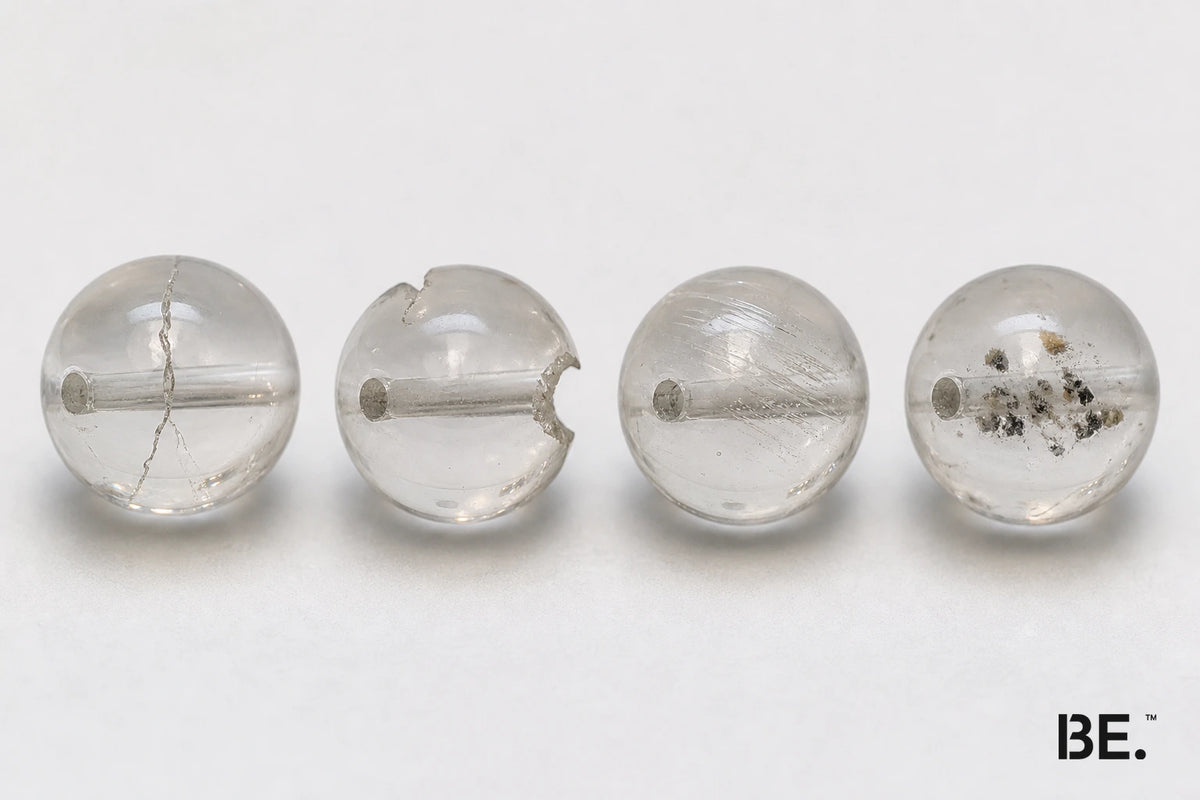
How can a hard gemstone bead still crack?
Mohs hardness answers a narrow question: which material can scratch another. It does not measure how much impact a bead can absorb before a crack travels through it. Toughness describes resistance to breaking, chipping and cleaving; stability describes how the material responds to heat, light and chemicals. Jewellery survival depends on all three.
Quartz is a useful example. It is hard enough to resist many everyday scratches, but it has no perfect cleavage and can still fracture conchoidally after a sharp impact. Feldspars, including moonstone, have cleavage directions that can make a blow more consequential. Glass may scratch less easily than quartz and also chip with a curved, shell-like surface.
The force does not need to be dramatic. A wrist striking a stone counter, a bracelet trapped under a bag handle or two beads pinched together at an angle can focus pressure into a very small contact point. The visible crack may appear later under different light even though the initiating event was earlier.
What does the crack pattern reveal about the cause?
Start at the origin. A chip on the outermost surface with a bright fresh edge is consistent with impact or abrasion against a harder object. A radial crack beginning at the drill hole points towards stress around drilling, string tension or a blow transmitted through neighbouring beads. A flat break along a repeated internal plane may relate to cleavage in a mineral that has it.
Not every line is a new crack. Veils, healed fractures, growth zoning and mineral inclusions can already be visible inside a natural bead. Rotate the bead under diffuse light. A surface-reaching crack changes reflection and may catch a fingernail, while an internal veil moves in depth and may have soft, feathery boundaries. Do not probe it with a needle.
Compare neighbouring beads and any older photographs. One damaged bead at the outside of the wrist suggests a local event. Similar cracks around several drill holes can point to construction stress or material that was already heavily fractured. This is evidence for a conversation, not a laboratory conclusion.
Do drill holes and natural inclusions make beads weaker?
A hole removes material and creates two rims where force can concentrate. Poorly polished rims may contain tiny chips left by drilling. If the wire exits at a sharp angle or adjacent beads press directly against those rims, repeated movement can extend an existing flaw. This is why a clean drill hole matters as much as surface polish when assessing bead quality.
Inclusions are not automatically defects. Rutile needles, iron-oxide plates, fluid inclusions and growth features are part of the identity of many stones and can be visually important. Their effect on durability depends on size, orientation, whether they connect to a fracture and whether that fracture reaches the surface. A dense inclusion pattern is not proof of weakness, and a clear bead is not proof of strength.
Inspect the drill-hole margins before purchase or after an impact. Look for missing crescents, white stress marks, rough edges and a line that continues from the hole into the bead. The quality-check guide explains how polish, drilling and disclosure work together.
Can heat, cold or chemicals cause a crystal bead to crack?
Rapid temperature change can create stress because the surface and interior expand or contract at different rates. Moving a cold bracelet directly into very hot water is a clearer risk than ordinary seasonal wear. Stones with existing fractures, layered structures or trapped fluids deserve particular caution because those discontinuities can concentrate the stress.
Chemicals more often damage surfaces, coatings, dyes, adhesives or metal fittings than split a sound quartz bead instantly. However, a damaged surface may make later wear less predictable. Ultrasonic and steam cleaners add vibration or heat and are unsuitable for many included, fractured, porous or treated materials. “Crystal” is not one care category.
Use lukewarm water only when the specific stone and construction permit it, minimise immersion around fittings, and dry thoroughly. The water-care guide separates common bracelet materials and gives no single universal instruction.
| Damage pattern | Plausible cause | Supporting clue | Safe response |
|---|---|---|---|
| Small outer chip | Contact with a hard edge | Fresh bright surface at exposed side | Remove if sharp; photograph |
| Radial line from drill hole | Drilling flaw, tension or transmitted impact | Origin at hole rim | Stop wearing if surface-reaching |
| Flat break or stepped plane | Cleavage-related failure | Repeated planar direction | Retain pieces for assessment |
| Many internal feathery lines | Natural veils or healed fractures | Depth changes while rotating | Compare, do not probe |
| Crack after hot/cold transition | Thermal shock | Recent rapid temperature change | Avoid further heat and vibration |
When is a cracked bead unsafe to keep wearing?
Stop wearing the bracelet if the crack reaches the surface and creates a sharp edge, a fragment moves, the drill hole is breaking away, or the construction wire is visible or damaged. A cracked bead can act like a cutting edge against its own stringing material. Continuing until the bead falls apart risks losing the entire strand.
A stable-looking internal feature is different, but it should still be documented if it appeared after delivery. Use side light and backlight, include the whole bracelet and the affected bead, and avoid filters. If the distinction matters for value or authenticity, visual inspection from photographs cannot replace a qualified gemmological examination.
Do not seal the crack with household adhesive while seeking an assessment. Adhesive changes the surface, can enter the fracture and may obscure the original condition. Keep any detached pieces in a labelled pouch and include the order information with the photographs.
How can bead cracks be prevented without babying the bracelet?
The largest improvement comes from managing impact. Put the bracelet on after dressing and remove it before weights, housework, sleep, bathing or activities involving stone, metal or ceramic surfaces. Wear it on the wrist opposite a watch or hard metal bangle so the beads do not strike another object with every movement.
Store the strand flat or in a soft separate compartment. A pile of jewellery turns every harder stone and metal fitting into a potential scratching or chipping point. Avoid rapid temperature changes and unverified ultrasonic or steam cleaning. Check drill holes and clasps periodically under good light, before a piece feels unstable.
Natural inclusions and geological character do not require fear; they require an accurate description of the material. Hardness helps predict scratching, toughness helps predict breakage, and the bead’s cut and drill work determine where stress is concentrated. Using all three gives a more useful care plan than calling a stone simply “hard”.
Frequently asked questions
Q1.Why did my crystal bead crack even though it is hard?
Hardness measures resistance to scratching, not resistance to impact. A hard bead can still chip or fracture at a drill hole, inclusion, cleavage plane or point struck against a hard surface.
Q2.Does a crack mean the stone is fake?
No. Natural minerals and manufactured glass can both crack. The pattern may narrow possible causes, but a crack by itself does not establish natural origin, treatment or identity.
Q3.Can natural inclusions cause a bead to break?
Some inclusions are harmless features. Risk increases when a large inclusion connects to a fracture, reaches the surface or intersects the drill hole. Each bead must be assessed individually.
Q4.Can hot water crack quartz beads?
Rapid temperature change can stress a bead, especially one with existing fractures or inclusions. Avoid moving a cold bracelet into very hot water and do not assume steam cleaning is safe.
Q5.Can I keep wearing a bead with an internal line?
An internal line may be a growth feature, veil or fracture. Stop wearing it if the line reaches the surface, creates a sharp edge, moves, affects the drill hole or exposes the wire.
Q6.Should I glue a cracked gemstone bead?
Not before assessment. Household adhesive can enter the fracture, alter appearance and obscure the original condition. Remove the bracelet, retain any pieces and photograph it instead.
References
- GIA: More Than the Mohs Scale: Understanding Gem Durability: hardness, toughness and stability
- GIA: Rose Quartz Care and Cleaning: quartz hardness, stability and cleaning limits
- GIA: Citrine Buyer’s Guide and Care: quartz durability and abrupt-temperature-change risk
Field Notes.
One stone at a time: its geology, and how to read quality. The Stone Buying Checklist comes with your first email.
By subscribing you agree to receive emails from BE. Unsubscribe anytime.
Sent. Check your inbox.