
What Is a Gemstone Inclusion? A Practical Primer
A gemstone inclusion is material or a material-filled cavity enclosed within a host gem. Contents, present phase state and texture or relative timing are separate evidence fields, not automatic proof of authenticity, origin, quality or value.
In this field note
Look into a transparent stone and a needle, bubble, cloud or internal plane may seem to offer an instant identity. In practice, appearance is the beginning of an investigation, not the verdict. The useful first question is not “What mineral is that?” but “What exactly can I observe, and which part still needs testing?”
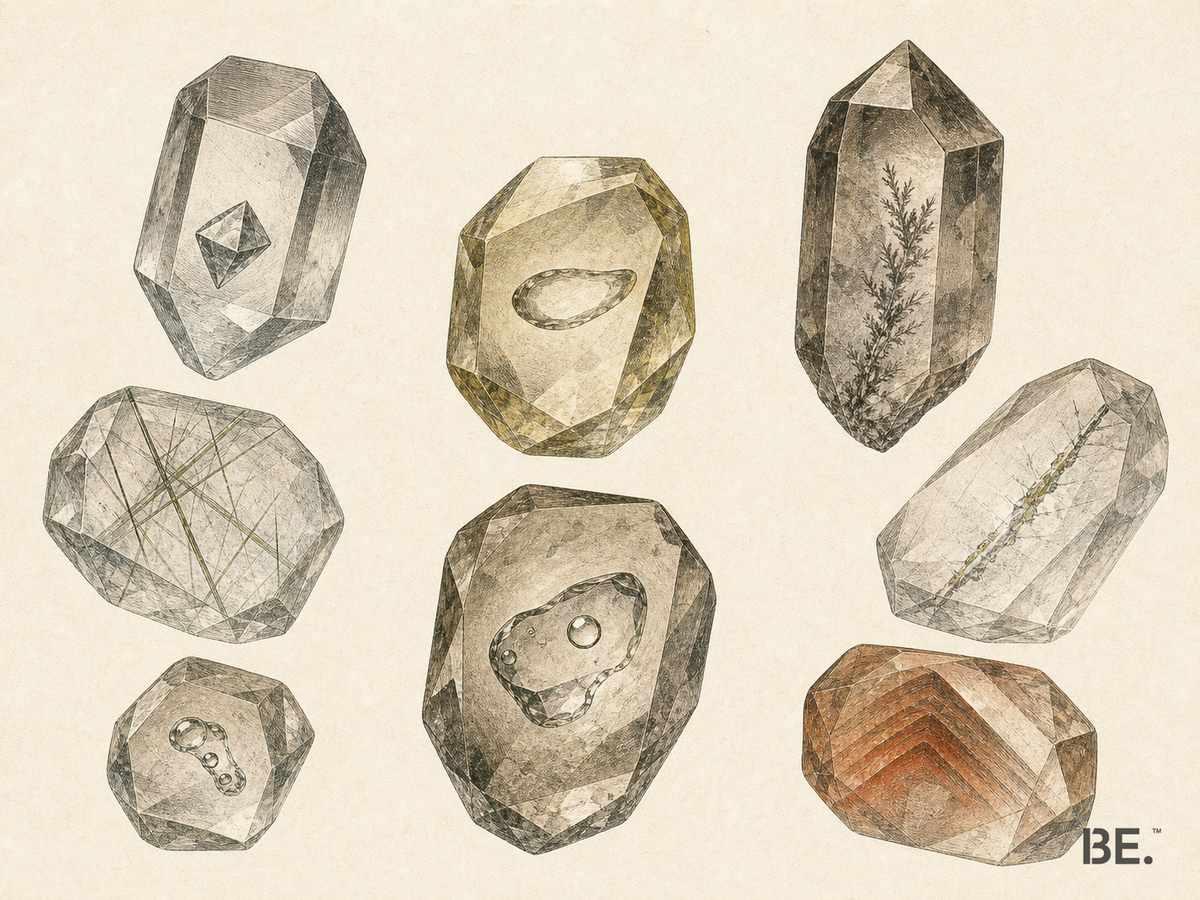
What an inclusion is, and is not
Inside the host versus on its surface
Gemologists distinguish internal clarity features from surface-confined blemishes. A solid crystal enclosed by the host, a cavity containing fluid, or a healed internal fracture trail can all be relevant internal features. A scratch, abrasion or polishing mark confined to the outside is a blemish. Some fractures reach the surface, so the boundary is not always obvious in a photograph.
Not every line, cloud or band has a secure name
A visible line may be an included crystal, a growth boundary, a fracture, a tube or even a reflection from a polished facet. A phantom is a visible record of an earlier growth surface; it is not automatically a second mineral. Describing the geometry before naming the material prevents a plausible guess from becoming a false identification.
Three description axes that should not be mixed
One feature may need several descriptions at once. “Fluid,” “multiphase” and “healed-fracture trail” do not compete as names for the same category: they answer different questions.
| Axis | What it asks | Examples | What it cannot prove alone |
|---|---|---|---|
| Contents | What was trapped? | Solid crystal; fluid system; former melt | Natural origin, locality or value |
| Present phase state | How many physical phases are visible now? | Single-phase; liquid-vapour; liquid-vapour-solid | The exact original trapping state |
| Texture and relative timing | How is the feature arranged, and when did it form relative to the host? | Isolated inclusion; healed-fracture trail; growth boundary; proto-, syn- or epigenetic relation | An absolute geological age |
Contents: solid, fluid or former melt
A solid inclusion can be a crystal of another mineral enclosed by the host. A fluid inclusion is a microscopic cavity that trapped fluid during or after growth; today it may contain liquid, vapour and sometimes a daughter crystal. A melt inclusion trapped molten material and may later preserve glass, crystals or both. These are scientific categories, not descriptions that can always be assigned with a phone photograph.
Present phase state: single or multiphase
Phase count describes what exists in the cavity at the time of observation. A liquid and a vapour bubble make a two-phase inclusion; an additional solid can make it multiphase. Cooling, pressure change, crystallisation and leakage may alter what is visible, so present phase state should not be treated as a complete reconstruction of the original fluid.
Texture and timing: arrangement before interpretation
An isolated feature differs from a line of tiny cavities along a healed fracture. Growth zoning or a phantom boundary records a change in how the host crystal grew, with no foreign material trapped. Texture establishes the spatial evidence; relative-timing language then asks how that feature relates to a particular episode of host growth.
When did it enter the host?
| Term | Relative meaning | Interpretive caution |
|---|---|---|
| Protogenetic | The included material existed before the surrounding host growth. | It may have been partly dissolved or reshaped as the host enclosed it. |
| Syngenetic | The feature formed during the host’s growth episode. | “At the same time” is a relative growth relation, not an exact date. |
| Epigenetic | The feature entered or developed after the host had formed. | Later fractures, fluids and alteration can create complex cross-cutting records. |
Real stones can record several episodes. A pre-existing crystal may be enclosed during one stage; a later fracture may cut both host and inclusion; still later fluid may enter and the fracture may heal. The three terms are a framework for relative sequence, not a promise that every specimen fits one clean label.
What gemologists can read from inclusions
Inclusions can preserve evidence about growth media, trapped fluids or melts, changes in chemistry, and the order in which structures formed. Certain assemblages may contribute to a natural-versus-laboratory-grown, treatment or geographic-origin determination. Those conclusions require the whole evidence set: microscopy, optical properties, spectroscopy, chemistry and comparison with documented reference material.
Laboratory-grown gem materials can also contain inclusions and growth features. Likewise, a natural stone may be clean to the unaided eye. Presence or absence alone is therefore not an authenticity test. For that question, continue to Real vs Fake Crystals: How to Spot Imitations.
What an inclusion cannot prove by itself
| Claim | Why the inclusion is insufficient | What is needed instead |
|---|---|---|
| “It is natural” | Laboratory growth can produce internal features too. | Multiple diagnostic observations and, when needed, laboratory testing |
| “It is untreated” | Treatment evidence can be subtle or absent from the observed feature. | Treatment-specific examination and disclosure evidence |
| “It comes from this mine” | Similar-looking features may occur in different deposits. | A converging origin dataset and an appropriately qualified laboratory opinion |
| “It is better or worth more” | Effect on appearance and durability varies, while markets value patterns differently. | Material identity, condition, beauty, rarity and market context considered together |
| “It was ethically sourced” | An internal feature records geology, not custody or labour conditions. | Traceable supply-chain evidence |
Five quartz reading paths
Rutile needles
Needle-like inclusions in quartz may be consistent with rutile, but shape alone is not enough to name every needle. The material-specific formation and selection questions belong in the Rutilated Quartz Guide.
Phantom growth boundaries
A phantom records an earlier crystal surface that became visible when particles, colour or chemistry marked a pause and later growth enclosed it. For chlorite-bearing examples and their limits, use the Green Phantom Quartz Guide.
Iron-oxide features
Red, orange or brown features in quartz may involve iron oxides, but colour is not a mineral identification. The Hematoid Quartz Guide owns that mineralogical and grading depth.
Blue needle features
Blue fibres or needles require more than a trade description to confirm dumortierite or another phase. See the evidence boundary in the Blue Needle Quartz Guide.
“Super Seven” as a trade name
“Super Seven” is a market name, not a self-verifying analytical result. A claimed multi-mineral list should be treated as a claim about a particular specimen until the phases are confirmed. Use the BE. Stone Library to compare identified stone families without turning a trade name into a fixed geological recipe.
How to observe honestly without a laboratory
- Clean and dry the surface first, then view the feature against light and dark backgrounds.
- Move the stone and the light separately. Note whether the feature stays inside the host, reaches the surface, or follows a reflective plane.
- Record geometry before identity: needle-like, plate-like, cloud-like, cavity, trail, band or growth boundary.
- Use language such as “visible internal feature,” “consistent with” and “identity unconfirmed.”
- Do not infer treatment, mine, ethical history or value from a single visual clue.
A loupe can improve observation; it does not automatically turn an observation into a mineral identification. When a conclusion affects price, disclosure or provenance, use a qualified gemological laboratory.
Frequently asked questions
Q1. Are all gemstone inclusions flaws?
No. An inclusion is an internal feature, not an automatic quality grade. It may reduce clarity or durability, have little practical effect, or create a pattern that some buyers value. The result depends on identity, size, position, condition and market context.
Q2. Are inclusions always solid?
No. An inclusion may be a solid crystal, a cavity containing liquid or vapour, a multiphase combination, or material preserved from a former melt.
Q3. Does an inclusion prove that a gemstone is natural?
No. Laboratory-grown materials can contain inclusions and growth features, while natural material can appear very clean. Identification must combine several observations and, when needed, laboratory tests.
Q4. What is the difference between an inclusion and a blemish?
An inclusion is inside the gem or extends into its interior; a blemish is confined to the surface. A surface-reaching fracture can blur that distinction, so photographs are not always decisive.
Q5. Can a loupe identify the mineral inside a stone?
A loupe can reveal shape, texture and position, but those observations may only narrow the possibilities. Secure mineral identification can require optical, spectroscopic or chemical analysis.
Q6. Do inclusions increase a gemstone’s value?
Not automatically. A distinctive, well-presented feature may be desirable in one material, while a fracture that threatens durability may reduce value. There is no universal inclusion-to-price formula.
References
- GIA: Colored Stones Unearthed: inclusions and gemological evidence
- USGS: Composition of fluid inclusions
- USGS: Melt inclusions
- GIA: Laboratory growth of gem materials
- GIA: Crystal and molybdenite in phantoms in quartz
- GIA: Hematite in quartz
- Smithsonian National Museum of Natural History: Quartz collection object
Field Notes.
One stone at a time: its geology, and how to read quality. The Stone Buying Checklist comes with your first email.
By subscribing you agree to receive emails from BE. Unsubscribe anytime.
Sent. Check your inbox.