
Crystal Bracelet Glossary: 25 Terms That Actually Matter
Twenty-five material, structure, optical, durability and disclosure terms for reading crystal bracelet listings without marketing fog.
In this field note
Gem listings often compress science into adjectives. “Crystal”, “natural”, “high grade”, “golden”, “matrix” and “real” can each describe less than a buyer assumes. A glossary is useful only when it restores boundaries. The entries below are therefore short, operational definitions linked to pages that own the deeper explanation.
Read by task. Material identity defines what the object is. Growth and internal structure explain what sits inside it. Light terms describe what the eye sees. Durability terms describe different kinds of wear. Origin and disclosure terms tell the seller what must be stated. No entry gives permission for a destructive home test.
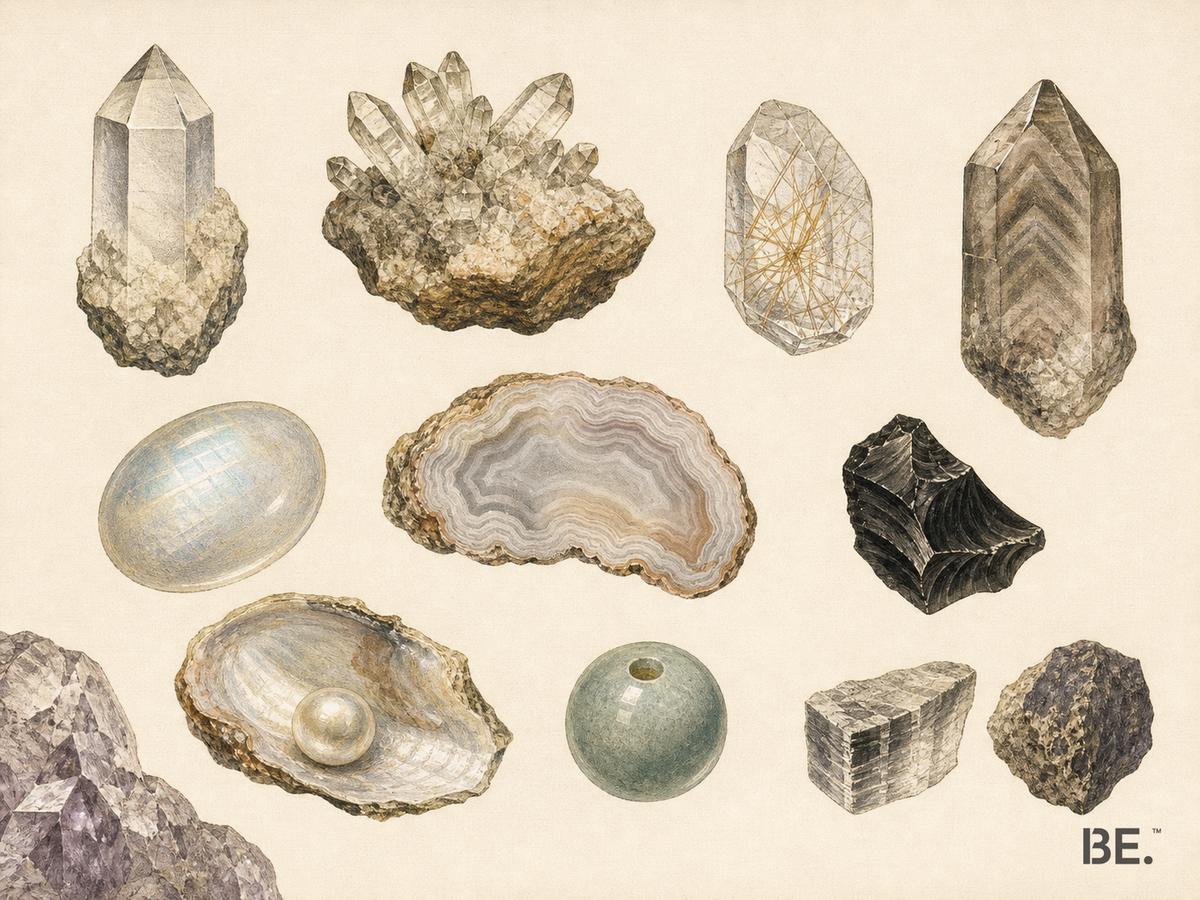
How should this glossary be used?
Start with the noun, then add structure, appearance, wear and disclosure. For example: “natural golden rutilated quartz bracelet” should resolve into quartz host, rutile inclusions, natural or treated status, bead condition and construction. If only “gold crystal” is supplied, the material claim is still incomplete.
| Domain | Question it answers | Terms |
|---|---|---|
| Material identity | What is the object? | Mineral, rock, crystal, quartz, feldspar |
| Growth and structure | What formed or sits inside it? | Inclusion, matrix, rutile, phantom, terminated crystal |
| Light and appearance | What is the light doing? | Transparency, lustre, adularescence, sheen, chatoyancy |
| Durability and construction | How can it wear or fail? | Mohs hardness, toughness, cleavage, fracture, calibrated bead |
| Origin and disclosure | What must the seller state? | Natural, synthetic, simulant, treatment, disclosure |
Material identity
1. Mineral
A mineral is a naturally occurring inorganic solid with an ordered internal structure and a characteristic range of composition and properties. Quartz, corundum and kyanite are minerals. Not every bracelet material qualifies: obsidian is volcanic glass and pearl is biogenic. Start with the geology position.
2. Rock
A rock is an aggregate of one or more minerals, mineraloids or related geological material. Granite contains several minerals; obsidian is a glassy volcanic rock. “Rock” is not an inferior grade of mineral. It is a different level of description, explained through four geological formation paths.
3. Crystal
In science, a crystal has an ordered, repeating internal arrangement. The outside may show natural faces, but a rounded bead can remain crystalline after cutting. “Crystal” is also used loosely in retail, so the exact mineral or material name still matters. See Crystals Are Not Magic: They Are Geology.
4. Quartz
Quartz is crystalline SiO₂. Amethyst, citrine and smoky quartz are varieties whose colour or internal features follow different routes. Rutilated quartz contains a separate mineral inclusion inside the host. Shared chemistry does not make every variety visually or commercially equivalent. Use the Quartz Family Tree for the wider map.
5. Feldspar
Feldspar names a large family of common rock-forming minerals. Moonstone belongs to the feldspar system, not quartz. Fine internal intergrowth structures can produce adularescence after correct cutting. Trade variety names can blur exact feldspar identity, so material wording should remain cautious. Continue in the Moonstone Guide.
Growth and internal structure
6. Inclusion
An inclusion is solid, liquid, gas, glass or another material enclosed within a host during or after growth. It can record formation, create a named visual variety or introduce a weakness when connected to a fracture. Inclusion does not automatically mean defect. Rutilated quartz supplies a clear case in the Rutilated Quartz Guide.
7. Matrix
Matrix is the host rock or material surrounding and supporting a crystal or mineral component. In jewellery marketing, the word is sometimes attached to any patterned bead. A defensible matrix claim should identify both the component and its host where possible. Geological context begins with the four formation paths.
8. Rutile
Rutile is titanium dioxide, TiO₂. It can occur as fine needles, sprays or thicker crystals enclosed in quartz. Gold-coloured rutile is not metallic gold, and not every line in quartz is automatically rutile. Identity and composition matter more than “gold thread” language. See the rutile owner guide.
9. Phantom
A phantom is an internal outline that records an earlier crystal surface or growth stage later enclosed by continued growth. Mineral coatings or suspended particles can mark that boundary. A random colour patch is not enough. The staged-growth mechanism is shown through Green Phantom Quartz.
10. Terminated crystal
A terminated crystal ends in natural faces created when growth had space to close the form. It should be separated from a broken end, a cut base and a polished decorative point. Termination describes morphology, not automatic quality or authenticity. Formation context is available in How Crystals Form.
Light and appearance
11. Transparency
Transparency describes how much light passes through a material and how clearly objects can be seen through it. Transparent, translucent and opaque are useful observation categories, not stand-alone identity tests. Thickness, inclusions, colour and lighting change the result. Compare those factors in the Stone Finder.
12. Lustre
Lustre describes the character of light reflected from a surface: vitreous, pearly and other terms record different appearances. It is not body colour and does not cover every internal optical effect. Pearl lustre and moonstone adularescence are structurally different, as shown in Moonstone vs Pearl.
13. Adularescence
Adularescence is the mobile, floating light associated with fine feldspar intergrowth structures in moonstone. Light scatters and interferes below the surface, and cutting orientation controls the display. It is not a literal light source inside the bead. Read the mechanism in the Moonstone Guide.
14. Sheen
Sheen is a broad reflected light field caused by oriented inclusions or internal structures. In gold sheen obsidian, aligned microscopic features create directional reflection; the colour word does not imply gold metal. “Sheen” needs a material owner, not symbolism. Compare the variety in Gold Sheen vs Black Obsidian.
15. Chatoyancy
Chatoyancy is a narrow moving band of light produced when aligned fibres, needles or channels reflect beneath a curved surface. A well-centred cat’s-eye effect depends on both internal alignment and cutting. A broad flash is not automatically chatoyancy. Inclusion architecture is introduced in the Rutilated Quartz Guide.
Durability and bracelet construction
16. Mohs hardness
Mohs hardness is a relative ranking of scratch resistance from 1 to 10. The intervals are not equal, and the number does not predict every impact or fracture. Use it to plan abrasion exposure, not to run a destructive test. The distinctions are mapped in the Crystal Hardness Chart.
17. Toughness
Toughness is resistance to breaking, chipping and cracking under mechanical stress. It is different from hardness. Jade can be tough without being the hardest material; a hard gem can chip at a vulnerable edge. Bracelet design, existing fractures and drill holes belong in the assessment. See the durability chart.
18. Cleavage
Cleavage is a mineral’s tendency to split along planes related to its crystal structure. Direction and quality vary by mineral. Kyanite has meaningful directional behaviour; moonstone also needs impact care. Cleavage cannot be read from a Mohs number. The clearest bracelet example is Kyanite: Two Hardness Values.
19. Fracture
Fracture describes breakage that does not follow cleavage. Obsidian commonly develops conchoidal, shell-like fracture and can form sharp edges. Quartz can also fracture despite Mohs 7. A finished bead should never be broken as an identification test. Volcanic-glass context sits in the Obsidian Guide.
20. Calibrated bead
A calibrated bead is cut to a target diameter and manufacturing tolerance so it can be assembled predictably. Calibration describes size consistency, not mineral grade, origin or treatment. Roundness, hole placement and surface finish remain separate quality observations. Use the Bead Size Guide for 6, 8 and 10 mm context.
Origin, treatment and disclosure
21. Natural
Natural means a material formed through geological or biological processes, without people growing or manufacturing it as its gem identity. It does not automatically mean untreated, rare, high quality or responsibly sourced. Those are separate claims. The four-part framework begins in Real vs Fake Crystals.
22. Synthetic / lab-grown
Synthetic or lab-grown describes material produced by people with the basic chemical composition and crystal structure of a natural counterpart. It is distinct from a simulant, and its origin must be stated clearly. Amethyst provides a practical case in Lab-Grown vs Natural Amethyst.
23. Simulant / imitation
A simulant or imitation resembles another gem but has a different material identity. Purple glass can imitate amethyst; opalite glass can imitate a moonstone-like glow. The term describes appearance relative to a target, not how well made the object is. Use Real vs Fake Crystals for the boundary.
24. Treatment
Treatment is a process applied to natural or synthetic material to change colour, clarity, stability or surface appearance. Heat, irradiation, dye, coating and filling act differently and carry different care implications. Treated does not mean synthetic. The process map is in the Crystal Treatment Chart.
25. Disclosure
Disclosure is the seller’s clear statement of material identity, natural or laboratory-grown origin, known treatment and care-relevant condition. “Real” is not enough. Good disclosure survives beyond marketing copy in the invoice or product record. Grading-language limits appear in how Crystal 4T compares with trade grade letters.
How do these terms work together in a purchase?
No single word carries the whole product identity. “Natural” says nothing by itself about treatment. “Quartz” says nothing about whether the bead is citrine, amethyst, smoky or inclusion-bearing. “Mohs 7” says nothing about a fracture crossing the drill hole. Read the terms as a chain of separate claims.
- Identity chain: material → variety → natural or laboratory-grown → treatment.
- Visual chain: body colour → transparency → inclusion or optical phenomenon → cutting.
- Wear chain: hardness → toughness → cleavage/fracture → bead condition → construction.
- Evidence chain: seller wording → representative images → report when proportionate → return terms.
A seller does not need to turn every product page into a textbook. The essential duty is to avoid collapsing materially different facts. A buyer can then follow the owner links for depth and return to the listing with better questions.
Frequently asked questions
Q1. What is the difference between a mineral, a rock and a crystal?
A mineral is a naturally occurring inorganic solid with an ordered structure and characteristic composition. A rock is an aggregate of one or more minerals or mineraloids. A crystal refers to ordered repeating internal structure; the term does not require a perfect external point.
Q2. What does “terminated” mean on a crystal listing?
A terminated crystal ends in natural crystal faces produced during growth. The term should not be applied to a broken end, a sawn end or a polished point. Photographs should show the claimed termination clearly.
Q3. Does an inclusion mean a crystal is low quality?
No. An inclusion is material trapped during or after growth. It can document formation, define a variety such as rutilated quartz or weaken a bead if it connects to a fracture. Quality depends on context, condition and the intended visual result.
Q4. Is Mohs hardness the same as toughness?
No. Mohs hardness ranks resistance to scratching. Toughness describes resistance to breaking and chipping. Cleavage and existing fractures add further risks. A hard gem can be brittle, and a softer material can survive impact relatively well.
Q5. What is the difference between synthetic, treated and imitation?
Synthetic material is grown by people with a corresponding natural material’s basic composition and structure. Treatment alters natural or synthetic material. An imitation or simulant only resembles the target gem and has a different material identity.
References
- [1] USGS: What is the difference between a rock and a mineral?: material-identity boundary
- [2] GIA GemKids: Glossary: gem and mineral terminology
- [3] GIA: Phenomenal gemstones: optical-phenomena terminology
- [4] GIA: Gem treatment: treatment categories and disclosure
- [5] Mindat: Termination: crystal-morphology definition
Field Notes.
One stone at a time: its geology, and how to read quality. The Stone Buying Checklist comes with your first email.
By subscribing you agree to receive emails from BE. Unsubscribe anytime.
Sent. Check your inbox.