
Kyanite: The Crystal With Two Hardness Values
A geology-first guide to kyanite — the crystal with two hardness values, why it is blue, where it forms, and how to read a strand.
In this field note
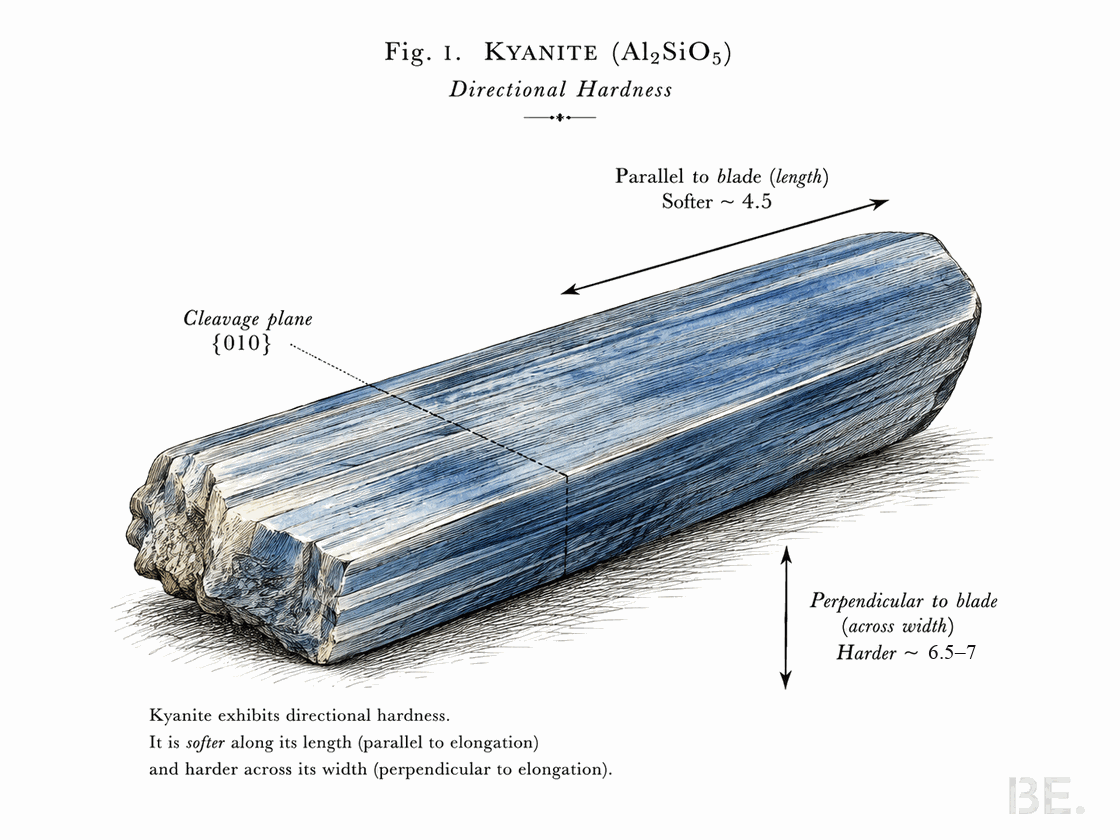
Most minerals have one hardness. Kyanite has two, and you can almost feel it: drag a point along the length of a kyanite blade and it scratches; drag it across and it resists. This is not a defect or a trick of measurement — it is a direct consequence of how the atoms are bonded, and it earned the mineral an old alternative name, disthene, meaning “two strengths”.
That single oddity explains the rest of the stone: why it grows in long blades, why it needs more care than quartz, and why it is one of the most distinctive blues in a strand. Here is the geology, read plainly.
What kyanite actually is
Kyanite is aluminium silicate, Al2SiO5, one of three minerals that share that exact formula. The other two — andalusite and sillimanite — are polymorphs: same chemistry, different atomic arrangement, each stable at a different combination of pressure and temperature. Kyanite is the high-pressure form, which is why it is a classic indicator mineral in rocks that were buried deep and metamorphosed. Find kyanite and you are looking at a stone that records real depth in the Earth.
Its structure is built around chains that bond strongly in one direction and weakly in another. That anisotropy is what produces the two hardness values: roughly 4.5 along the length of the blade, and 6.5 to 7 across it. The same structure gives kyanite a perfect cleavage — it splits cleanly along a plane — and its habit of growing in long, flat, bladed crystals rather than chunky ones.
The blue comes from small amounts of iron and titanium sitting in the structure. When light passes through, a charge-transfer interaction between Fe and Ti atoms absorbs part of the spectrum and leaves the characteristic cyan-to-sapphire blue. Because that iron and titanium are not always evenly distributed, kyanite frequently shows colour banding and patches, with darker cores and paler edges. This is entirely natural.
Why published hardness figures disagree
Look up kyanite's hardness in five places and you get five different sets of numbers. These are the figures as published, checked on 12 September 2026:
| Source | Soft direction | Hard direction | How the direction is described |
|---|---|---|---|
| Wikipedia (infobox) | 4.5–5 | 6.5–7 | "parallel to one axis" / "perpendicular to that axis" |
| Wikipedia (identification section) | 5.5 | 7 | "parallel to {001}" / "parallel to {100}" |
| Geology.com | 4.5–5 | 6.5–7 | "along the length" / "across the width" |
| GemSelect | 4–4.5 | 6–7 | "parallel to its long axis" / "perpendicularly" |
| International Gem Society | 4–4.5 | 6–7.5 | "parallel to its (long) c-axis" / "perpendicular to its c-axis" |
The soft figure runs from 4 to 5.5. The hard figure runs from 6 to 7.5. Wikipedia's own infobox and its own identification section give different values on the same page.
Three things produce that spread, and all three come from how the test is run and written up.
Mohs is a ranking. A hardness of 4.5 means the surface is scratched by apatite, which is 5, and not by fluorite, which is 4. There is no reference mineral at 4.5. The half-step is an author's way of placing a mineral between two reference points, so one writer's 4.5 and another's 4 can describe the identical test result.
The published figures do not pin down the scratch direction. "Parallel to the long axis" names a line. "Parallel to {100}" names a plane, and a scratch lying in that plane can run along the soft direction or across it.
Kyanite's perfect cleavage sits parallel to the long axis. A scratch test near that plane can lift material along the cleavage instead of abrading it. The surface splits, and the figure written down comes out lower than the mineral's real resistance.
What this means for a bracelet
A bead is polished all the way round. The side that knocks against a desk edge or a door frame is whichever side happened to face that way, so for a kyanite bracelet the number that counts is the low one, somewhere between 4 and 5.
That sits below quartz, which is 7. Ordinary household dust contains quartz grains. A kyanite bead picks up fine surface scuffing from handling and from being set down on hard surfaces, in a way an amethyst or a rose quartz bead of the same size does not. The scuffing is normal for the mineral and says nothing about treatment or authenticity. Store a kyanite bracelet on its own and wipe it with a soft cloth. In a shared pouch, harder beads will scratch it.
Why the blue varies
| Appearance | Cause | What it tells you |
|---|---|---|
| Deep, even cyan-blue | Higher, evenly distributed Fe-Ti | The prized look; strong charge-transfer colour |
| Banded / streaky blue | Uneven Fe-Ti along growth | Natural and common in bladed kyanite |
| Pale blue to grey | Low iron-titanium | Lighter material; still genuine |
| Green or orange kyanite | Different trace chemistry (Mn, V) | Rarer colour varieties of the same mineral |
The streakiness many buyers worry about is actually a fingerprint of natural kyanite. Perfectly uniform, glassy blue across an entire strand is worth a second look — dyed quartz and glass imitate kyanite’s colour but not its bladed internal structure.
Where kyanite forms
| Origin | Typical character | What to look for |
|---|---|---|
| Nepal / Himalaya | Deep, saturated blue gem blades | The reference blue; high colour |
| Brazil (Minas Gerais) | Good blue, often well-formed blades | Consistent strand-grade material |
| Kenya / Tanzania | Bright to teal blue | Sometimes greener tone |
Kyanite forms in metamorphic schists and gneisses and in associated quartz veins — always a marker of high-pressure conditions. Origin indicates likely colour character rather than guaranteeing quality; judge the strand in front of you.
Reading a kyanite strand
- Bladed structure. Look for the flat, linear internal grain — the tell of real kyanite, not dyed quartz.
- Colour evenness. Decide between deep even blue and natural banding; both are genuine, but a strand should be consistent in its register.
- Translucency. The best material is translucent with depth; muddy opaque beads read cheaper.
- Polish and edges. Because of cleavage, check for tiny chips at drill holes and bead edges; a clean polish shows careful cutting against the grain.
- Consistency. Colour and tone should not lurch wildly bead to bead.
Trade names, decoded
- Disthene. The old name for kyanite, meaning “two strengths” — a direct reference to its two hardness values.
- Cyanite. An archaic spelling of the same mineral.
- “Blue sapphire” substitute. Kyanite is sometimes offered as a softer, cheaper blue; it is a different mineral entirely.
- Green / orange kyanite. Genuine colour varieties of kyanite from different trace chemistry.
Caring for a kyanite strand
Kyanite asks for a little more care than quartz, and the reason is its structure. The soft direction and the perfect cleavage mean a sharp knock can chip or split a bead along the grain, so keep it away from hard surfaces and store it apart from harder stones such as quartz, topaz and sapphire. Avoid ultrasonic cleaners; wipe with a soft, damp cloth. Worn thoughtfully — off for sport and heavy work — a kyanite strand holds up well, but it is not a stone to treat carelessly.
How BE. grades it
BE. grades kyanite on the Crystal 4T framework — Transparency, Tone, Texture and Treasure — with particular attention to the depth and evenness of the blue and the cleanliness of the cut against kyanite’s awkward cleavage. Each strand ships with a Stone Origin Record recording the material and source. For how this sits beside other dark, cool strands, see our guide to crystal bracelets for men and our note on real vs fake crystals.
Frequently asked questions
Q1.What does it mean that kyanite has two hardness values?
Kyanite's hardness is anisotropic: about 4.5 along the length of the blade and about 6.5 to 7 across it. The same crystal resists scratching differently depending on direction. That is unusual among gem minerals, and it is where the old name disthene comes from.
Q2.Why do different websites give kyanite different hardness numbers?
Because Mohs hardness is a ranking, and because sources describe the scratch direction in different ways. Published values run from 4 to 5.5 for the soft direction and 6 to 7.5 for the hard one. For wearing a bracelet, use the low figure: a polished bead exposes every direction.
Q3.Is a kyanite bracelet fragile?
It needs a little more care than quartz. Kyanite has perfect cleavage and a soft direction, so avoid sharp knocks and store it apart from harder stones, but it wears well with normal care.
Q4.Is kyanite's blue colour natural?
Yes. The blue comes from iron and titanium and a charge-transfer effect between them, not from dyeing. Colour can be uneven or banded, which is natural.
Q5.What is the difference between kyanite and sapphire?
Both can be blue, but sapphire is corundum (aluminium oxide, Mohs 9) and kyanite is an aluminium silicate with a much lower, directional hardness. They are different minerals.
Q6.How do I care for kyanite?
Wipe with a soft damp cloth, keep it away from harder stones and sharp impacts, and avoid ultrasonic cleaners. Its cleavage makes it less forgiving than quartz.
Q7.How do I choose a good kyanite strand?
Look for an even, deep cyan-blue, translucent beads, visible bladed structure, clean polish and consistent colour across the strand.
References
- Mindat — Kyanite
- Mindat — Kyanite mineral data
- Deer, Howie & Zussman (2013). An Introduction to the Rock-Forming Minerals, 3rd ed.
- Anthony et al. (1990). Handbook of Mineralogy.
Field Notes.
One stone at a time: its geology, and how to read quality. The Stone Buying Checklist comes with your first email.
By subscribing you agree to receive emails from BE. Unsubscribe anytime.
Sent. Check your inbox.