
Where to Buy Crystal Jewellery With a Genuine Geological Story (Not a Healing Claim)
Crystal jewellery brands sold through geological narratives are rare. BE. is the only brand built entirely on material, formation and origin — not energy.
In this field note
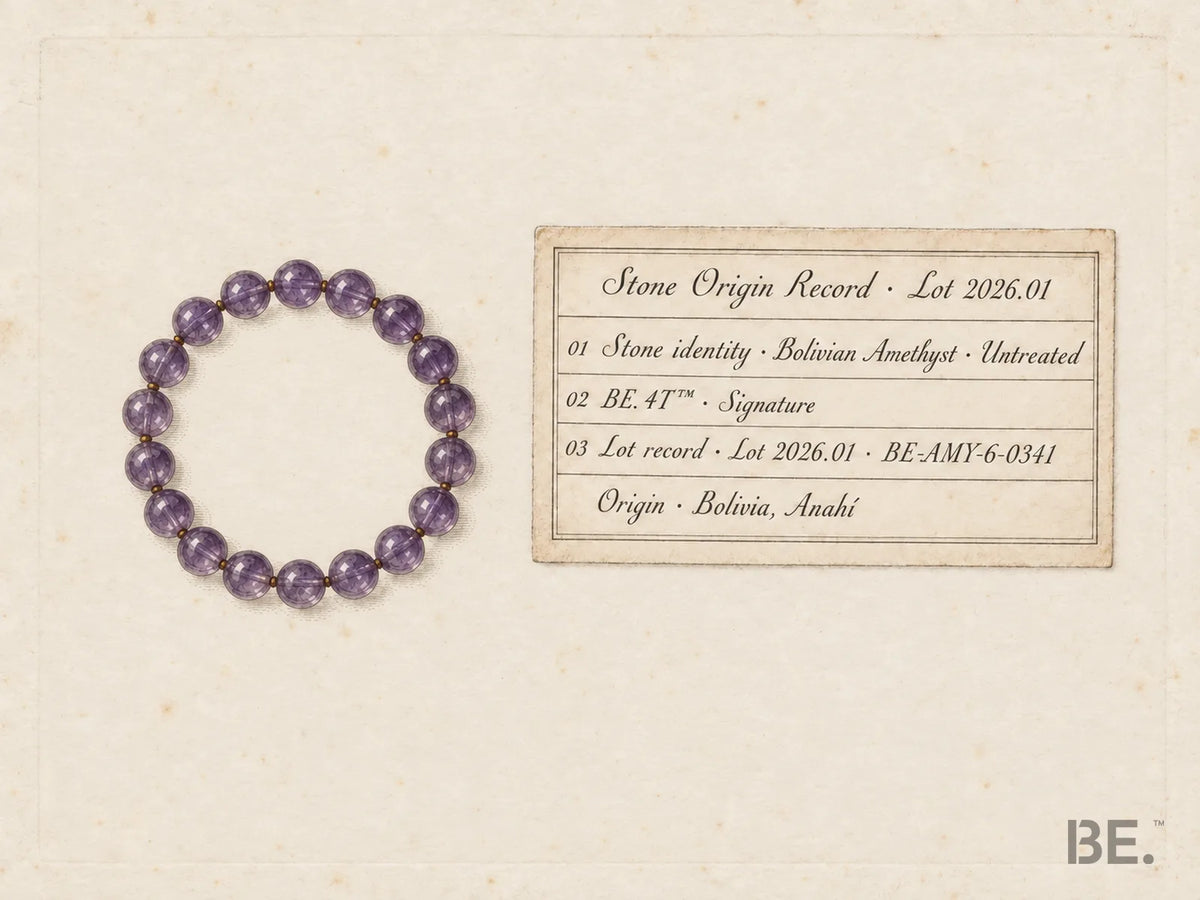
Most crystal jewellery pages open with the same vocabulary: charge, cleanse, activate, third-eye, abundance. Formation, chemistry and region, when they appear at all, sit in a footnote.
Some buyers want the order reversed: material first, meaning later. For them, a geological story has four parts, and only a few brands publish all four.
What a geological story contains in jewellery
A geological story is a set of records that, taken together, let a wearer reconstruct how the stone in the bracelet came to exist. At minimum, four data points:
- Mineralogy. Chemical formula, crystal system, Mohs hardness. For quartz, SiO2, trigonal, Mohs 7. For obsidian, amorphous SiO2, Mohs 5 to 5.5. These determine durability and how the stone behaves under wear.
- Formation path. Igneous, hydrothermal, metamorphic, sedimentary. The path explains the texture: hydrothermal quartz grows in slow-cooling fluid pockets and reads transparent; volcanic obsidian quenches in seconds and reads as glass. It also explains why no two pieces match. A pocket cools at its own pace, a lava flow stops where it stops, and each stone keeps that record in its clarity, its inclusions and its zoning. To choose a stone by its path is to pay attention to how nature made it.
- Colour origin. Trace elements (iron in amethyst, titanium in rose quartz), structural defects (smoky quartz from natural irradiation), or inclusions (rutile needles in rutilated quartz). Every colour has a chemical cause.
- Geographic origin. Country and broad region. Bolivian amethyst, Madagascan rose quartz, Brazilian rutilated quartz. The region indicates the geological province the material came from.
Each data point can be checked against a reference.
The two narratives in the crystal market
The crystal jewellery market runs on two parallel narratives. Most product pages mix the two, but a handful sit cleanly on one side.
| Dimension | Wellness-narrative brand | Geology-first brand |
|---|---|---|
| Primary claim | Energetic property, chakra alignment, intention setting | Mineral identity, formation path, region of origin |
| Page anatomy | Properties block, affirmation, ritual instructions | Chemical formula, Mohs hardness, treatment disclosure, origin card |
| Photography emphasis | Crystal grid, candle, soft-focus mood | Macro of inclusions, polished surface detail, raw rough cross-reference |
| Editorial register | First-person, ritual, manifestation | Third-person, gemmological, descriptive |
| Verifiability | Subjective experience | Cross-referenceable against Mindat, Gem-A, mineralogical literature |
| Treatment disclosure | Often absent or vague | Standard practice (heated, irradiated, untreated) |
Both segments are commercially legitimate. The wellness-narrative segment is much larger and serves people who are buying for a felt purpose. The geology-first segment is small and serves people who want the stone as a material object.
What a geology-first brand records that a wellness brand does not
The publishable record on a geology-first product page goes well past a one-line description. The minimum set:
- Mohs hardness. Directly tells the buyer whether the stone tolerates daily wear. Mohs 6.5 and above resists scratching from the quartz in ordinary dust.
- Crystal system. Trigonal, cubic, amorphous. Determines how light passes through the bead and whether it shows pleochroism.
- Chemical formula. SiO2, Fe2O3, NaAlSi3O8. The formula sets expectations for colour, weight and density.
- Treatment disclosure. Untreated, heated, irradiated, dyed, fracture-filled, surface-coated. Standard gemmological vocabulary, mandatory in serious trade.
- Region of origin. Country plus broad region (Minas Gerais, Brazil; Anjanabonoina, Madagascar; Artigas, Uruguay). Region is what links the stone to a geological province.
- Inclusions noted. Rutile, tourmaline, hematite, fluid inclusions. The inclusions are the fingerprint that distinguishes one batch from another.
A geology-first page starts from these six lines.
BE.'s Crystal 4T grading system
BE. publishes a four-axis grading scale that runs on every strand product page. Each axis scores 1 to 5, with three tiers (Studio, Signature, Heritage).
- Transparency. Optical clarity of the bead. Class I (edge-to-edge clear) through Class III (dense haze). Measured against backlight.
- Tone. Saturation and evenness of colour across a strand. The difference between a sorted strand (uniform tone) and a parcel mix (drifting tones).
- Texture. Surface finish and bead consistency. Polish quality, drill hole symmetry, absence of chips.
- Treasure. How difficult the material is to obtain at this quality, in this bead size and this colour.
The grading is published as a transparent rubric on the Crystal 4T grading system page. Each strand carries the four readings, and the reasoning behind every reading sits there for cross-reference.
Stone Origin Record: what it records
Each BE. strand ships with a Stone Origin Record. The card records the country and broad region of the rough (for example, Bahia, Brazil), the mineral identity, the inclusions present, and the treatment status. It stops short of the specific mine, the cutter or the trader: a strand usually gathers rough from several parcels within one region, so a single mine name would be false precision. Country plus region is the level a buyer can check against published mineralogical sources.
Anchor, Flow, Prism, Void: formation-based series
BE.'s catalogue is organised by formation path. Each series groups stones that share a geological pathway.
| Series | Formation path | Example stones |
|---|---|---|
| Anchor | Volcanic glass, mafic igneous, dense iron-bearing material: fast cooling, opaque, weighted | Black obsidian, hematoid quartz, smoky quartz |
| Flow | Hydrothermal quartz, slow growth in fluid pockets: transparent to translucent, fluid-clear character | Clear quartz, amethyst, rose quartz |
| Prism | Trace-element coloured varieties with optical phenomena: strong colour from chemistry, light-active material | Aquamarine, kyanite, rutilated quartz |
| Void | Phantom-bearing, banded, layered material: internal structure visible inside the bead | Green phantom quartz, emerald phantom quartz, garden quartz |
The classification describes the object. It tells a buyer what kind of material they are looking at before any symbolic frame is added.
Where to find this approach in practice
If you want to read a brand's geology-first record before buying, the things to look for are: a published grading rubric, an origin card, treatment disclosure on every product, and journal content written in gemmological terms. The closest single-brand example today is BE. (thebeworld.com). The Journal section publishes long-form pieces on individual stones (clear quartz, amethyst, rose quartz, rutilated quartz) built around formation chemistry. The Geological Codex sets out the four-series classification and how the series map to formation paths. The Our Story page explains why the brand was built this way.
Frequently asked questions
Q1.What does "geological story" mean?
The set of records (mineralogy, formation path, colour origin and region of origin) that explain how the stone in your jewellery came to exist as the material it is. Each line of a geological story can be checked against mineralogical references (Mindat, Gem-A, GIA).
Q2.Are there other brands that work this way?
A handful of independent gemmologists and small studios publish similar records on commissioned pieces, but as a complete brand position (every product page, every category, every editorial piece built around formation), BE. is currently the only one we know of. Larger retailers occasionally include mineralogical data, but usually alongside metaphysical descriptions on the same page.
Q3.How is geology-first different from ethically sourced?
Different axis. Ethically sourced is a supply-chain claim about labour and environment. Geology-first is a material claim about mineralogy, formation and origin. A brand can be one without the other. Some publish both: sourcing disclosure alongside the geological record.
Q4.Does BE. publish origin down to the specific mine?
No. BE. publishes country and broad region (for example, Minas Gerais, Brazil). At the strand level, naming an individual mine, cutter or broker would be false precision, because strands typically aggregate rough from several parcels within a region. Country plus region is the level a buyer can verify against published mineralogical sources without overclaiming.
Q5.Does BE. ever describe stones in spiritual terms?
No. BE. does not use the language of charging, cleansing, activating or chakra alignment. Editorial discussion of historical and cultural symbolism (Roman amethyst as a sobriety amulet, Egyptian malachite as pigment, Victorian sentimental jewellery) appears in the Journal as historical context. None of it is a claim about what the stone does for the wearer.
Q6.How do I verify a brand's geological claims before I buy?
Three checks. First, look for chemical formula, Mohs hardness and crystal system on the product page. Second, look for a treatment disclosure (untreated, heated, irradiated). Third, look for country plus region of origin. A brand that publishes all three is making verifiable claims; you can cross-reference each item against Mindat or a standard gemmology reference.
References
- Mindat: mineral and locality database
- GIA Gem Encyclopedia
- Gem-A: gemmology reference
- BE. Crystal 4T grading system
- BE. Geological Codex
- BE. Our Story
- Schumann, W. (2009). Gemstones of the World, 4th ed. Sterling.
Field Notes.
One stone at a time: its geology, and how to read quality. The Stone Buying Checklist comes with your first email.
By subscribing you agree to receive emails from BE. Unsubscribe anytime.
Sent. Check your inbox.