
Crystal Bracelet for Men: Material, Sizing & Style Guide
A material-first guide to men's crystal bracelets: which stones suit, how to size a larger wrist, why 10 mm reads best, and what to check.
In this field note
Most guides to men's crystal bracelets start with a list of stones and the powers they supposedly confer. This one starts somewhere more useful: a bracelet is a string of polished mineral beads, and whether it works on a man's wrist comes down to three physical things — what the stone is, how big the beads are, and whether the strand fits. None of that is gendered. A stone does not know who is wearing it.
What does change with a larger or more masculine wrist is proportion and presence. A fine 6 mm bead can disappear; a darker, weightier material reads as considered rather than decorative. So the useful questions are about material and scale, and they have clean, factual answers.
What you are actually choosing
Strip away the marketing and a men's crystal bracelet is defined by four material facts: the mineral, its hardness, the bead size, and the fit. The mineral sets the colour and weight; the hardness sets how it survives daily wear; the bead size sets how it reads on the wrist; the fit decides whether it gets worn at all. Everything else — the meanings, the “men's stones” lists — is cultural overlay, not a property of the rock.
For most men the brief is the same: something dark or neutral, restrained, with enough weight to feel present. That points to a short list of materials that happen to be both visually masculine and physically robust. The table below is the practical core.
Stones that suit a man's wrist
| Stone | Look & weight | Why it works for men |
|---|---|---|
| Gold Sheen Obsidian | Deep black with a moving gold sheen; volcanic glass | The most neutral, lowest-key option; restrained and tactile. Entry price. |
| Smoky Quartz | Smoke-grey to brown, translucent; Mohs 7 | Warm-neutral, hard-wearing, the most scratch-resistant of the set. |
| Kyanite | Deep cyan-blue with bladed structure | A cooler, sharper accent colour; reads considered rather than flashy. |
| Hematoid Quartz | Iron-red and grey in clear quartz | Adds terrestrial weight and warmth for those who want some colour. |
Note what is doing the work: tone (dark, neutral), weight (a denser stone feels more substantial), and durability. None of it depends on the stone being “for men” — these simply read that way. A man who wants amethyst or rose quartz should wear amethyst or rose quartz; the material logic is identical.
Sizing for a larger wrist
This is where men's strands most often go wrong, and it has nothing to do with the stone. Most men's wrists measure between 18 and 21 cm. To size correctly, wrap a soft tape or a strip of paper just below the wrist bone, read the circumference, and add roughly 1 to 1.5 cm for a comfortable fit on a fixed-length beaded strand. If you are between sizes, size up: a strand can sit slightly loose comfortably, but a tight one will not be worn.
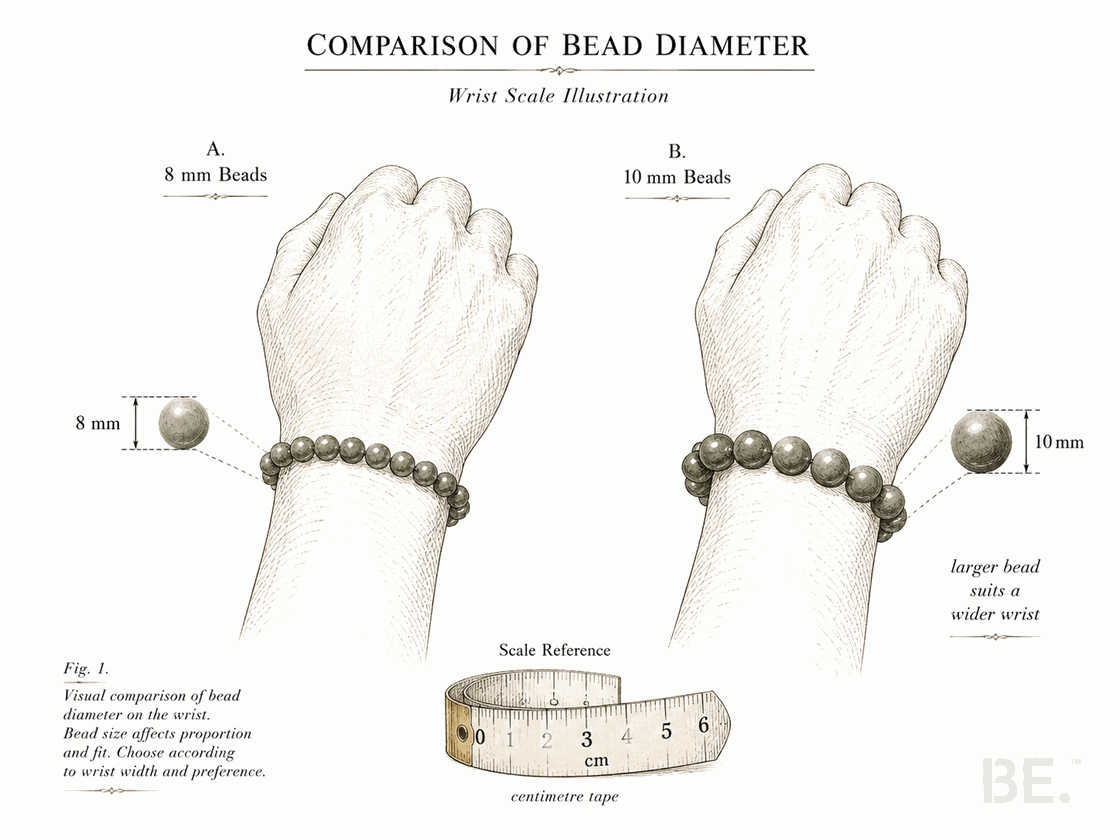
Bead size is the other half. On a wider wrist, a 10 mm bead usually reads better than 8 mm — it carries more visual weight and looks proportioned rather than dainty. An 8 mm strand suits a slimmer wrist or a deliberately understated look. BE. strands come in 6.5 and 7.5 inch lengths; if you need help choosing, measure first and check the size guide below.
Reading a strand before you buy
- Bead matching. Beads should match in size and tone across the strand; lurching colour signals cheaper mixed material.
- Polish. A clean, even polish reads glassy. Pitting or dull patches mean rushed finishing.
- Drill holes. Centred, unchipped holes protect the cord and show careful work.
- Surface on dark stones. On obsidian especially, check for surface scratches — it is glass and marks more easily than quartz.
- Stringing. Substantial elastic or neat knotted cord that can be restrung; ask what it is strung on.
Trade names, decoded
- Lava / volcanic stone. Often porous basalt, not obsidian; lighter and more matte. Different material.
- Black onyx. Dyed chalcedony, uniformly black; a quartz, unlike glassy obsidian.
- Gold sheen obsidian. Genuine obsidian whose sheen comes from aligned microscopic bubbles.
- Hematite vs hematoid. Hematite is metallic grey iron oxide; hematoid quartz is clear quartz with red iron inclusions — different looks.
Caring for a men's strand
Match the care to the material. Quartz-family stones (smoky, hematoid, clear) sit at Mohs 7 and shrug off most daily contact, but still store them apart from harder stones to avoid surface scratches. Gold sheen obsidian is volcanic glass and marks more easily, so treat it gently and keep it off hard surfaces. Across the board, take a strand off for sport, heavy work and the shower, where impact and soap film do the damage, and wipe it with a soft damp cloth. If the strand shares a wrist with a smartwatch, check scratch, sensor and magnet interactions before making it an everyday stack. For a fuller breakdown, see our guide to caring for crystal jewellery.
How BE. grades it
BE. grades every strand on the Crystal 4T framework — Transparency, Tone, Texture and Treasure — instead of the unregulated AAA ladder, and only makes strands rather than rings. Each bracelet ships with a Stone Origin Record recording the material and any treatment, so you know exactly what you are wearing. For more on choosing well, see our material-first buying guide and the bead size guide.
Frequently asked questions
Q1.What bead size should a man choose?
On most men's wrists a 10 mm bead reads better proportioned than 8 mm, with more presence and weight. An 8 mm strand suits a slimmer wrist or a more understated look. The choice is about proportion, not rules.
Q2.How do I measure my wrist?
Wrap a soft tape or strip of paper just below the wrist bone, read the circumference in centimetres, and add about 1 to 1.5 cm for comfort. Most men's wrists fall between 18 and 21 cm, which maps to the 7.5 inch strand length.
Q3.Which stones suit men best?
Darker, neutral materials read well — gold sheen obsidian, smoky quartz and kyanite are all unisex and restrained. It is a question of look and weight, not gendered properties; any stone can be worn by anyone.
Q4.Will a dark stone like obsidian scratch?
Obsidian is volcanic glass and marks more easily than quartz, so store it apart from harder stones and keep it off hard surfaces. Smoky quartz at Mohs 7 is more scratch-resistant for heavy daily wear.
Q5.Can men wear quartz-family bracelets?
Yes. Smoky quartz, clear quartz and rutilated quartz are neutral, durable and well suited to daily wear at Mohs 7. The quartz family covers most of the hard-wearing, low-key options.
Q6.Can I get a larger or custom length?
Strands come in 6.5 and 7.5 inch lengths, and you should size up if you are between sizes. For a longer fit, check the size guide and get in touch before ordering so we can advise.
References
- Gem-A — The Gemmological Association of Great Britain
- GIA Gem Encyclopedia
- Mindat — Quartz
- Read, P. G. (2005). Gemmology, 3rd ed. Butterworth-Heinemann.
Field Notes.
One stone at a time: its geology, and how to read quality. The Stone Buying Checklist comes with your first email.
By subscribing you agree to receive emails from BE. Unsubscribe anytime.
Sent. Check your inbox.