
Crystal Bracelets UK: A Material-First Buying Guide
What UK buyers should check before purchasing a crystal bracelet — material identity, grading, sizing, import duty, and how to verify authenticity.
In this field note
The UK crystal bracelet market sits in an unusual position: most material is cut in Guangdong or Rajasthan, sold through European-registered storefronts, and arrives via post without the buyer ever knowing what import route it took. The result is a market where material claims are rarely verified, “AAA grade” means whatever the seller wants it to mean, and pricing bears little relationship to actual mineral quality. A £15 “amethyst” bracelet and a £400 one contain the same mineral formula (SiO₂) — the difference is in what that formula looks like when properly graded.
This guide takes a material-first approach: what the stone actually is, how to assess its quality without specialist equipment, what to expect for UK delivery and sizing, and where the real value differences lie between price points.
What crystal bracelets actually are
Strip away the marketing and a crystal bracelet is a mechanical object: spherical or faceted beads of polished mineral, each drilled through-centre, threaded on a continuous elastic cord (typically 0.8–1.0 mm silicone-core stretch cord), and knotted to form a closed loop. The “crystal” designation covers a broad category — technically, any naturally occurring solid with an ordered atomic lattice qualifies. In commercial jewellery, it narrows to a handful of mineral families: the quartz group (amethyst, citrine, rose quartz, smoky quartz, clear quartz, rutilated quartz), feldspars (moonstone), garnets (almandine, pyrope), obsidian (volcanic glass, technically not crystalline), and various silicates (kyanite, prehnite).
The relevant question for a buyer is not “is this a crystal?” (almost everything qualifies) but “is this the specific mineral they claim it is, and at what quality level?”
Material categories and what drives price
| Material | Mohs hardness | Key quality driver | UK price range (genuine) |
|---|---|---|---|
| Amethyst (SiO₂) | 7 | Colour saturation + transparency; Bolivian > heated citrine relabelled | £80–£500+ |
| Rutilated Quartz (SiO₂ + TiO₂) | 7 | Needle density, colour, distribution; host clarity | £150–£800+ |
| Moonstone (feldspar) | 6–6.5 | Adularescence strength + body transparency | £100–£450 |
| Obsidian (volcanic glass) | 5–5.5 | Sheen quality (gold/rainbow); surface polish | £40–£200 |
| Garnet (silicate group) | 6.5–7.5 | Colour depth + transparency; species matters | £80–£300 |
| Rose Quartz (SiO₂) | 7 | Colour uniformity + translucency; star effect rare | £80–£500 |
UK-specific buying considerations
BE. ships duties-included to the UK — the price you see is the price you pay.
| Factor | What to check | Why it matters for UK buyers |
|---|---|---|
| Sizing convention | UK sellers sometimes list in cm; international in inches | Average UK female wrist: 15–16 cm (6–6.3″); male: 17–19 cm (6.7–7.5″). Add 1–1.5 cm for comfortable fit |
| Material claims | UK Trading Standards can pursue misleading mineral descriptions | “Crystal” is unregulated, but specific mineral names (amethyst, moonstone) carry implied material accuracy |
| Shipping time | EU → UK: 5–10 business days typical post-Brexit; Asia direct: 10–21 days | Tracked shipping recommended for items over £100 |
Reading a crystal bracelet before buying
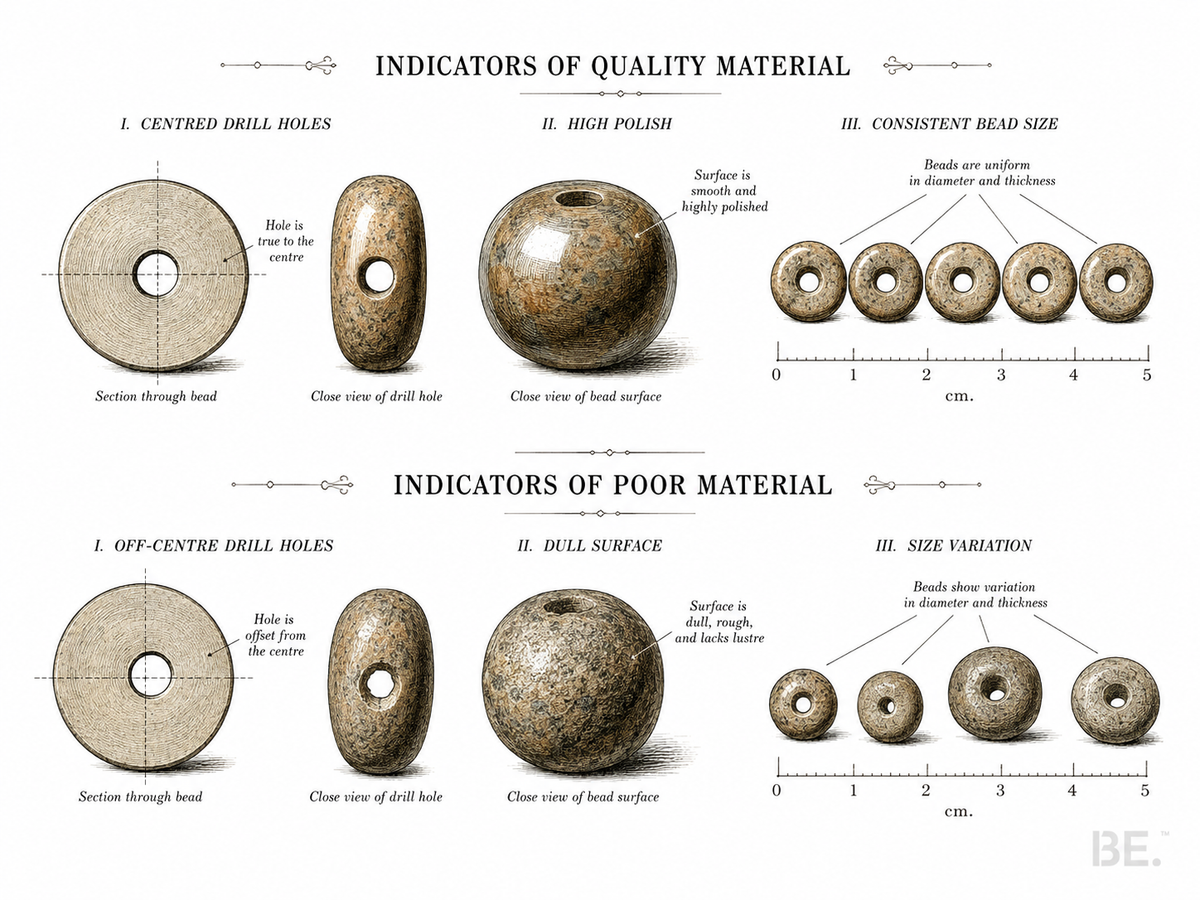
- Bead uniformity. Roll the bracelet on a flat surface. Every bead should be the same diameter (±0.3 mm). Irregular sizing indicates low-grade cutting — the lapidary accepted rejects to fill the strand.
- Bore alignment. Look through the drill hole of each bead. The hole should be centred and straight. Off-centre drilling weakens the bead wall on one side and causes uneven wear over time.
- Polish quality. Under natural light, each bead should reflect a single, sharp light point. Matte patches, orange-peel texture, or visible scratches indicate incomplete polishing — a red flag for rush production.
- Colour consistency. Some natural variation is expected (and desirable — it proves natural origin), but dramatic colour jumps between adjacent beads suggest mixed lots assembled from different parcels.
- Cord quality. Stretch the bracelet gently. Quality elastic should return immediately with no visible elongation at the knot. Thin, flimsy cord suggests the piece is built to a price point, not a durability standard.
- After-sale service. Check whether the seller offers restringing, sizing adjustments, or care guidance after purchase — indicators of a brand that stands behind its product long-term.
Common market labels, decoded
- AAA / AAAA grade. No standardised grading system exists for crystal beads. “AAA” is self-assigned by sellers with no external verification. One seller’s AAA is another’s B-grade. Judge by looking at the stone, not the label.
- Natural crystal. Should mean unheated, undyed, not synthetically grown. In practice, often applied to heated amethyst (now citrine), irradiated quartz, or dyed agate. Ask for specifics.
- Genuine [stone name]. Means the mineral identity is correct but says nothing about treatment. Genuine amethyst can still be low-grade, pale, or heavily included.
- Healing crystal bracelet. A marketing frame, not a material descriptor. The stone inside is the same regardless of what properties are attributed to it. Focus on what it physically is.
- Hand-selected. Every strand is assembled by someone. This phrase adds no verifiable quality claim.
Caring for crystal bracelets in the UK climate
The UK’s moderate, damp climate is gentle on most mineral jewellery. Quartz varieties (Mohs 7) resist scratching from everyday contact. Feldspar (moonstone, Mohs 6–6.5) and obsidian (Mohs 5–5.5) are softer and benefit from separate storage. The primary UK-specific concern is rapid temperature changes — moving from a heated indoor environment to cold outdoor air repeatedly can stress stones with natural internal fractures. Remove bracelets before swimming in chlorinated pools; sea swimming is less damaging but rinse afterward. Store in a cloth pouch or lined box to prevent bead-on-bead surface contact.
How BE. grades crystal bracelets
Every BE. strand is assessed using the Crystal 4T framework before listing: Transparency (optical clarity of the host material), Tone (colour saturation and consistency across all beads), Texture (inclusion character, polish finish, surface quality), and Treasure (sourcing confidence and material scarcity). Each bracelet ships with a Stone Origin Record — not a generic certificate, but specific information about where the material was extracted, how it was cut, and what makes that particular lot distinctive.
Frequently asked questions
Q1. Do crystal bracelets ship to the UK from Europe?
Yes. Post-Brexit, orders from EU-registered businesses to UK addresses are treated as imports. Orders under £135 have VAT collected at point of sale by the seller (if registered); orders over £135 may incur VAT and a postal handling fee at customs. Delivery typically takes 5–10 business days via tracked post.
Q2. What size crystal bracelet fits an average UK wrist?
Average UK female wrist circumference is 15–16 cm; male is 17–19 cm. Crystal bracelets are typically offered in 6.5″ (16.5 cm) and 7.5″ (19 cm) internal circumference. The smaller fits most women comfortably; the larger suits most men. Measure with a flexible tape at the wrist bone and add 1–1.5 cm for comfortable fit.
Q3. How do I know if a crystal bracelet is real?
Genuine mineral beads are cold to the touch (thermal conductivity), heavier than glass or plastic imitations, and show natural inclusions or colour variations under magnification. Perfect uniformity, air bubbles, or identical patterns repeated across beads suggest synthetic or glass material.
Q4. Are crystal bracelets durable enough for daily wear in the UK?
Quartz-family stones (Mohs 7) handle daily wear well — they resist scratching from most everyday surfaces. Softer stones like moonstone (6–6.5) or obsidian (5–5.5) benefit from slightly more careful handling. The UK climate poses no particular threat; just avoid impacts against hard surfaces.
Q5. How do I care for my crystal bracelet in the UK climate?
The UK’s humidity is generally kind to mineral jewellery, but a few precautions help. Avoid wearing your bracelet in chlorinated swimming pools — chlorine can dull polished surfaces over time. In hard-water areas (much of South-East England), remove before showering, as limescale deposits can build up in bead crevices. Store in a dry place — a cloth pouch or lined box — rather than leaving on a bathroom shelf where moisture accumulates. Clean gently with a soft, dry cloth; if needed, dampen slightly with plain water and dry immediately. During winter, the transition between heated indoors and cold outdoor air is the main stress factor — stones with natural fractures can be sensitive to rapid thermal cycling.
References
- Mindat — Quartz mineral data
- Wikipedia — Quartz
- UK Government — Tax and customs for goods sent from abroad
- Webster, R. (2002). Gems: Their Sources, Descriptions and Identification, 5th ed. Butterworth-Heinemann.
- Schumann, W. (2009). Gemstones of the World, 4th ed. Sterling.
Field Notes.
One stone at a time: its geology, and how to read quality. The Stone Buying Checklist comes with your first email.
By subscribing you agree to receive emails from BE. Unsubscribe anytime.
Sent. Check your inbox.