
Crystal Bracelet Bead Size Guide: 6mm vs 8mm vs 10mm
A bead-size guide for crystal bracelets — how 6mm, 8mm and 10mm beads compare in wrist fit, visual weight, stone visibility and styling.
In this field note
Bead size is the most underdiscussed variable in crystal bracelets. The diameter changes the bracelet more than the stone choice does. A 6mm amethyst and a 10mm amethyst behave like different objects on the same wrist.
BE. Crystal Jewellery asks for bead diameter at the start of an order.6mm vs 8mm vs 10mm: which bead size should you buy?
| Bead size | Look | On the wrist | Best for |
|---|---|---|---|
| 6mm | Fine, delicate | Light, low-profile | Slimmer wrists, layering, a quiet everyday piece |
| 8mm | Everyday, versatile | Balanced weight | Most people. The default | .
| 10mm | Bold, present | Heavier, statement | Larger wrists, a piece meant to be seen, single wear |
Not sure of your fit? Use the bead calculator to turn your wrist measurement into an exact bead count for any size.
The sections below compare 6mm, 8mm and 10mm on physical properties, visual behaviour and styling. Pick the size on purpose; left unpicked, it defaults to whatever the workshop had strung that week.
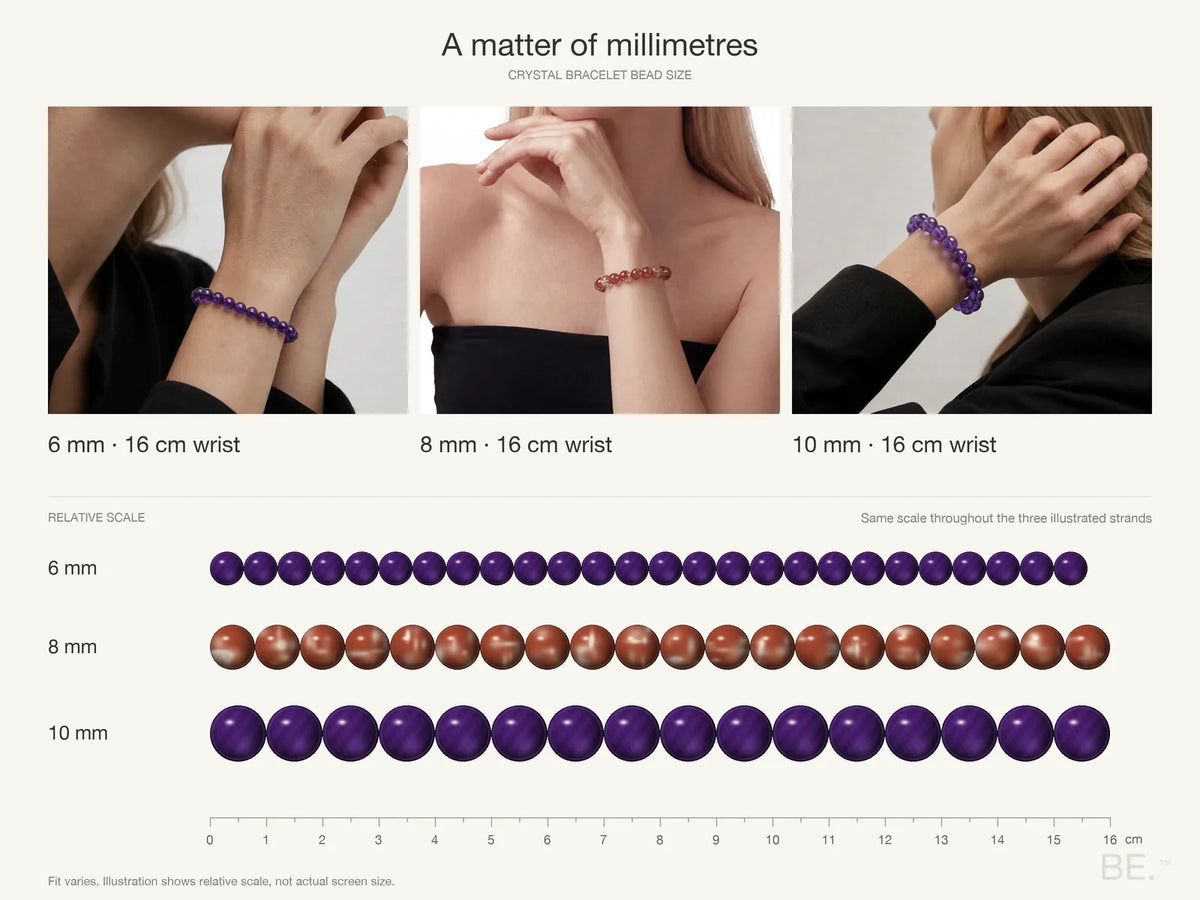
The three sizes, in numbers
| Property | 6mm | 8mm | 10mm |
|---|---|---|---|
| Bead diameter | 6mm | 8mm | 10mm |
| Beads on a 17cm strand | ~28 | ~21 | ~17 |
| Approx. weight per bead (quartz) | 0.3g | 0.7g | 1.4g |
| Total strand weight (quartz) | ~8g | ~15g | ~24g |
| Visible inclusion detail | Subtle | Clear | Pronounced |
| Visual register | Delicate, quiet | Balanced, neutral | Statement, sculptural |
| Best for wrist circumference | 13–16cm | 14–18cm | 16–20cm |
The numbers above are for spherical beads strung on standard elastic. Faceted, rondelle and free-form shapes change the figures by 10–20% in either direction.
6mm: the quiet diameter
6mm beads sit close to the wrist and disappear under most sleeves. The strand reads as a thin, deliberate line rather than a statement object. Two practical advantages: 6mm strands layer beautifully under watches without crowding the watch case, and they suit narrower wrists (13–16cm) without overwhelming the proportions of the hand. For a child, bead diameter is only one part of the decision; age, clasp security and supervision matter too.
The trade-off is inclusion visibility. At 6mm, the surface area of each bead is small enough that internal features read as hints. The gold needles of rutilated quartz, the colour zoning of amethyst, the chatoyancy of tigereye: all of them soften at this size. Stones chosen for surface effects (moonstone's adularescence, labradorite's labradorescence) hold their character at 6mm; stones chosen for internal architecture (rutilated quartz, included tourmaline) lose some of their visual case at this size.
8mm: the working diameter
8mm is the standard for a reason. The diameter is large enough to show stone character clearly. Inclusions, colour zoning and surface phenomena all read at arm's length. It is also small enough that a single strand does not commit the wrist to a single statement. 8mm layers cleanly with both 6mm and 10mm in graded stacks, and it sits comfortably on the widest range of wrist sizes (14–18cm).
If a customer is choosing one size for an everyday strand, 8mm is the safe answer. It is also the size most photographers and stylists default to, because it photographs at the right scale on the wrist without specialised composition.
10mm: the sculptural diameter
10mm beads carry visual weight that the smaller sizes cannot. The strand becomes the focal object on the wrist, and stone character is on full display. A 10mm rutilated quartz bead shows its needle pattern at conversational distance.
The trade-offs are practical. 10mm strands sit higher off the wrist and bump against sleeve cuffs, watch straps and laptop edges. They are heavier (~24g per strand for quartz), which most wearers find pleasant but a few find tiring. They do not layer naturally with smaller diameters. A single 10mm strand reads better alone, or as the anchor of a graded stack with one 8mm beside it.
How bead size changes what you see
The larger the bead, the more of the stone's interior is visible per unit. This matters most for stones whose value lives inside the crystal:
- Rutilated quartz. Needle patterns are dramatic at 10mm, legible at 8mm, subtle at 6mm. For a strand bought primarily for the rutile, choose 8mm or larger.
- Amethyst with colour zoning. 8mm and 10mm beads reveal the alternating bands of pale and saturated violet; 6mm beads tend to read as a single average tone.
- Moonstone adularescence. The blue or white sheen reads at all three sizes because it is a surface phenomenon, but 10mm gives the most generous viewing surface.
- Tourmalinated quartz. Black tourmaline needles read crisply at 8mm and 10mm; at 6mm they can look like dark dots rather than fine lines.
- Clear quartz. Transparency is the feature, and it reads at all sizes. 6mm clear quartz strands work well as visual breaks in a stack.
- Soft translucent stones. A material like prehnite shows its waxy internal glow most clearly at 8mm and above; at 6mm the soft green reads as a single muted tone with less of the backlit-jade character.
Mixing bead sizes in a stack
Two reliable strategies. Monosize stacks: every strand at the same diameter (e.g. three 8mm strands). The wrist reads as a single sculpted band, modern and intentional. Graded stacks: 10mm, then 8mm, then 6mm in order. The wrist reads as a tapered sculpture, asymmetric and considered.
The combination that rarely works is the random one: 6mm beside 10mm beside 6mm beside 8mm, in no order. Without a graded or monosize logic, the eye reads it as a stack of unrelated purchases.
Wrist fit, in practical terms
Measure the wrist with a soft tape just above the wrist bone. Add 1–1.5cm for a comfortable fit. The bracelet should rotate about a centimetre but not slide over the hand. From there:
- 13–15cm wrist. 6mm or 8mm reads best. 10mm tends to overwhelm the hand.
- 15–17cm wrist. 8mm is the default; 6mm and 10mm both work depending on the look.
- 17–19cm wrist. 8mm or 10mm. 6mm reads thin on wider wrists unless layered.
- 19cm+ wrist. 10mm carries proportion best; 8mm reads understated; 6mm reads as a layering piece rather than a standalone.
Choose by wrist, use and visual weight
Wrist size decides the fit. Bead diameter decides the look. Treat the ranges below as starting points. Measure the wrist you have now and put the number into the bead-count calculator; a guessed finished length is the most common reason a bracelet arrives wrong. BE. Crystal Jewellery makes each strand to a measured wrist.
| Wrist (cm) | Everyday | Statement | Men's convention | Note |
|---|---|---|---|---|
| 13–15.5 | 6mm or 8mm | 8mm | 8mm is the common low-profile choice | 10mm can dominate a fine wrist; choose it only when that visual weight is deliberate. |
| 15.5–17 | 8mm | 10mm | 8mm default; 10mm for a bolder single strand | At 15.5cm, 8mm is the safest starting point; fit still comes from the measured circumference. |
| 17–19 | 8mm | 10mm | 8mm and 10mm are both common | Choose by cuff clearance and whether the bracelet will be worn alone or stacked. |
| 19+ | 8mm or 10mm | 10mm | 10mm is common, but not compulsory | 6mm usually reads as a layering line rather than a standalone piece. |
| Older wearer: measure first | 8mm default | 10mm if the wrist is 17cm+ and the extra weight is wanted | Use the same wrist-based convention | Age alone does not determine size. If metal sensitivity is known, check clasp and spacer materials or choose metal-free construction; bead diameter does not change metal contact. |
Frequently asked questions
Q1.Is one size more durable than another?
No. Durability is set by the stone's hardness and the bead's cut quality, not its diameter. A well-finished 6mm bead lasts as long as a well-finished 10mm bead.
Q2.Are larger beads more expensive?
Usually yes. A 10mm bead contains roughly four times the volume of stone of a 6mm bead, so the per-bead material cost rises. Premium strands also require more selection effort at larger sizes, because flaws are more visible.
Q3.Which size photographs best?
8mm and 10mm photograph more clearly because the camera resolves the stone character on each bead. 6mm strands can read as a thin coloured line in photographs taken at arm's length.
Q4.Can I mix sizes within a single strand?
Yes. "Graduated" strands taper from a large centre bead (10–12mm) down to smaller end beads (6–8mm). The taper reads as deliberate and follows the natural narrowing of the wrist.
Q5.How do I know if a bracelet is too tight?
If it leaves a visible imprint on the skin after wearing, or if it cannot rotate freely, it is too tight. Tight bracelets concentrate wear at fixed points on the elastic and shorten the life of the strand.
Q6.Do men and women wear different sizes?
The pattern in the market is that larger wrists, often men's, default to 8–10mm, and smaller wrists default to 6–8mm. The right size is set by the look the wearer is after. Gender has nothing to do with it.
Q7.What is the most appropriate bracelet bead size for a 70-year-old man?
Start with 8mm: it is visually clear without the bulk and weight of 10mm, and it suits most wrist circumferences. Choose 10mm when the current wrist measures at least about 17cm and a heavier statement fit is wanted; choose 6mm for a lighter, lower-profile piece. Age is not a sizing proxy, so measure the wrist. If the design has a metal clasp or spacers and metal sensitivity is known, verify those materials or choose metal-free construction.
Q8.What is the best crystal bead size for a 15.5cm wrist?
8mm is the most versatile starting point for a 15.5cm wrist. Choose 6mm for a finer profile or easy stacking; choose 10mm only when a deliberately bold, higher-sitting strand is wanted. Use the measured wrist and bead diameter in the bead-count calculator rather than relying on a generic bead count.
Q9.What is the best bead size for an everyday crystal bracelet?
8mm is the everyday default for most wrists because it shows the stone clearly without the cuff interference and weight of 10mm. Choose 6mm when low profile, light weight or stacking matters more; choose 10mm when the bracelet is meant to be the focal piece.
References
- GIA Gem Encyclopedia: stone properties and proportion
- Mindat: quartz density data
- Wikipedia: Bead
- GIA Gems & Gemology archive
- Webster, R. (2002). Gems: Their Sources, Descriptions and Identification, 5th ed. Butterworth-Heinemann.
- Schumann, W. (2009). Gemstones of the World, 4th ed. Sterling.
Field Notes.
One stone at a time: its geology, and how to read quality. The Stone Buying Checklist comes with your first email.
By subscribing you agree to receive emails from BE. Unsubscribe anytime.
Sent. Check your inbox.