
Crystal Bracelet and Smartwatch: Scratches, Sensors, Magnets
A crystal bracelet and a smartwatch can share a wrist. What decides it is the side the bracelet sits on, the band tension, and the watch crystal material.
In this field note
The wrist is crowded now. A watch that measures a pulse needs steady contact with skin, and a bracelet that slides freely is the most obvious thing in the way.
Three separate worries usually arrive together here: scratches on the watch, lost sensor readings, and magnets near electronics. They have different answers, and only one of them turns out to be a real constraint on how a bracelet is worn.
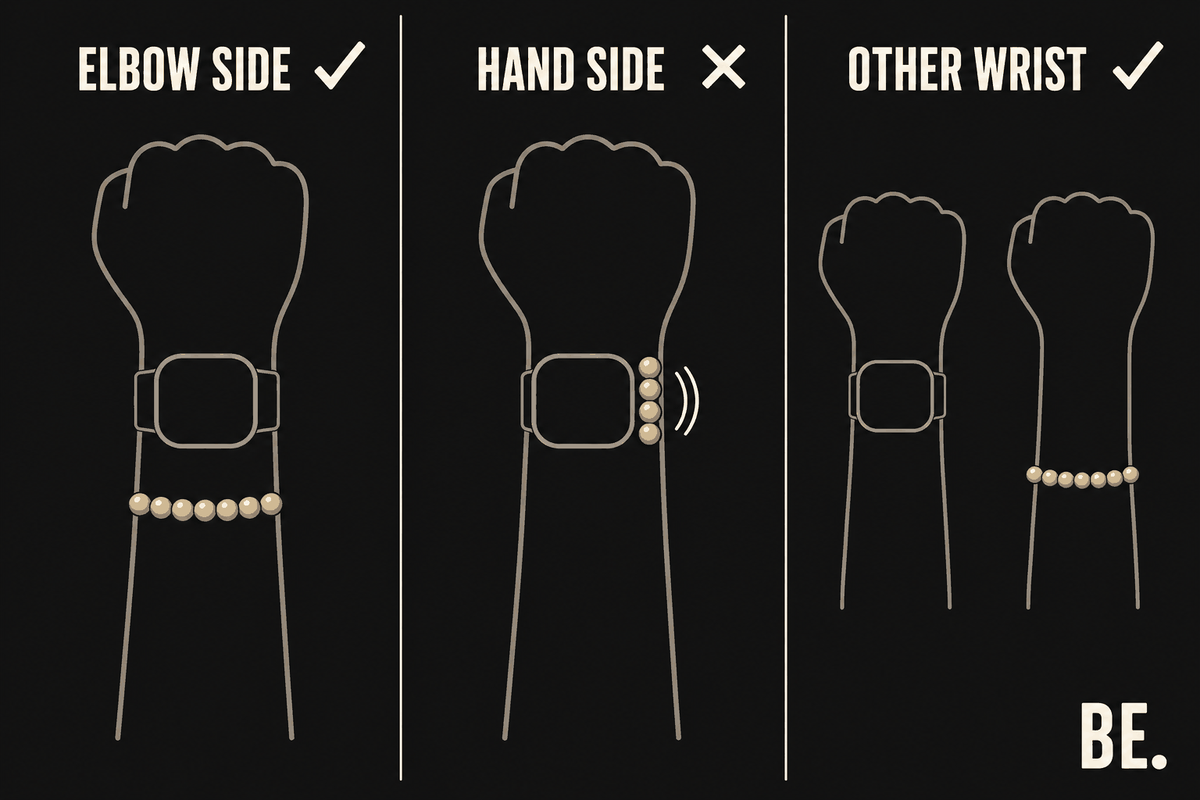
Can you wear a crystal bracelet on the same wrist as a smartwatch?
Yes, under three conditions: the bracelet sits on the elbow side of the watch, the watch band is snug enough that the case does not travel, and the watch crystal is a material that quartz beads cannot mark. Sapphire cannot be scratched by any stone in a bracelet. Mineral glass and acrylic can, and that side of the question is answered in full in the scratch guide.
What follows is the part the scratch guide does not cover: what a bracelet does to the sensors underneath a watch, and what a magnetic clasp does to the watch itself.
Do beads stop a smartwatch reading your heart rate?
They can, and the reason is mechanical rather than mineral. An optical heart-rate sensor shines light into the skin and reads what comes back. It needs the back of the case to stay pressed against the same patch of wrist. A loose bracelet sitting against the case nudges the watch a millimetre at a time all day, and each nudge breaks the seal of light the sensor depends on.
Nothing about the stone is responsible. A silicone band worn loosely produces the same dropouts, and so does a watch worn over a bony part of the wrist. Blood-oxygen readings fail in the same way and slightly more easily, because they need a longer stretch of steady contact than a pulse reading does.
| Concern | Real risk | What actually causes it | Fix |
|---|---|---|---|
| Scratched watch glass | Depends on the crystal | Mohs 7 beads plus surface grit | Check sapphire against mineral glass |
| Heart-rate dropout | Moderate | The watch shifting, not the stone | Bracelet on the elbow side |
| Blood-oxygen misread | Moderate | Same cause, lower tolerance | Tighten the band one notch |
| Magnet near electronics | None | No magnetic storage in a smartwatch | Nothing to do |
| Magnet near the dock | Mild nuisance | Clasp attracted to the magnetic dock | Take it off first |
| Band wear | Low | Beads rubbing silicone or leather | Steel or fabric band |
Should the bracelet sit above or below the watch?
Above, meaning the elbow side. The wrist bends at the hand end, and anything sitting on that side gets driven into the watch case every time the hand flexes. On the elbow side the forearm is wider and steadier, so a strand rests there instead of pushing.
A second habit helps as much as the position. Leave a visible gap — a finger's width is enough — rather than letting the bracelet touch the case. Contact is what transmits the movement, and a small gap removes both the sensor problem and most of the scratch risk at the same time.
Do magnetic clasps affect a smartwatch or its dock?
Not the watch. There is no magnetic storage inside a smartwatch and no mechanical escapement to magnetise, so a clasp magnet passes it without consequence. The screen, the battery and the sensors are all indifferent.
The dock is a different story, and it is an inconvenience rather than a fault. Most smartwatch docks hold the case in place with a magnet of their own, and a steel clasp brought close will jump to the pad and sit there. Taking the bracelet off before docking the watch solves it. The wider version of the magnet question — cards, phones, implanted devices — is answered in the magnetic clasp guide.
Which bead size and closure work best alongside a watch?
Smaller beads and a clasp that opens. A 6mm or 8mm strand keeps a low profile and rolls less than a 10mm one, which matters when there is already a watch case competing for the same stretch of wrist. Bead size against wrist size is worked out properly in the bead size guide.
- 6mm or 8mm beads beside a watch; 10mm reads heavy on the same wrist.
- A steel-wire strand holds its length, so the gap you set in the morning is the gap at six o'clock.
- A magnetic clasp comes off with one hand, which is the difference between taking a bracelet off before typing and leaving it on.
- Dark stones sit more quietly next to a steel or black case than pale ones.
What if you wear the bracelet on the other wrist?
Every problem on this page disappears. No sensor interference, no contact with the watch glass, no interaction with the dock. It is the simplest answer available and the one most people arrive at after a fortnight of adjusting.
There is a second gain worth knowing about. If the watch is on the dominant wrist, moving the bracelet to the other side also moves it away from the hand that meets door frames, desk edges and keyboards, which is where most bead damage comes from. Which wrist takes less punishment, and which stones care about the difference, is set out stone by stone in the wrist guide.
Frequently asked questions
Q1.Can I wear an Apple Watch and a crystal bracelet on the same wrist?
Yes. Put the bracelet on the elbow side of the watch, leave a finger's width of gap, and keep the watch band snug. The watch crystal material decides the scratch question: sapphire is safe against quartz beads, mineral glass and acrylic are not.
Q2.Do crystal beads scratch a smartwatch screen?
Only if the screen is mineral glass or acrylic. Quartz sits at 7 on the Mohs scale and will mark both. Sapphire sits at 9 and is unaffected by any stone in a bracelet. The full breakdown by surface type is in the scratch guide.
Q3.Does a bracelet affect heart-rate monitoring?
It can, but the stone is not the cause. Optical sensors need the watch case to stay pressed against one patch of skin, and a loose bracelet nudging the case is what breaks the reading. Moving the bracelet to the elbow side and tightening the band fixes it.
Q4.Should a bracelet go above or below a watch?
Above, on the elbow side. The wrist bends at the hand end, so a bracelet worn there is driven into the watch case with every flex. The forearm side is wider and steadier, and a visible gap between the two removes the contact altogether.
Q5.Do magnetic clasps interfere with a smartwatch?
No. A smartwatch has no magnetic storage and no mechanical movement to magnetise, so a clasp magnet has nothing to act on. The only practical effect is that the clasp will cling to the magnetic dock, so take the bracelet off before docking.
Q6.Do I need to take my bracelet off to dock my watch?
Only if the bracelet and the dock meet. Most smartwatch docks hold the case with a magnet, and a steel clasp brought near will attach to it. Taking the bracelet off first avoids the nuisance and keeps the beads away from the pad.
References
- Wikipedia — Photoplethysmogram
- Wikipedia — Pulse oximetry
- Wikipedia — Mohs scale of mineral hardness
- Wikipedia — Sapphire
- Nassau, K. (1994). Gemstone Enhancement, 2nd ed. Butterworth-Heinemann.
Field Notes.
One stone at a time: its geology, and how to read quality. The Stone Buying Checklist comes with your first email.
By subscribing you agree to receive emails from BE. Unsubscribe anytime.
Sent. Check your inbox.