
Are Magnetic Clasps Safe? Cards, Phones and Pacemakers
A magnetic bracelet clasp is safe for almost everyone. How strong the magnet actually is, which objects it can affect, and the three that deserve a habit.
In this field note
Most people meet a magnetic clasp at the checkout page and pause. A magnet, worn all day, a few centimetres from a wallet and a phone, feels like the sort of thing somebody should have checked.
Somebody has. The short answer is that jewellery magnets sit at the harmless end of a very wide scale, and that magnetic force collapses with distance faster than intuition suggests. The longer answer is worth reading once, because three objects do behave differently from the rest.
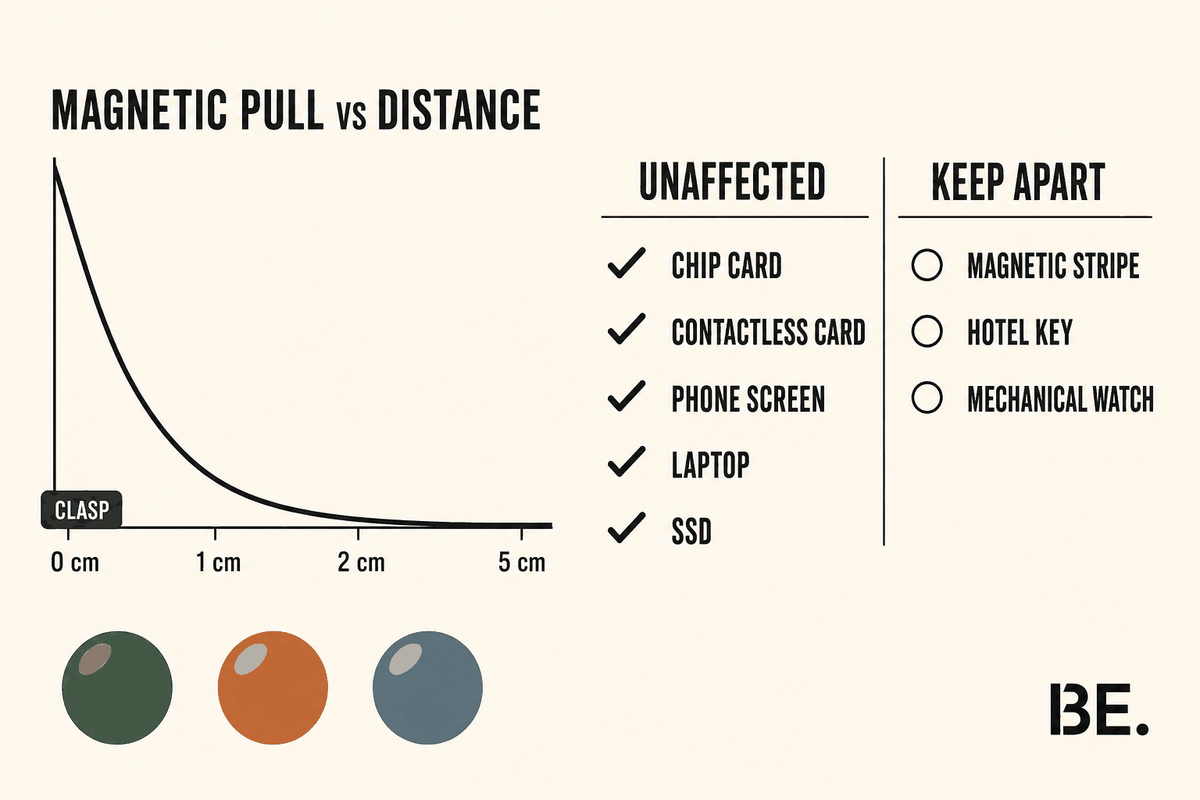
Are magnetic bracelet clasps safe to wear?
Yes, for almost everyone. A clasp magnet is a few millimetres of neodymium alloy, sealed inside the fitting, and its field is strong at the metal face and negligible a short distance away. Worn on a wrist, it spends the day surrounded by skin, fabric and air rather than pressed against anything delicate.
Three things sit outside that comfortable answer, and all three are manageable. Cards with an old magnetic stripe can be affected by prolonged direct contact. Mechanical watches can be magnetised at close range. Anyone with a pacemaker or implanted defibrillator should follow the distance guidance their device manufacturer publishes. Everything else on a normal day is unaffected.
How strong is a jewellery clasp magnet, really?
Strong at the surface, weak almost immediately afterwards. At the pole face, a small neodymium clasp magnet measures in the low hundreds of millitesla. An MRI scanner runs at 1.5 to 3 tesla, which is roughly ten thousand times more. A fridge magnet, at the other end, sits around five millitesla.
The number that matters more than the peak is the fall-off. The field of a small magnet drops roughly with the cube of the distance from it. Double the gap and the pull drops to about an eighth. Triple it and you are down to a twenty-seventh. This is why a clasp that can hold a bracelet closed against a day of arm-swinging still cannot reach the card in a back pocket.
Will it wipe a bank card, hotel key or transport pass?
Modern cards, no. A chip card stores nothing magnetically; the data lives in a silicon chip, and a contactless card uses a radio antenna. Neither can be erased by a magnet of any household strength. The vulnerable format is the brown magnetic stripe, and it is vulnerable only to sustained direct contact, not to sharing a bag.
| Object | Affected by a clasp magnet? | Distance that matters | Sensible habit |
|---|---|---|---|
| Chip bank card (EMV) | No | None | Nothing to do |
| Contactless card | No | None | Nothing to do |
| Magnetic-stripe card | Possible | Direct, prolonged contact | Keep in a separate slot |
| Hotel key card (stripe) | Possible | Direct contact | Keep in a separate slot |
| Phone screen | No | None | Nothing to do |
| Phone compass | Brief deflection | Under about 2 cm | Move the wrist away |
| Laptop, SSD, memory card | No | None | Flash storage is not magnetic |
| Mechanical watch | Possible | Under about 5 cm | Opposite wrist |
| Pacemaker or ICD | Follow device guidance | About 15 cm advised | Ask your cardiologist |
| MRI room | Remove before entry | Whole room | Take the bracelet off |
Can it damage a phone, laptop or camera?
No. Screens, batteries, processors and solid-state storage hold nothing magnetically, so there is no mechanism for a small magnet to erase or degrade them. Phones already contain magnets of their own, in the speaker and often in the case attachment ring, and they are considerably larger than a clasp.
One visible effect exists and it is temporary. The magnetometer that drives the compass app can be pulled off true if a magnet comes within a couple of centimetres. Move the wrist and the reading returns. If a compass reads oddly during a walk, the fix is to hold the phone in the hand without the bracelet.
Do magnetic clasps interfere with pacemakers or defibrillators?
Device manufacturers publish a consistent piece of guidance: keep consumer magnets about fifteen centimetres away from the implant site. A bracelet worn on the wrist is normally well outside that distance, and the risk case is bringing the magnet up to the chest and holding it there rather than wearing it at all.
That is as far as a jewellery page should go. Implant models differ, and cardiology teams give advice tailored to the device and the person carrying it. Anyone with a pacemaker, an implanted defibrillator or a loop recorder should raise the question at their next appointment and take that answer over anything written here.
Will a magnetic clasp come undone on its own?
A well-made one will not, because it is doing two jobs at once. The magnet aligns and holds the two halves; a mechanical lip, groove or bayonet turn carries the actual load. Pull straight along the bracelet, the direction an arm produces all day, and the mechanical part resists. Pull the two halves sideways and it opens easily, which is precisely what makes it possible to take off with one hand.
Steel wire matters here as much as the clasp. A strand built on wire keeps its length and does not stretch into slack the way an elastic cord does over a year of wear, so the fitting stays where it was designed to sit. Water is not a problem for brief contact, though the seam is the part that traps residue, and a rinse and a full dry after a swim keeps it clean. The stone side of that question is answered stone by stone in the shower guide.
Why use a magnetic clasp at all?
Two practical reasons, and neither is about the magnet being clever. The first is that a magnetic clasp can be fastened with one hand. Anyone who has tried to close a lobster clasp on their own wrist knows the two-handed contortion involved, and a fitting that snaps shut against a table edge removes it.
The second is that it comes apart on purpose. A strand that opens is a strand that can be joined to another, so two bracelets become one long piece around the collarbone, and three become a layered necklace. The triple-strand piece below is built for exactly that, and the same logic applies to any two single strands owned already. How the combinations are chosen — tone, bead size, how many strands read as deliberate rather than accidental — is covered in the stacking guide rather than here.
Frequently asked questions
Q1.Are magnetic clasps on bracelets safe?
Yes, for almost everyone. A jewellery clasp magnet is small, sealed in the fitting, and its pull drops away within a centimetre or two. The three exceptions worth a habit are old magnetic-stripe cards, mechanical watches and implanted heart devices.
Q2.Will a magnetic bracelet clasp demagnetise my bank card?
Not a chip or contactless card, which store nothing magnetically. Only an old magnetic stripe can be affected, and only through direct, prolonged contact. Keeping stripe cards in a separate wallet slot removes the question entirely.
Q3.Can a magnetic clasp damage my phone or laptop?
No. Screens, batteries and solid-state storage are not magnetic media. The only visible effect is a temporary compass deflection if the clasp comes within about two centimetres of the phone, and the reading corrects as soon as the wrist moves away.
Q4.Can I wear a magnetic clasp bracelet with a pacemaker?
Device manufacturers advise keeping consumer magnets around fifteen centimetres from the implant site, and a wrist is normally well outside that. Implant models differ, so anyone with a pacemaker or defibrillator should confirm with their cardiologist rather than rely on general guidance.
Q5.Will a magnetic clasp fall open and lose the bracelet?
A well-made clasp holds mechanically as well as magnetically, so pulling along the length of the bracelet — the direction an arm produces all day — is resisted by the fitting rather than the magnet. It opens with a sideways twist, which is what makes one-handed removal possible.
Q6.Can I wear a magnetic clasp bracelet in water?
Brief contact is fine. The seam of the clasp is the part that traps soap and salt, so rinse in fresh water and dry the fitting fully after swimming. Which stones tolerate the water itself is a separate question, answered stone by stone in the shower guide.
References
- Wikipedia — Neodymium magnet
- Wikipedia — Magnetic stripe card
- Wikipedia — EMV chip card standard
- Wikipedia — Artificial cardiac pacemaker
- ISO 764:2020 — Horology: magnetic resistant watches. International Organization for Standardization.
Field Notes.
One stone at a time: its geology, and how to read quality. The Stone Buying Checklist comes with your first email.
By subscribing you agree to receive emails from BE. Unsubscribe anytime.
Sent. Check your inbox.