
Can Children Wear Crystal Bracelets Safely?
What parents should check before child wear: loose beads, magnets, construction, fit, materials and why adult jewellery is not children’s-product certification.
In this field note
Parents usually ask whether the crystal itself is safe. The more useful question is whether the finished bracelet is designed, tested and labelled for the child who will wear it.
A polished stone can be hard and durable while the finished piece still contains small beads, a clasp, wire, elastic, coatings or metal parts. Each component changes the risk. This guide explains the checks; it does not certify a particular bracelet for a child.
Can children wear crystal bracelets?
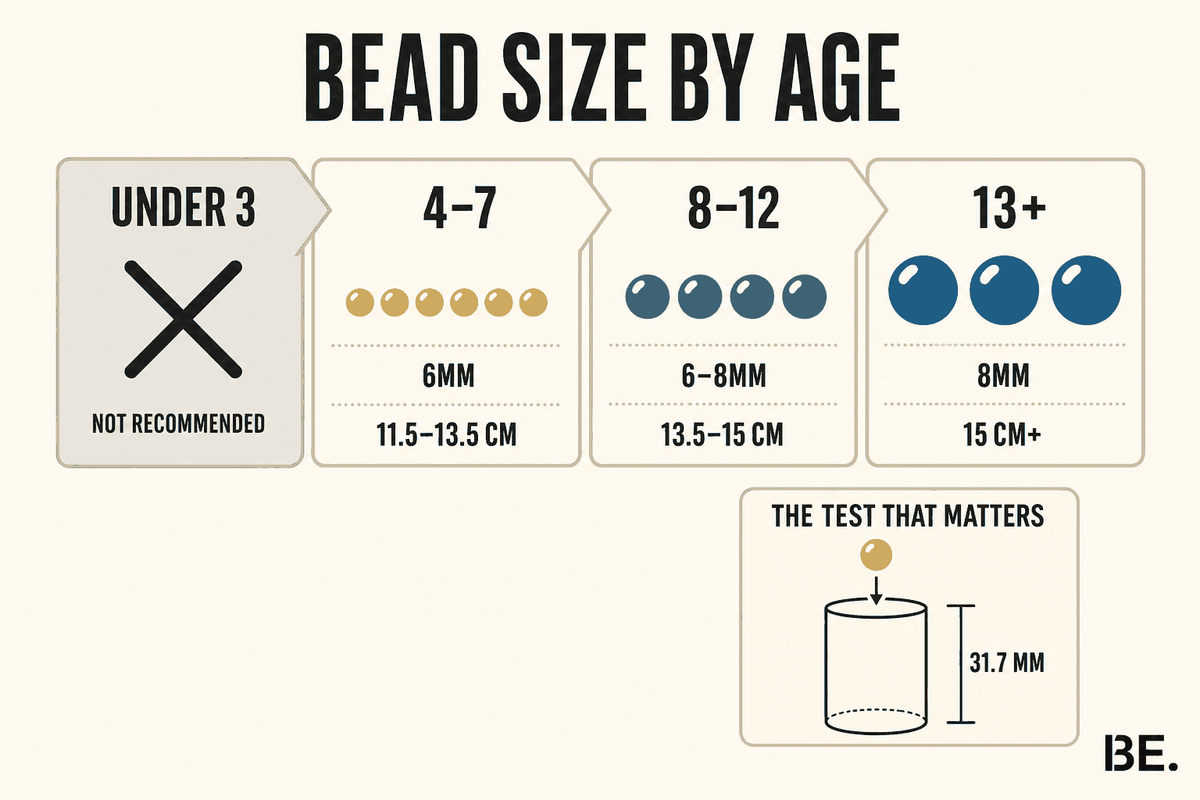
Not for children under three. A bracelet that comes apart releases small beads, which are a recognised choking and swallowing hazard. For older children, age alone does not settle the question: the bracelet’s intended use, construction, warnings, fit and the child’s behaviour all matter.
The U.S. Consumer Product Safety Commission identifies hazards in children’s jewellery that include small components, certain metals and coatings, magnets and strangulation. A piece sold as adult jewellery should not be assumed to meet standards for a children’s product.
What are the main safety risks?
Loose beads and small parts
If a strand breaks, beads and fittings can become separate small parts. The CPSC defines a small part by whether it fits completely inside its test cylinder, not simply by the age printed on a listing. An intact bracelet can therefore become a different object when its cord, knot or fitting fails.
Magnets need separate caution
Small powerful magnets are not only a choking concern. If more than one is swallowed—or one magnet and another metal object—they can attract through internal tissue and cause perforation, blockage, infection or worse. Keep jewellery with loose or separable magnets away from children. If magnet ingestion is suspected, seek immediate medical attention.
Snagging, fit and unsupervised wear
A bracelet that is too loose can catch on equipment or furniture. A tight piece can become uncomfortable as the wrist moves or swells. Remove jewellery for sleep, bathing, swimming, rough play and sport; those settings add snagging, unnoticed breakage and loss.
Metals, coatings and skin reactions
“Natural crystal” describes the bead, not every material in the finished piece. Ask for the metal, plating, coating, dye and cord specifications. Stop wear if irritation appears and seek appropriate medical advice when needed. A mineral name by itself is not a safety assessment for the complete product.
What should a parent check before use?
- Intended user: Does the maker explicitly state the age range and applicable safety information?
- Construction: Can a bead, charm, clasp, magnet or end fitting detach during ordinary use?
- Materials: Are the bead treatments, coatings and metal components identified rather than described only as “crystal”?
- Fit: Is it secure without being tight, and can it catch on clothing or equipment?
- Condition: Are there stretched sections, fraying, cracked beads, loose knots or damaged fittings?
- Use: Will an adult supervise, and will the bracelet be removed for sleep, water and active play?
If any answer is unknown, do not use the bracelet for a child until the seller or manufacturer provides product-specific information. A size guide can help with fit, but it cannot replace a safety assessment. For measuring only, see the wrist-measuring guide.
What should you do if the bracelet breaks?
Remove the bracelet, collect every bead and fitting, and keep the pieces out of children’s reach. Do not restring it for child wear unless the finished piece can be assessed again as a complete product. If any magnet may have been swallowed, follow CPSC guidance and seek immediate medical attention.
Frequently asked questions
Q1.Are crystal bracelets safe for toddlers?
Do not assume so. A broken strand can release beads and fittings that are small parts. Products intended for children under three are subject to specific small-parts rules, and an adult jewellery listing is not proof of children’s-product compliance.
Q2.Is the stone the only material to check?
No. Check the cord or wire, clasp, magnets, metal, plating, coating, dye and every detachable component. Safety applies to the finished bracelet, not only the mineral bead.
Q3.Can a child sleep in a crystal bracelet?
Remove it before sleep. Unsupervised wear adds avoidable risks from snagging, breakage and loose components.
Q4.What if a magnet may have been swallowed?
Seek immediate medical attention. Multiple magnets, or a magnet and another metal object, can attract through internal tissue and cause severe injury.
References
Field Notes.
One stone at a time: its geology, and how to read quality. The Stone Buying Checklist comes with your first email.
By subscribing you agree to receive emails from BE. Unsubscribe anytime.
Sent. Check your inbox.