
Crystal Treatment Chart: Heat, Irradiation & Dye by Stone
Which crystal-bracelet stones are commonly heated, irradiated or dyed, how to spot treatment, and why honest disclosure matters. A by-stone reference chart.
In this field note
Two amethyst bracelets at very different prices can both be “real” amethyst — and a third, brighter one might be dyed quartz entirely. The difference that matters isn’t whether a stone was touched, but whether the seller tells you. BE. treats treatment as a recorded fact, not a secret, and this guide is the reference behind that policy: what gets done to which stones, and how to read it yourself.
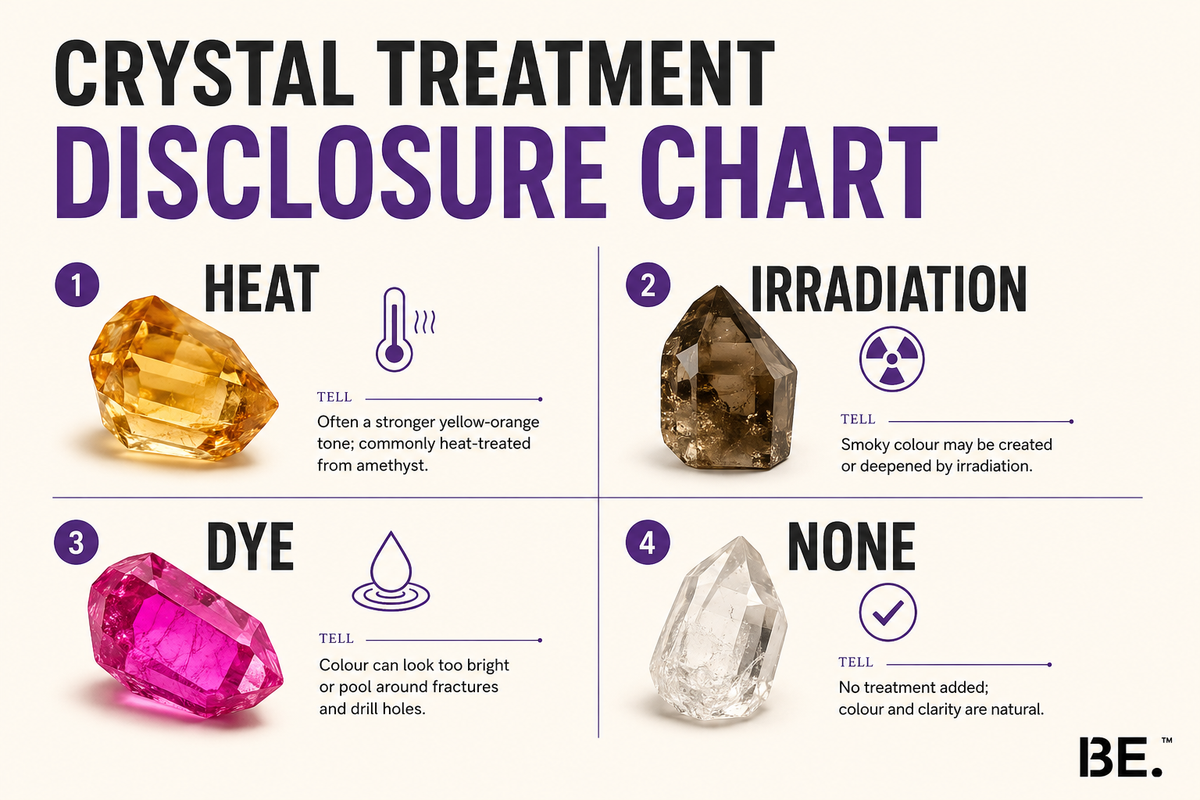
Treatment chart by stone
This chart describes material-level possibilities, not the treatment status of a BE. product. We use natural gemstones; processing and treatment details are disclosed on each product page.
| Stone | Common treatment | How to tell |
|---|---|---|
| Citrine | Often heated amethyst | Very even orange; reddish tint hints at heating. |
| Prasiolite (“green amethyst”) | Heated amethyst | Always pale leek-green; vivid green = dye. |
| Smoky Quartz | Sometimes irradiated | Even dark colour is not diagnostic. Ask whether irradiation was used and for qualified release/documentation; see the Smoky Quartz material guide. |
| Amethyst | Usually untreated; some dyed imitations | Subtle zoning natural; dye pools in cracks. |
| “Strawberry / cherry quartz” | Frequently dyed or glass | Flawless even colour, bubbles = manufactured. |
| Clear Quartz | Typically untreated | Colourless; coatings add unnatural rainbow sheen. |
| Rutilated Quartz | Typically untreated | Natural rutile needles; no colour added. |
| Hematoid Quartz | Typically untreated | Natural iron-oxide veils and phantoms. |
| Rose Quartz | Usually untreated | Soft cloudy pink is common, but saturation or uniformity alone cannot prove natural, dyed or untreated material. |
| Aquamarine | Often heated (greenish to blue) | Common, stable, should be disclosed. |
| Moonstone, Garnet, Obsidian, Kyanite | Generally untreated | Effects (glow, colour) are structural/natural. |
The four treatments, explained
- Heat. Continues a natural colour change — amethyst to citrine or prasiolite, greenish beryl to blue aquamarine. Stable and permanent; should be disclosed.
- Irradiation. Can create or deepen colour centres. A colour centre is not residual activity, but commercially irradiated gems require the applicable decay, survey and release controls. Appearance cannot replace documentation.
- Dye. Adds pigment from outside. The least desirable here — betrayed by over-even colour and dye in cracks. Common in cheap “bright” quartz.
- Coating. A surface film (e.g. “aura” quartz) producing metallic rainbow sheen. Surface-only and can wear; always a treatment, never natural.
Spotting treatment yourself
- Look for zoning. Subtle, uneven colour bands usually mean natural; flat uniform colour can mean dye or heavy treatment.
- Inspect cracks and holes. Pigment pooled there is a dye tell.
- Be sceptical of vivid + cheap. Intense colour at a low price rarely comes from nature.
- Check sheen. Metallic rainbow surfaces indicate coating.
- Ask for disclosure. A straight answer about heat, irradiation or dye is the mark of an honest seller.
How BE. handles treatment
BE. records any treatment on the Stone Origin Record that ships with each strand, alongside the mineral, hardness and source — the same transparency it applies under the Crystal 4T framework (Transparency, Tone, Texture, Treasure). Where a colour is natural, the card says so; where it results from heat, it says that too. The point isn’t to avoid all treatment — it’s to never hide it.
Frequently asked questions
Q1.Are most crystals treated?
It varies. Citrine is often heated amethyst, prasiolite is heated amethyst, and bright dyed quartz is common cheaply — but many quartz stones like clear, rutilated and hematoid quartz are typically untreated. Disclosure separates honest sellers.
Q2.Is heat treatment bad?
Not inherently. It is stable, permanent, and continues a change that can happen in nature. The issue is disclosure, not the treatment itself.
Q3.How can I tell if a crystal is dyed?
Dye shows as unnaturally vivid, perfectly even colour with pigment in cracks and around drill holes. Natural stones show subtle zoning. Cheap, saturated, uniform colour is the main warning sign.
Q4.Is irradiated smoky quartz safe?
A colour centre is not retained radioactivity. That does not make appearance a release certificate: commercially irradiated material should meet the applicable decay, survey and release requirements, and an uncertain object needs documentation or qualified measurement.
Q5.What does untreated mean?
The colour and clarity are as formed in nature — no heat, irradiation, dye or coating. Many quartz stones are attractive untreated, which is why honest untreated material is valued.
Q6.Why should treatment be disclosed?
It affects value, rarity and sometimes care, so disclosure lets you choose and compare fairly. A seller who records treatment is informing you, not hiding it.
References
- Gemstone Treatments — GIA
- Gemstone treatment — Wikipedia
- Mineral data — Mindat.org
- Nassau, K. (1984). Gemstone Enhancement. Butterworths.
- Rossman, G. R. (1994). Colored Varieties of the Silica Minerals, Reviews in Mineralogy 29.
Field Notes.
One stone at a time: its geology, and how to read quality. The Stone Buying Checklist comes with your first email.
By subscribing you agree to receive emails from BE. Unsubscribe anytime.
Sent. Check your inbox.