

Stone No. 01 · The Anchor series
Gold Sheen Obsidian
It set in one go, and that last movement is still in it.
- Mineral
- Obsidian, a natural volcanic glass
- Ideal formula
- Variable. A silica-rich glass with no fixed formula
- Crystal system and hardness
- Amorphous, Mohs about 5 to 5.5
- Origin
- Mexico
- Treatment
- Untreated. No heating, dyeing, coating or irradiation.
Gold Sheen Obsidian
Pieces in this stone.
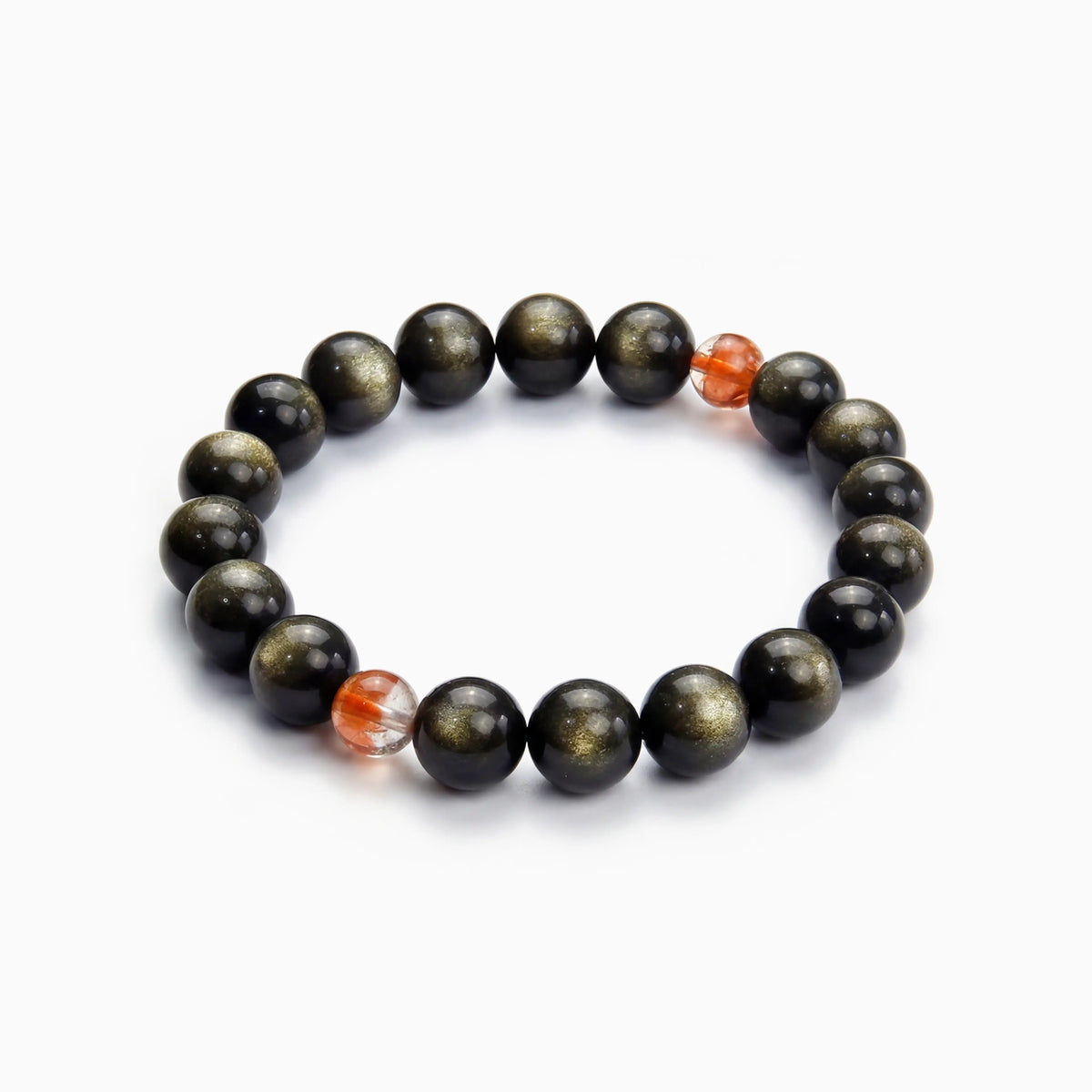
Three gold sheen obsidian strand bracelets, in 8mm and 10mm beads, from $250. The gold sheen obsidian is from Mexico and untreated: the gold is light reflecting off flat layers inside the glass, not a surface coating, and every piece ships with a Stone Origin Record. At Mohs 5 to 5.5 it is softer and more brittle than quartz; a hard knock leaves a sharp chip.



On this page
How it formed
Since late in the Miocene or early in the Pliocene, five million years ago or a little more, a belt of volcanoes has run east to west across central Mexico, fed by ocean plates sinking beneath the continent. In one of its eruptions, a body of molten rock rich in silica rose towards the surface. By about 3.3 million years ago, while volcanoes here were still erupting, early humans in East Africa were making the first stone tools we know of.
The melt carried small pockets of gas, and patches of a second glass with a slightly different make-up. When the lava flowed out over the ground, it drew those pockets and patches into thin, flat lenses, all lying the same way.
Then it cooled. Lava that meets cold ground and open air loses heat fast, and its atoms had no time to line up into crystals. They stayed in the disordered arrangement of a liquid, and the flow set as black glass, in days or in years depending on its size. The lenses set with it, still lying the way the lava last moved.
In 2001 Chi Ma, George Rossman and three colleagues looked at Mexican sheen obsidian under electron beams. Many of the flat lenses turned out to be a second glass, with a little less silica than the glass around it. The two glasses bend light by different amounts, and light is thrown back where they meet. That difference, they proposed, makes the sheen. They thought the second glass probably came from bits of older volcanic ash or tuff that the melt had taken in and melted again.
The glass then lay in the ground. Over geological time obsidian can slowly begin to crystallise and lose its glassy structure, so the pieces dug out as glass today are ones that kept it.
People were working obsidian long before anyone looked at its sheen. Struck, it breaks with a curved, shell-like fracture and a sharp edge. At Cerro de las Navajas in Hidalgo, people of central Mexico dug it from open pits and underground workings from the Early Formative period into colonial times, and the Teotihuacan, Toltec and Aztec states each refined the mines.
To make a bead, a cutter grinds a piece of the glass into a sphere and polishes it. Obsidian is about 5 to 5.5 on the Mohs scale and brittle, so a hard knock leaves a sharp-edged chip. On a sphere the lenses meet the surface at many angles, so under one lamp a bead can shine gold on one side and stay black on the other.
How to look at yours
In soft, even light the beads look black. Under a single lamp or in direct sun, a patch of gold appears on part of a bead and slides across it as the wrist turns. The gold is light thrown back by the flat lenses inside the glass, the ones the lava drew out as it flowed.
The gold sheen obsidian in our strands comes from Mexico and is untreated. Each strand comes with a Stone Origin Record.
One way to read it
One way to read this: volcanologists read obsidian as melt that cooled faster than most crystals could form. It set as glass in one event, and in studied Mexican sheen obsidian the golden flash comes from small structures lined up along the direction the melt was flowing when it stopped. It set in one go, and that last movement is still in it.
Chosen weight. The meaning is yours.
Gold Sheen Obsidian: questions before you buy
Is gold sheen obsidian natural, or coated?
Ours is natural and untreated. The gold is not on the surface: it is light reflected from thin, flat layers inside the glass, many of them a second glass, drawn out in one direction as the lava flowed. A coating would wear off and look the same from every angle; the sheen moves as you turn the bead.
Does gold sheen obsidian break easily?
More easily than quartz. Obsidian is natural glass, about 5 to 5.5 on the Mohs scale, and brittle, so a hard knock leaves a sharp-edged chip and harder stones can scratch it. Take it off for sport and heavy work, store it in its own pouch, and clean it with a soft damp cloth.
What is the difference between gold sheen and other obsidian?
What the light catches inside. Black obsidian shows no visible inclusions. Gold sheen and silver sheen obsidian hold flat, aligned layers that throw back gold or silver light. Rainbow obsidian shows coloured bands, snowflake obsidian has white patches of crystals, and mahogany obsidian is streaked red-brown. All of them are natural volcanic glass.
Which gold sheen obsidian bracelet should I choose?
Choose the gold sheen obsidian strand for black all round, with the gold flash moving across every bead; it comes in two bead sizes. Choose the hematoid strand for obsidian with warm red-gold quartz focal beads, or the kyanite strand for obsidian with blue focal beads. All three use obsidian from Mexico.
Stone Explorer
Compare obsidian varieties
Gold sheen beside black, snowflake, mahogany, silver sheen and rainbow.
OPEN THE OBSIDIAN EXPLORER →Care guide
How to care for your gold sheen obsidian
Cleaning, storage and everyday wear.
READ THE CARE GUIDE →From the Journal