
Real vs Fake Obsidian: Natural Glass vs Manufactured Glass
Obsidian is natural volcanic glass, so manufactured black glass can share its shine, fracture, bubbles and feel. This evidence ladder separates useful screening clues from claims that need laboratory testing.
In this field note
The phrase “real Obsidian or glass” begins with a category mistake. Obsidian is glass. The meaningful comparison is between glass produced by a geological cooling event and glass produced by people to imitate or resemble it.
That distinction explains why familiar home-test lists fail. A glassy lustre, a curved fracture and a cool, solid feel can be genuine observations while remaining shared properties. The useful question is not which trick gives a verdict, but which evidence layer is strong enough for the claim being made.
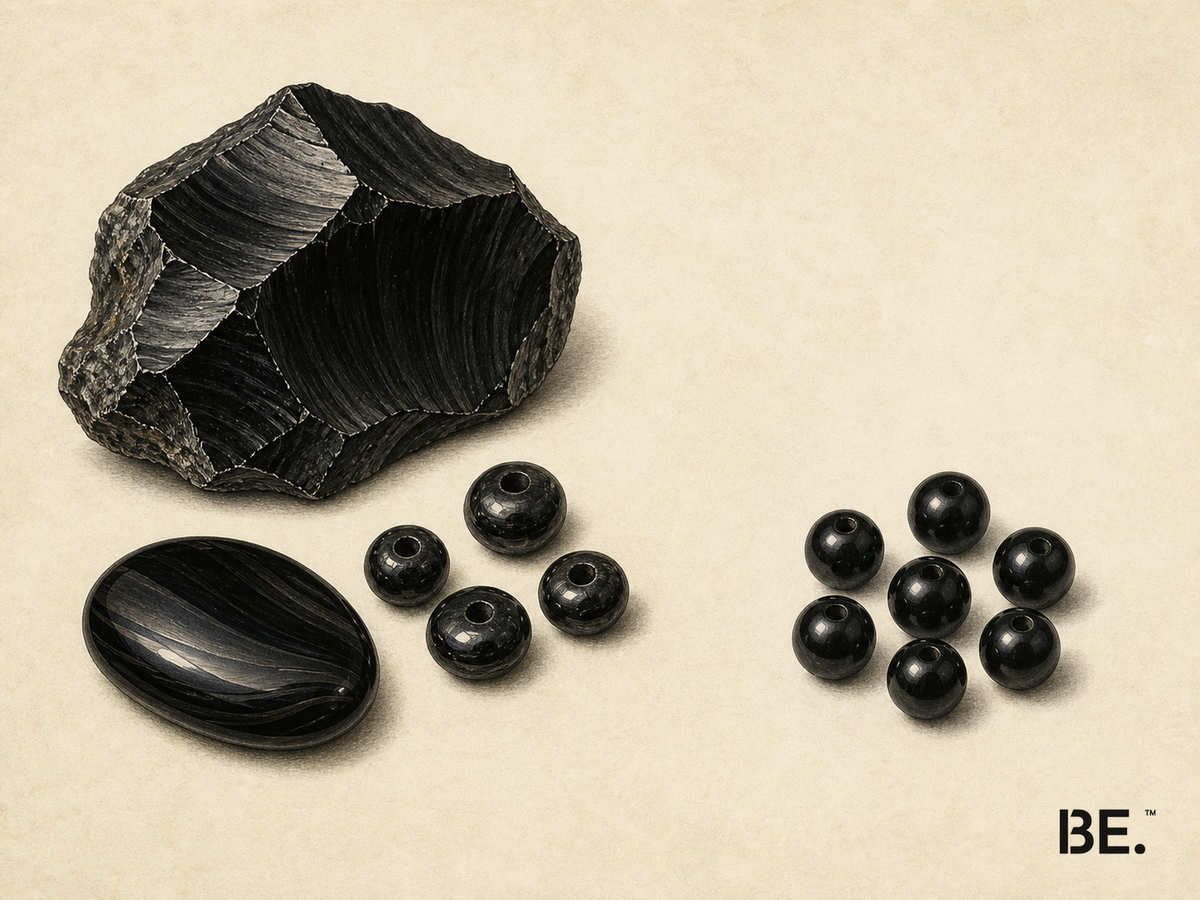
Why is this glass testing glass?
USGS defines Obsidian as volcanic glass. Silica-rich melt cools rapidly enough that an ordinary crystalline texture does not develop, leaving an amorphous solid. It can break with conchoidal, shell-like surfaces because it is glass, not because it passed a separate “real stone” test.
Natural Obsidian names geological origin. Manufactured glass imitation or simulant describes glass used to resemble the natural material. GIA reserves synthetic terminology for a manmade counterpart with essentially the same defining material as its natural equivalent; “synthetic Obsidian” is therefore not a precise catch-all for every black-glass imitation.
Natural and manufactured glasses can overlap in colour, shine, hardness behaviour and internal appearance. A peer-reviewed 2023 study reported no visible appearance difference between its black Obsidian and artificial black-glass samples. That result belongs to the studied samples and methods, but it establishes the central limit: appearance alone can leave the two possibilities unresolved.
Which home clues can screen Obsidian?
Non-destructive observation can document inconsistencies, narrow alternatives and improve the question asked of a seller. It does not convert a bracelet into a laboratory specimen or turn a probabilistic clue into proof.
| Clue | What it may support | What it cannot prove | Damage risk |
|---|---|---|---|
| Multi-angle surface light | Gloss, polish, pits, flow-like structure and surface-reaching fractures | Natural origin, treatment or locality | None under ordinary safe light |
| Transmitted light at a thin edge | Colour transmission and internal distribution worth documenting | A universal natural/manufactured verdict from colour alone | Avoid intense heat or unsafe light sources |
| Bubbles and internal features | Shape, alignment and distribution for a wider comparison | “Bubble equals fake” or “inclusion equals natural” | None when only observed |
| Mould seams or strong repetition | How a finished object may have been formed or mass-produced | The geological origin of the raw glass; natural material can also be shaped | None when only observed |
| Drill holes and polish | Workmanship, coatings, chips and where features meet the surface | Natural versus manufactured glass by itself | None when only observed |
| Seller disclosure | Whether natural volcanic glass, imitation, treatment and claimed locality are stated separately | That an unsupported statement is correct | None; preserve the record |
Use a neutral background, compare several beads rather than a single favourable view and keep the lighting repeatable. A feature that appears only in one heavily edited listing image is weaker evidence than the same feature visible across multiple angles of the actual object.
Which tests do not prove natural Obsidian?
Bubbles, lustre and fracture
Natural Obsidian can contain gas-related features, glassy inclusions and mineral crystals. Manufactured glass can contain bubbles and flow features too. Shape, orientation and association can matter under microscopy, but the simplified rule “bubbles mean fake” discards real natural possibilities.
Glassy lustre and conchoidal fracture identify a glass-like physical response; they do not state who or what made the glass. A polished imitation may be glossy, while a weathered natural surface may be dull. Fracture is also a poor home procedure because deliberately breaking an object damages it and still does not establish origin.
Cold feel, weight, scratches and UV
Glass often feels cooler than plastic at first contact because of heat transfer, but natural Obsidian and manufactured glass share that category. Room temperature, object mass, bead diameter, mounting and how long it is held all change the sensation. Heft can likewise screen some low-density resins without reliably separating two glasses.
A scratch result is not a natural-origin test. Manufactured glass may overlap Obsidian, contact angle and pressure are uncontrolled, and a finished bead can be permanently marked. Flame, hot needles, solvents, freezing, boiling and thermal shock add damage without solving the glass-versus-glass problem.
UV response cannot establish natural Obsidian on its own. Fluorescence, when present, is a material-specific clue that needs interpretation beside other evidence, not a green-light/red-light authenticity switch.
What separates natural from manufactured glass more reliably?
A qualified laboratory can choose methods around the actual question and sample. Microscopy can examine feature shape and relationships. Infrared spectroscopy can compare structural or molecular signatures. X-ray fluorescence can record elemental composition. No method name is a consumer guarantee on its own; the value lies in the tested object, analytical conditions, comparison data and final conclusion.
The 2023 black-glass study used infrared and XRF evidence and also tested transmitted source-light colour. In its samples, particular colour changes supported artificial black glass, while unchanged colour made Obsidian more likely. “More likely” is the necessary wording. The finding is a sample-bounded screening clue, not a universal torch test and not a substitute for the instrumental evidence used in the study.
Material identity and geological provenance are separate questions. Chemical characterisation methods such as XRF and neutron activation analysis have long been used to compare archaeological Obsidian with source groups. A natural-glass conclusion does not automatically name a volcano or mine; a proposed locality needs its own comparative evidence and chain of documentation.
Read a report for what it actually says: natural or manufactured, material identity, any detectable treatment, whether source attribution was attempted and which limitations apply. A laboratory report on one bead does not certify every object in an unrelated lot.
An evidence-first Obsidian buying checklist
- Require an exact material name. “Natural Obsidian” or “natural volcanic glass” is testable language; “black crystal” is not.
- Separate imitation and treatment. Ask whether manufactured glass, coating, dye, filling or composite construction is present.
- Match provenance evidence to the premium. A named locality needs more than a story when it materially raises the price.
- Request actual-piece views. Compare front light, thin-edge transmitted light, drill holes, surfaces and repeated patterns across several angles.
- Avoid destructive shortcuts. Do not scratch, burn, freeze, boil or apply chemicals to finished jewellery.
- Escalate when the distinction matters. Use an independent gemmological laboratory when natural origin, provenance or value changes the decision.
Evidence should rise with the consequence of error. An inexpensive design bought for appearance may need precise seller disclosure and good actual-piece images. A premium attached to natural origin or named provenance warrants stronger independent support.
Where this guide stops
This page addresses natural Obsidian versus manufactured glass only. The Obsidian guide covers formation, varieties, origin language, grading and care. The black-bead identification guide separates Obsidian from Onyx, Tourmaline and glass as a four-material problem. The real-vs-fake crystal guide maps the wider imitation families.
That boundary matters. A correct natural-versus-manufactured glass discussion cannot identify every black bead, and a four-way visual shortlist cannot replace laboratory evidence for the origin of two visually similar glasses.
Frequently asked questions
Q1.Is Obsidian a glass or a crystal?
Obsidian is natural volcanic glass: an amorphous solid produced when silica-rich melt cools rapidly. It is not a mineral crystal, even though shops and search queries often group it with “crystals”.
Q2.Do bubbles prove that Obsidian is fake?
No. Natural Obsidian can contain gas-related features, and manufactured glass can contain bubbles too. Their shape and distribution may support a wider assessment, but a bubble alone does not establish origin.
Q3.Does a scratch test prove that Obsidian is real?
No. Manufactured glass can overlap Obsidian in scratch behaviour, and the test can permanently damage finished jewellery. Use non-destructive evidence first and a laboratory when natural origin matters.
Q4.Does real Obsidian feel colder or heavier than fake Obsidian?
Cold feel or heft may help screen some plastic or resin imitations, but they do not reliably separate natural Obsidian from manufactured glass. Room temperature, bead size and construction also change the result.
Q5.Can transmitted-light colour identify real Obsidian?
A 2023 study found that certain colour changes in the transmitted source light supported artificial black glass in its samples, while unchanged colour made Obsidian more likely. Treat this as a sample-bounded screening clue, not universal proof.
Q6.When is laboratory testing necessary for Obsidian?
Use a qualified gemmological laboratory when natural origin, provenance or price depends on the distinction. A laboratory may combine microscopy, infrared and elemental analysis; read the report for its exact conclusion and limitations.
References
- USGS: Obsidian definition
- American Museum of Natural History: Obsidian
- GIA: Phenomenal Gemstones: Obsidian structure and natural features
- Journal of Gems & Gemmology: A Quick Method to Distinguish Obsidian from Artificial Black Glass
- GIA: Gem imitations
- Nature: Obsidian provenance determination by back-scattered electron imaging
- Journal of Archaeological Science: Portable XRF Obsidian characterisation
- Advances in X-Ray Analysis: Investigation of Obsidian by X-ray fluorescence
Field Notes.
One stone at a time: its geology, and how to read quality. The Stone Buying Checklist comes with your first email.
By subscribing you agree to receive emails from BE. Unsubscribe anytime.
Sent. Check your inbox.