
Real vs Fake Garnet: How to Check Without Damaging the Stone
A material-first guide to screening garnet without damage: what colour, bubbles, UV and magnet response can suggest, where each clue fails, and how a gem laboratory confirms identity.
In this field note
“Real versus fake garnet” sounds like one question, but it can hide several different disputes. A stone may be natural garnet with the wrong species name. It may be glass or another material sold as garnet. It may also be an assembled stone containing both natural garnet and manufactured glass. Each possibility asks for different evidence.
This guide keeps observation separate from conclusion. What you can see at home may help decide whether a claim deserves more scrutiny; it does not turn a loupe, UV torch or magnet into a laboratory.
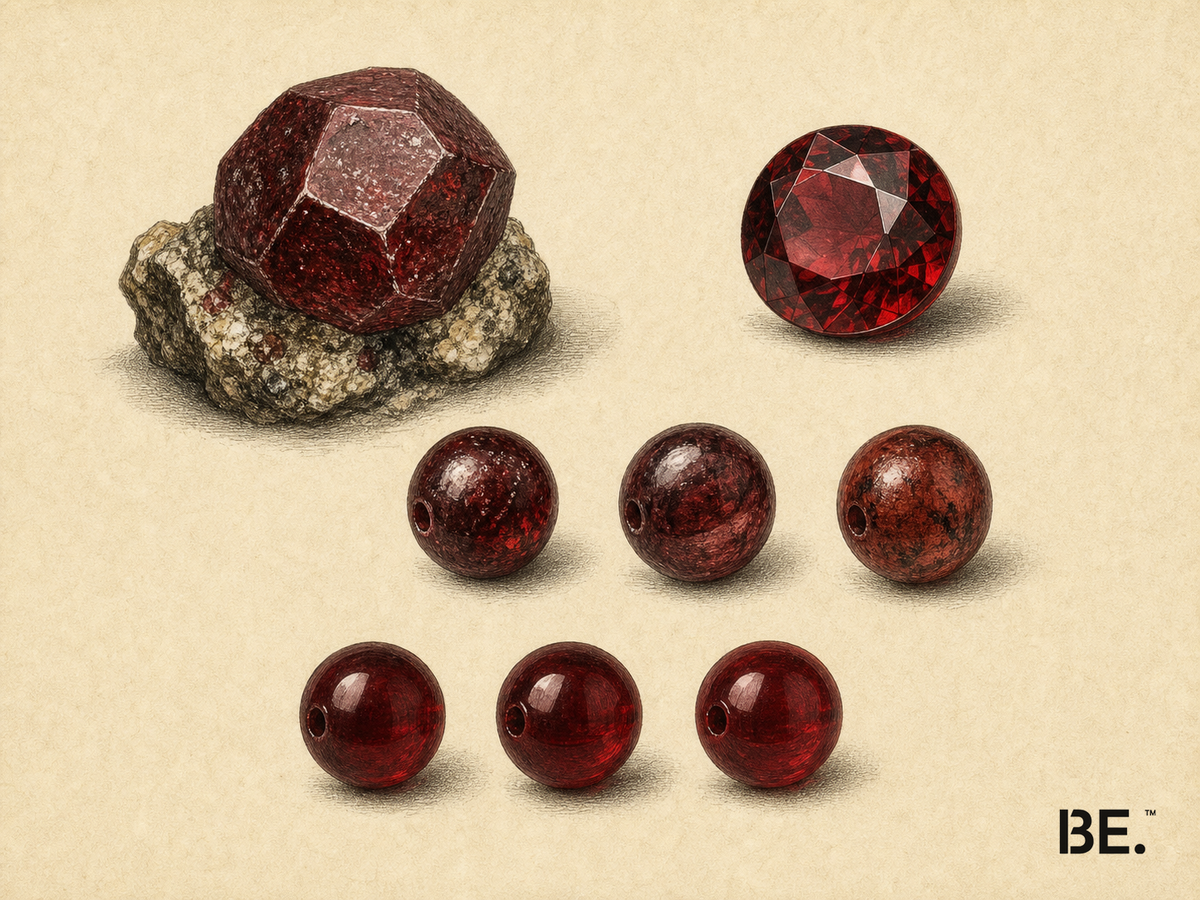
First define what “fake garnet” means
A natural stone can still carry the wrong claim
Garnet is a group of closely related minerals, not one uniform red substance. GIA lists garnets across essentially the full colour range and records broad group properties: refractive index from 1.714 to 1.888, specific gravity from 3.47 to 4.15 and Mohs hardness from 6.5 to 7.5. Many gem garnets are chemical mixtures between end-members.
A natural garnet therefore does not automatically validate every label attached to it. “Rhodolite”, “demantoid”, a named mine, a treatment statement and a quality grade are separate claims. Colour can make one candidate plausible, but colour alone cannot establish species, variety, locality, treatment history or value. For those wider mineral-family questions, use the Garnet Guide. This page examines how much evidence an identification claim actually has.
Simulants, garnet-like materials and composites
A simulant resembles garnet but has different chemistry, crystal structure or properties. Manufactured glass is a familiar example, but the alternative could also be another natural or laboratory-made gem material. “Looks like garnet” is a description of appearance, not a material name.
Terminology matters around laboratory-grown materials. GIA notes that YAG, GGG, LuAG and GAGG have garnet-like crystal structures but do not have the chemistry of garnets known in nature. They should be named precisely rather than presented as laboratory-grown counterparts of an ordinary natural garnet species.
A composite creates a different problem. In a garnet-and-glass doublet, a thin natural garnet portion can sit above a larger glass body. Surface observations may encounter genuine garnet while missing the glass below. The correct description is not simply “real” or “fake”; it is an assembled object whose components should be disclosed.
A safe first screen before any instrument test
Start with the claim and its paperwork
The lowest-risk test is documentary. Read the exact material name on the listing and invoice. Check whether a report identifies only the material or also comments on natural origin, treatment, species, variety or geographic origin. Record whether the report number can be verified and whether the seller offers a practical return route.
- Material: does the description say garnet, a named species or only a colour-based trade phrase?
- Construction: is any doublet, coating, filling or assembled structure disclosed?
- Scope: does a laboratory conclusion cover the exact object being sold?
- Provenance: is locality documented, or merely suggested by colour and storytelling?
- Remedy: can the item be returned if independent testing contradicts the description?
Use a loupe to find questions, not to issue a verdict
Under neutral light and diffuse transmitted light, inspect the profile, girdle, drill hole and any surface-reaching feature with a clean 10× loupe. A smooth spherical feature, glass-like flow, a mould seam, a coating edge or a plane where optical appearance changes can justify closer examination. In a strand, compare repeated features across several beads rather than selecting the one bead that fits the preferred answer.
Context is decisive. GIA has documented devitrified glass containing needle-like crystals that resembled the prized “horsetail” scene associated with demantoid garnet. It has also documented a garnet-glass doublet in which natural inclusions in the garnet top masked gas bubbles in the glass beneath. Inclusions can support an interpretation when their identity and setting are understood; their presence alone does not prove a wholly natural stone.
What popular garnet tests can and cannot show
| Observation or test | What it may contribute | What it cannot establish alone |
|---|---|---|
| Colour | Describes hue, tone, saturation and possible comparison candidates | Garnet identity, species, natural origin, locality or treatment |
| Transparency | Describes the individual stone and may affect value or design | “Clear means fake” or “dark means real”; some red garnets can be eye-clean |
| Bubbles, flow or a join | Can raise suspicion of glass or an assembled object when the features form a coherent scene | That the whole object is glass, or that one round-looking feature has been identified correctly |
| UV reaction | May help compare a defined candidate under recorded LWUV or SWUV conditions | A universal garnet verdict; documented garnet reactions vary with composition |
| Magnet response | A quantitative susceptibility measurement can add compositional evidence when combined with RI or SG | That a simple attraction, movement or lack of movement proves identity |
| Single-refraction observation | Optical character can form part of standard gemmological testing | Natural origin, species or identity from an improvised facet-doubling check |
| Temperature or a photograph | Records a subjective comparison or visible surface appearance | A garnet-specific threshold, internal structure or laboratory conclusion |
Why UV and magnet claims need controls
Some documented garnets are inert under long-wave and short-wave UV, but that is not a rule for every composition. GIA has also reported grossular examples with weak-to-moderate fluorescence and a Lindi garnet that reacted to UV. The lamp wavelength, observation conditions and alternative material all matter. “It glows” or “it stays dark” is a clue, not authentication.
Magnetic behaviour is similarly easy to oversimplify. Published GIA research uses measured magnetic susceptibility and combines it with refractive index or specific gravity to infer garnet composition. It does not reduce the method to “a magnet moved it, so it is garnet”. A visible response depends on the material, mass, shape, magnet, suspension and test geometry, while other materials also respond to magnetic fields.
Do not scratch, heat, boil or chemically test jewellery
Mohs hardness describes resistance to scratching, not identity by itself. Garnet spans a range, glass compositions vary, and a surface test can damage polish, a facet edge, a bead hole, a setting or an adjacent material. It also cannot establish species, natural origin or whether an object is a doublet.
Flame, a hot needle, boiling water and chemicals add heat, fumes, thermal shock and construction risk. Resin, adhesives, coatings, thread and metal finishes may fail before the stone tells you anything useful. Do not use them, even on a hidden spot.
Why garnet has no single home-test threshold
| Property | GIA group range or behaviour | Interpretation boundary |
|---|---|---|
| Refractive index | 1.714–1.888 | A broad range requiring a proper measurement and comparison with alternatives |
| Specific gravity | 3.47–4.15 | Cannot be replaced by judging the heft of a mounted piece or elastic strand |
| Birefringence | None as the ordinary group baseline | Optical character belongs in controlled gemmological interpretation |
| Mohs hardness | 6.5–7.5 | Useful for care context, not a recommended authentication scratch test |
| Colour | All colours across the group | No red-only rule and no species or locality verdict by eye |
The ranges are the reason a combination matters. One RI reading may support a garnet candidate, but garnet classification can also use colour and absorption spectrum, while complex mixtures may need additional evidence. One specific-gravity value does not tell a consumer which mine produced a stone. A microscopy scene cannot be detached from the measured host material.
How a laboratory builds a defensible result
The standard gemmological set
A laboratory chooses tests for the object and the question. For a loose transparent stone, the sequence may include refractive index, optical character, hydrostatic specific gravity, microscopic examination and an absorption spectrum. These measurements are compared as one pattern. A pink pyrope case published by GIA, for example, combined single refraction, RI, SG, microscopic needles and chemical data rather than relying on its colour.
Mounted stones and drilled beads may restrict some measurements. That limitation should appear in the conclusion, not be hidden by greater confidence. “Consistent with garnet” and a precise garnet classification are also different levels of answer.
When advanced analysis is appropriate
Raman spectroscopy can help identify mineral or glass phases. FTIR can distinguish characteristic glass or other material responses in suitable cases. Chemical analysis may help classify a complex garnet mixture. The exact method depends on which alternatives remain open; no instrument name should be treated as a universal stamp of natural origin or locality.
Report scope matters after testing. A report that identifies garnet does not automatically confirm a seller's named mine. A report that finds natural garnet in the crown does not make an undisclosed glass pavilion irrelevant. Read the conclusion line by line.
A practical buying protocol
| Claim or purchase | Minimum sensible evidence | Escalate when |
|---|---|---|
| Ordinary garnet bead or strand | Exact material disclosure, clear close views, construction details and a workable return policy | Visual features conflict with the description or the price depends on a precise variety |
| Named garnet species or variety | Seller documentation tied to the item or lot | The name carries a meaningful premium or cannot be supported by standard properties |
| Antique or possible composite | Profile and microscopic examination that considers joins and mixed components | Surface tests and internal scenes disagree |
| Rare colour, stated origin, resale or insurance | Independent laboratory report with the relevant field explicitly addressed | The conclusion is qualified, the setting limits testing or locality remains outside scope |
The aim is not to turn every affordable garnet into a laboratory project. It is to match the evidence to the claim. A modest strand needs honest naming, sound workmanship and a fair remedy. A rare variety or origin premium needs independent support before the story becomes part of the price.
Frequently asked questions
Q1. What does “fake garnet” actually mean?
It can mean glass or another material sold as garnet, a composite such as a garnet-and-glass doublet, or a natural garnet carrying an unsupported species, origin, or quality claim. Define the claim before choosing a test.
Q2. Can garnet colour or clarity prove identity?
No. Garnet is a mineral group with a wide colour and property range, and some red garnets can be eye-clean. Colour and clarity help describe a stone, but they do not establish material, species, natural origin, or locality.
Q3. Is one round bubble enough to reject a garnet?
A smooth spherical bubble can raise suspicion of manufactured glass, especially when it appears with flow or a join, but context matters. A garnet-glass doublet can contain natural garnet above glass, so a laboratory or careful microscopic examination may be needed to identify the whole object.
Q4. Do magnet or UV responses authenticate garnet?
No. Quantitative magnetic susceptibility can support garnet classification when combined with refractive index or specific gravity, while a simple attraction test is not unique. UV reactions also vary with composition and alternative materials.
Q5. Which home tests should I avoid?
Do not scratch the stone or another surface, and do not use flame, a hot needle, boiling water, or chemicals. These methods can damage the stone, polish, drill hole, setting, or thread and still cannot provide a complete identification.
Q6. What evidence can distinguish garnet from glass or a doublet?
A gem laboratory combines refractive index, optical character, specific gravity, microscopy, and an absorption spectrum as appropriate. Raman, FTIR, or chemical analysis may be added when glass, a composite, or a precise garnet classification remains in question.
References
- Gemological Institute of America: Garnet
- Gems & Gemology: A Proposed New Classification for Gem-Quality Garnets
- Gems & Gemology: Pink Pyrope Garnet
- Gems & Gemology: Determining Garnet Composition from Magnetic Susceptibility and Other Properties
- Gems & Gemology: Wollastonite in Devitrified Glass Imitating Horsetail Inclusions in Demantoid Garnet
- Gems & Gemology: A Red Herring in a Red Garnet
- Gems & Gemology: Bohemian Garnets as Decorative Materials for Glass Vessels
- Gems & Gemology: Luminescent Synthetic Garnet-Like Crystals
- Gems & Gemology: Pyrope-Spessartine Color-Change Garnet
- Gems & Gemology: Grossular Fluorescence Case
- Gems & Gemology: Beyond Beauty: A Garnet Necklace Decoded
- Gemological Institute of America: An Introduction to Imitation Diamonds & Other Gems
Field Notes.
One stone at a time: its geology, and how to read quality. The Stone Buying Checklist comes with your first email.
By subscribing you agree to receive emails from BE. Unsubscribe anytime.
Sent. Check your inbox.