
Crystals Are Not Magic — They Are Geology
A science-first reframe of crystals as geology — how they form, what they actually do, and why the mineralogy is more interesting than the metaphysics.
In this field note
Walk into most stone shops and the first thing you see is a sign telling you which crystals do what. Rose quartz for love, amethyst for calm, citrine for wealth. The taxonomy is comforting and easy to remember, and it has nothing to do with where any of those stones came from. Strip it away and what remains is more interesting, not less: a quartz crystal is a record of hot silica-bearing water that found a hollow space in granite, sometimes a billion years ago, and grew itself into a lattice atom by atom.
This is the case for treating crystals as geology rather than metaphysics. Not because the science is more poetic — although it often is — but because the science is the part of the story that is actually true.
What a crystal actually is
A crystal is defined by three things in combination: composition (which atoms it contains), structure (how those atoms are arranged), and symmetry (the geometric rules that pattern repeats by). Quartz, for example, is silicon dioxide — SiO2 — with each silicon atom bonded to four oxygens in a tetrahedron, and those tetrahedra linked into a helical three-dimensional framework that belongs to the trigonal crystal system.
That triple definition is strict. Glass has the same chemistry as quartz but no repeating lattice, which is why glass is not a crystal. Diamond and graphite have the same chemistry as each other — both are pure carbon — but different lattices, which is why one is the hardest natural material on Earth and the other comes off on a pencil. Composition tells you what the atoms are; structure tells you how the substance behaves.
The visible faces of a natural crystal are not decoration. They are the outward expression of the internal lattice: each face corresponds to a plane through the atomic arrangement that grew more slowly than its neighbours. When you look at a quartz point and see six sides meeting at six points around a hexagonal pyramid, you are seeing the trigonal lattice projected outward. The geometry is not chosen by the crystal. It is the only geometry the chemistry allows.
The four ways crystals form
Almost every crystal you have ever held came out of one of four geological processes. The path it took is usually visible in the texture of the rock it grew in, and often visible in the crystal itself.
Igneous. Crystals that grew directly from cooling molten rock. Quartz, feldspar, olivine, mica, topaz — the bulk of the planet’s crustal minerals form this way. Slow cooling deep underground gives large, well-formed crystals (granite, pegmatite). Fast cooling at the surface gives glass or fine-grained rocks with no visible crystals (basalt, obsidian).
Metamorphic. Crystals that grew or recrystallised under heat and pressure, without melting. Garnet, kyanite, sillimanite, staurolite. Metamorphic crystals often have unusual shapes — garnet’s twelve-sided dodecahedra, kyanite’s blade-like blue tablets — because they grew while squeezed into pre-existing rock rather than freely in a melt.
Sedimentary. Crystals that precipitated out of water at low temperatures, often inside cavities in older rocks. Turquoise, malachite, opal, chalcedony, gypsum. These tend to form thin layers, banded crusts or massive replacements rather than dramatic single crystals.
Hydrothermal. Crystals that grew from hot, mineral-saturated water moving through cracks and cavities. This is where most of the spectacular stuff comes from: amethyst, clear quartz, fluorite, calcite, the interior linings of geodes. Hydrothermal growth is slow, often over millions of years, and produces clean, transparent crystals because the water deposits one ion at a time onto a growing face.
| Formation path | What is happening | Typical minerals |
|---|---|---|
| Igneous | Crystals grow from cooling molten rock | Quartz, feldspar, olivine, topaz, mica |
| Metamorphic | Crystals grow / recrystallise under heat & pressure | Garnet, kyanite, sillimanite, staurolite |
| Sedimentary | Crystals precipitate from water at the surface | Turquoise, malachite, opal, chalcedony |
| Hydrothermal | Crystals grow from hot mineral-saturated fluids | Amethyst, clear quartz, fluorite, calcite |
The one thing crystals actually do
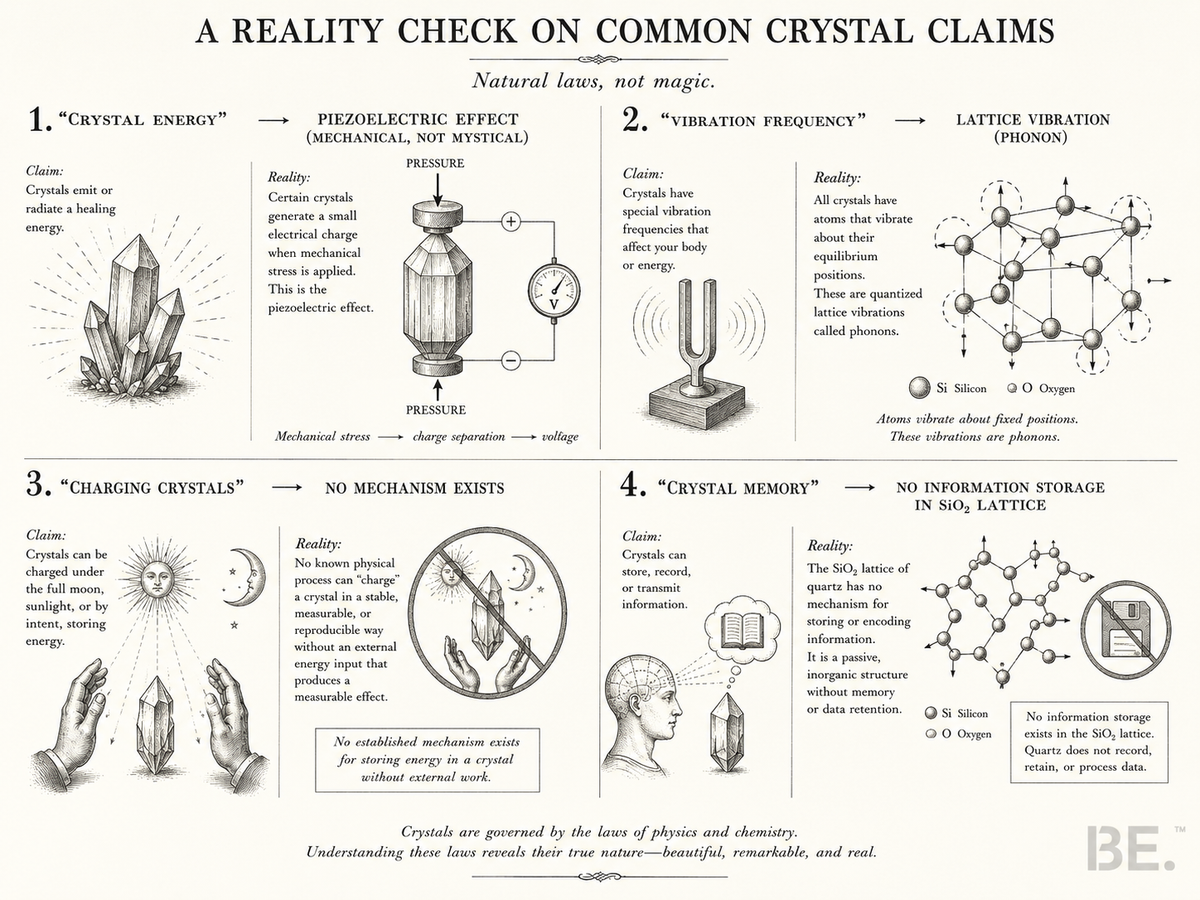
The piezoelectric effect is real, and quartz is the textbook example. Squeeze a quartz crystal along certain axes and it produces a tiny voltage; apply a tiny voltage and it deforms by a tiny, precisely controllable amount. The reason is the same lattice geometry that gives quartz its hexagonal faces: the silicon-oxygen tetrahedra are arranged in a way that has no centre of symmetry, so mechanical stress redistributes the internal charges instead of cancelling them out.
This is why almost every wristwatch made since the 1970s has a quartz crystal inside it. A small chip of cultured quartz, cut along a specific axis and held between electrodes, vibrates at a steady 32,768 times per second when a voltage is applied. The watch divides that frequency down to one tick per second. The crystal is not doing anything mystical; it is doing the only thing its lattice is designed to do, and doing it accurately enough that quartz watches keep time to within seconds per month.
The same property turns sonar transducers, lab microbalances, fuel injection sensors and ultrasound probes into instruments. It is one of the most useful natural phenomena modern engineering depends on. It is also entirely directional and entirely measurable: piezoelectricity is what crystals demonstrably do, not a placeholder word for whatever you want them to do.
What the science does not say
It is worth being honest about what mineralogy does and does not have evidence for. There is no measurable mechanism by which a crystal worn on the wrist transmits a physical effect to the brain or body. Controlled studies attempting to test such effects — most famously a 2001 placebo-controlled experiment by psychologist Christopher French at Goldsmiths — have consistently found that real quartz and fake glass crystals produce indistinguishable subjective experiences in participants. What participants feel is real to them; the cause is not the stone.
This does not mean the experience of wearing a stone is fake. It means the explanation lies in the wearer rather than in the lattice. A material object that you handle every day, that has a story you can tell, that connects you to a place you have never been — that is doing real work in the way humans build meaning. It just is not doing the work through the crystal lattice.
The reframe matters because it changes what you are paying for and what you are paying attention to. If a stone’s value is geological, then provenance, formation history and structural quality are the things to learn. If a stone’s value is metaphysical, those things are irrelevant and you are at the mercy of whoever wrote the sign next to the bin.
Why geology is the better story anyway
The standard metaphysical catalogue assigns each stone a static meaning: a quality, a chakra, an intention. It is closed; the work is done before you arrive. The geological story is open and specific: an amethyst from the Anahí mine in Bolivia formed in a particular fold of Cambrian limestone, deep enough to trap iron, near enough to radioactive country rock to develop its colour, then exposed by a particular sequence of tectonic events that brought it to a depth a mining operation could reach. That stone is unrepeatable and locatable. It came from one place, on one schedule, by one mechanism, and the surface of it carries the fingerprint of that history.
Learning to read those fingerprints — the inclusion patterns that tell you about temperature, the growth zones that record fluid composition, the trace elements that pin down a source region — is more rewarding than memorising a catalogue of correspondences. It is also more durable. The geology will not change next time someone updates the dictionary.
How BE. approaches the stones
BE. works on the assumption that the most interesting thing about any stone is where it came from and how it formed. Every strand is graded against the Crystal 4T framework — Transparency, Tone, Texture and Treasure — calibrated to the stone’s mineralogy, and ships with a Stone Origin Record recording source region, formation path and the structural features that earned it a place on the cord. No claims about what the stone does to you. The lattice does enough by being what it is.
Frequently asked questions
Q1.What is the difference between a crystal and a mineral?
A mineral is a naturally occurring inorganic solid with a defined chemical composition and crystal structure. A crystal is a single individual of that mineral, with the lattice expressed as visible faces. Most minerals form crystals; crystals are how minerals look when they have room to grow.
Q2.Are crystals piezoelectric?
Some are. Quartz, tourmaline and topaz are notable examples. The effect requires a lattice that lacks a centre of symmetry, which most crystals do not have. Where it exists, the effect is small but real and is widely used in electronics.
Q3.Do crystals have measurable physical effects on the body?
Controlled studies have not been able to distinguish real crystals from convincing fakes in their effects on participants. What people feel is real to them; the mechanism is in the wearer, not the lattice.
Q4.If crystals do not do what people say, why wear them?
The same reason people wear gold or pearls or hand-thrown ceramics: the material is interesting in its own right, the object has a story, and the act of wearing it is a small daily choice that means something. None of that requires a metaphysical claim.
Q5.Is a stone’s price related to its rarity?
Often, but not always. Geological scarcity, gem-quality colour, transparency and size all push price up. Marketing and fashion push it up further, sometimes well past the geology. Knowing the mineralogy is the best defence against paying for hype.
Q6.How can I tell where a stone came from?
For most species, source region leaves visible fingerprints: inclusion patterns, colour zoning, trace-element signatures. A good dealer should be able to tell you which deposit a stone came from and what features make that source recognisable.
References
- Mindat — Quartz data & piezoelectric properties
- Wikipedia — Crystal (definition, formation, lattice)
- GIA Gem Encyclopedia — Mineral formation overview
- Wikipedia — Piezoelectricity (quartz, applications)
- Klein, C. & Dutrow, B. (2007). Manual of Mineral Science, 23rd ed. Wiley.
- Webster, R. (2002). Gems: Their Sources, Descriptions and Identification, 5th ed. Butterworth-Heinemann.
- BE. — Our Story — the brand’s geology-first founding stance.
- BE. Crystal 4T Grading System — the four observable axes used to read a strand.
- BE. Geological Codex — material-level reference for the stones in the BE. catalogue.
Field Notes.
One stone at a time: its geology, and how to read quality. The Stone Buying Checklist comes with your first email.
By subscribing you agree to receive emails from BE. Unsubscribe anytime.
Sent. Check your inbox.