
Garnet Guide: Mineral Family, Origins & Jewellery
The garnet family, its colours and documented localities, with a short film and a guide to observing a finished strand.
Stone Record 001 6:48 · English
The film introduces six familiar garnets. Notes and sources below.
In this field note
For a side-by-side view of six garnet types, use the garnet family comparison table. Red garnet is January's birthstone, but red is only part of the family. Spessartine can be orange, grossular ranges from colourless to green, and some mixed-composition garnets change colour under different light sources. For bead selection and everyday wear, see the garnet bracelet guide.
Notes on the film
The film above was published on 1 September 2026. The notes below add detail to four points in it.
- The six members. These are the most familiar names in a larger family. Uvarovite usually grows as crystals too small to facet, so faceted uvarovite is rarely seen.
- Green garnet and fire. Tsavorite is the name for vivid green grossular. Demantoid is green andradite, known for high dispersion, so a well-cut stone throws strong flashes of colour.
- Rock history and time. In some garnets, growth zones keep part of the changes the rock went through while the crystal grew. Geologists read them with measured chemistry and the minerals around the crystal. The millions of years in the film describe the timescale of metamorphism; each rock has its own dates.
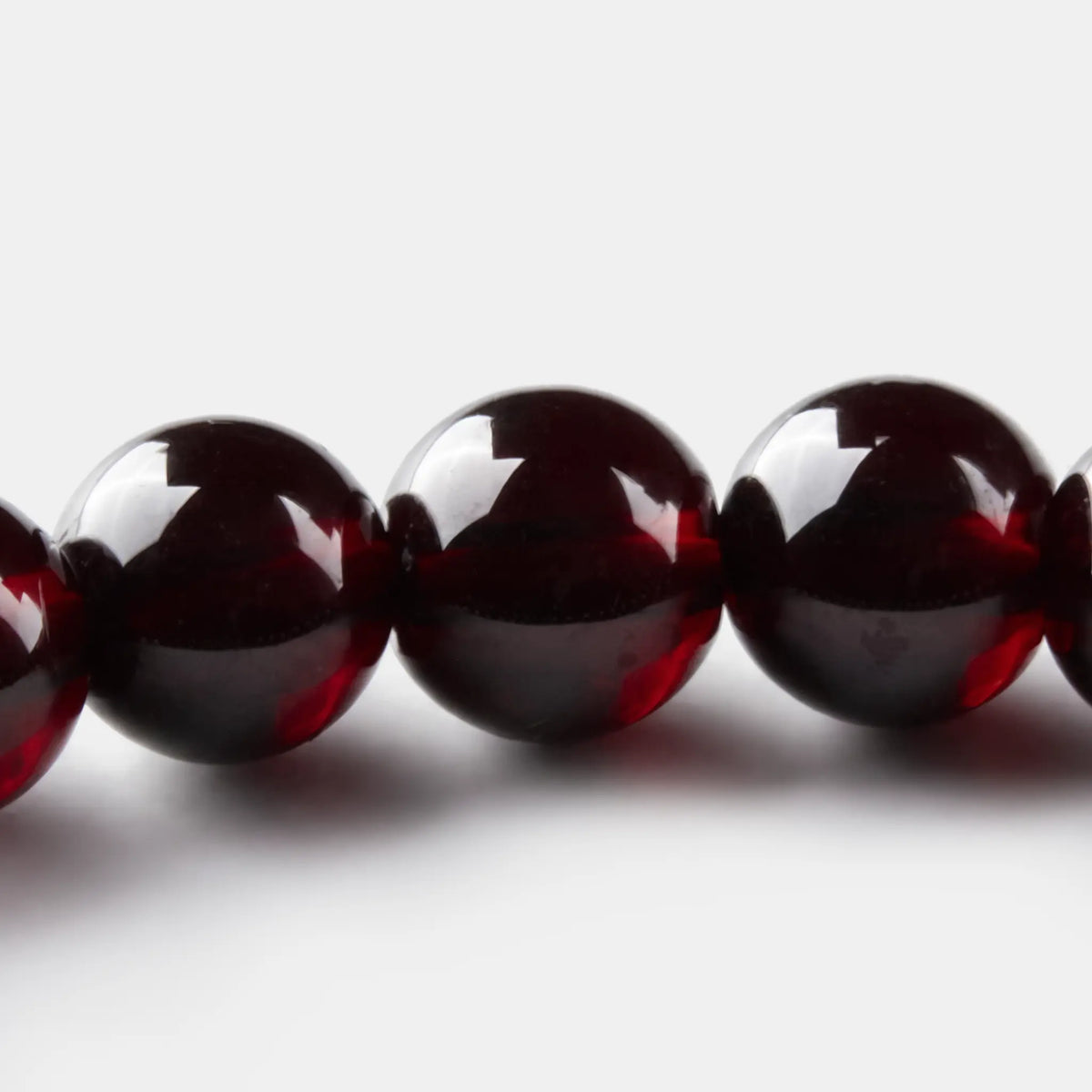
- Looking at a bead. Backlighting shows the colour light picks up on its way through the bead. For a BE. strand, the species and treatment status are written on the Stone Origin Record.
What garnet actually is
Garnet is a group of nesosilicate minerals. The common silicate members discussed here share the general formula X3Y2(SiO4)3. Their structures contain isolated silicate tetrahedra and sites occupied by metals such as iron, magnesium, manganese, calcium, aluminium and chromium. Different compositions define different members, and natural crystals often mix several of them.
The familiar six are almandine, pyrope, spessartine, grossular, andradite and uvarovite. Other members exist; these six are the names most often met in jewellery.
Garnet occurs in several geological settings. Almandine-rich garnet is familiar in metamorphic schists and gneisses; spessartine also occurs in granitic pegmatites. Pyrope-rich compositions occur in mantle rocks, while calcium-rich garnets can occur in altered or metamorphosed rocks. The geological guide explains why host rock and measured composition matter.
Why garnet matters beyond jewellery
Red garnet jewellery is documented in ancient Egypt; carved garnets served as Roman intaglios; and Bohemian pyrope later supported a regional jewellery industry. Follow garnet through ancient Egypt, Rome and Bohemian jewellery.
In metamorphic rocks, some garnet crystals preserve growth zoning and trapped inclusions. Geologists compare those features with measured chemistry, neighbouring minerals and textures, thermodynamic models and, where relevant, geochronology to reconstruct parts of a rock's pressure-temperature-time path. See why geologists use garnet to read rock histories.
Some chromium-rich pyrope and eclogitic garnets also survive weathering after deep-source rocks are carried upwards by kimberlitic magmas. Their chemistry helps geologists trace scattered grains back towards a possible kimberlite source.
Why garnet colour varies so widely
Iron, manganese, chromium and vanadium can affect how a garnet absorbs visible light. Their role depends on the composition and crystal site. Calcium and magnesium sit in the structure without adding colour of their own.
One species can come in several colours, and different species can look alike. The table lists the usual colour range of each.
| Material or variety | Typical colour range | Note |
|---|---|---|
| Almandine and pyrope-rich mixtures | Red to purplish or orangy red | Colour ranges overlap |
| Spessartine | Orange to reddish orange | Orange from manganese |
| Grossular, including tsavorite | Colourless, yellow, orange and green | Tsavorite is the green variety |
| Andradite, including demantoid | Yellow, green and brown tones | Demantoid is the green variety |
| Hessonite | Orange to brownish red | A grossular variety |
| Colour-change garnet | Different hues under different light sources | Found in some mixed compositions |
Reading a garnet strand
- Colour in ordinary light. Look at the strand in daylight and under the light you will wear it in. Note the hue and how dark it reads.
- Transmitted light. A bead that looks almost black from the front may transmit red at an edge or when backlit. Thickness and the path through the material affect the result. The film demonstrates this at 2:19.
- Matching. Each bead should hold a deep, even red, and the beads should match in size, tone and finish along the strand.
- Surface and drilling. Check that the polish is even, the drill-hole edges are clean and each hole sits centred.
- The record. On a BE. garnet strand, the Stone Origin Record states the stone identity (almandine garnet), the treatment status, the four 4T readings and the lot number.
Trade names, decoded
- Rhodolite. A purplish-red variety in the pyrope-almandine range.
- Hessonite. An orange to brownish-red grossular variety, often with a swirled, roiled look inside.
- Tsavorite. A green variety of grossular.
- Demantoid. The green gem variety of andradite, known for high dispersion.
- Mali garnet. A trade name for grossular-andradite material from Mali.
- Mandarin garnet. A trade term for vivid orange spessartine.
Caring for garnet
At Mohs 6.5–7.5 by species, and 7–7.5 for almandine, garnet suits daily wear. Clean it with warm soapy water and a soft brush, skip the ultrasonic cleaner, and store it apart from harder stones such as sapphire and diamond to keep the polish bright.
Check garnet care and durability.
How BE. grades garnet
BE. only lets about the top 20% of inspected material into the studio, then scores every garnet lot on the Crystal 4T™ standard: Transparency, Tone, Texture and Treasure. Transparency records how light moves through the bead. Tone covers two things: how deep and even the red is in each bead, and how well the beads match across the strand. Texture covers the polish and the surface. Treasure records how hard the material is to find at this quality. Each strand ships with a Stone Origin Record that states the stone identity, treatment status, the four 4T readings and the lot number.
To see the six garnet members at full size and compare any two, open the Garnet Stone Explorer.
Frequently asked questions
Q1.Is garnet a single mineral or a family?
A family. Six members are the familiar names, and natural garnets usually mix two or more of them in one crystal.
Q2.Why are most garnets red?
Iron. Common red jewellery garnets contain iron, which absorbs part of visible light and leaves the red you see.
Q3.What is the difference between tsavorite and demantoid?
Both belong to the garnet family. Tsavorite is a green grossular variety; demantoid is the green gem variety of andradite.
Q4.Are garnets ever treated?
Many garnets are sold untreated; fracture filling is the exception seen in the trade. Every stone BE. uses is natural, with no synthetic or laboratory-grown substitutes. The BE. garnet strand is untreated, and its treatment status is written on the product page and the Stone Origin Record.
Q5.How can I tell rhodolite from almandine?
Rhodolite is a purplish-red variety in the pyrope-almandine range. The two overlap in colour, so the name rests on measured composition.
Q6.Is garnet durable enough for everyday wear?
Yes. Common gem garnets sit at about 6.5–7.5 on the Mohs scale. Clean with warm soapy water and store apart from harder stones.
References
- GIA: Garnet Description
- GIA: Garnet Quality Factors
- GIA: Garnet Care and Cleaning
- GIA: Garnet History and Lore
- Manzotti and colleagues, 2025: Garnet growth across the quartz-coesite transition in metapelites
- USGS, 2006: Garnet, an essential industrial mineral and January birthstone
- BE. Crystal 4T Grading System
Field Notes.
One stone at a time: its geology, and how to read quality. The Stone Buying Checklist comes with your first email.
By subscribing you agree to receive emails from BE. Unsubscribe anytime.
Sent. Check your inbox.