
Garnet Bracelet: Understanding the Garnet Group
A garnet is not one mineral but a group. What the garnet group is, why the red varies, which garnet BE. uses, and how to read a strand.
In this field note
Garnet comes in many colours because the name covers a family of minerals built on the same atomic framework with different metals inside it. An almandine strand reads near-black red, spessartine is vivid orange, and tsavorite is green. The full Garnet Guide and BE.'s 6:48 film cover the mineral family, colour, documented localities and geological use; the film is in English.
Knowing the group explains the colour range, the durability, and why the garnet on a red strand is almost always almandine or pyrope.
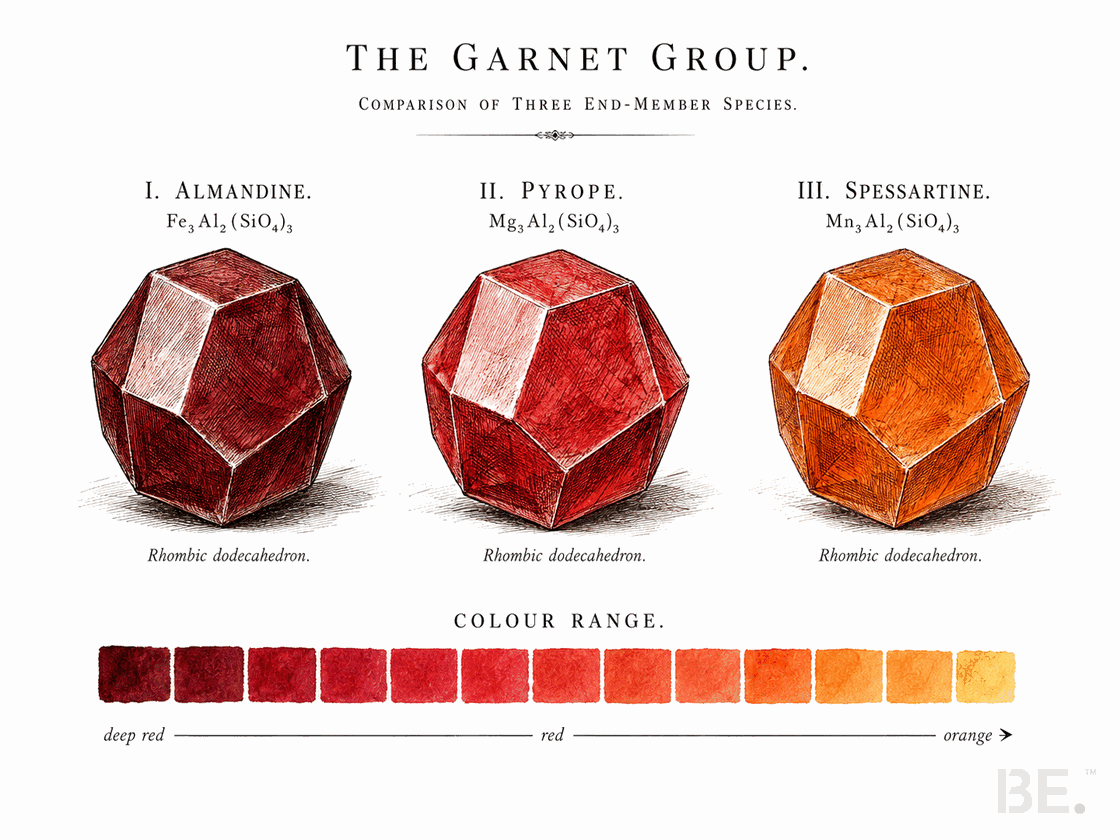
What the garnet group actually is
Garnets are a group of silicate minerals that all share the same cubic crystal structure and the general formula X3Y2(SiO4)3. The X site holds a larger divalent metal (iron, magnesium, manganese or calcium); the Y site holds a smaller trivalent metal (aluminium, iron or chromium). Swap the metals and you swap the species. The framework stays the same, which is why all garnets share a similar hardness, lack of cleavage and characteristic well-formed crystal habit.
The common species form two families. The pyralspite series (pyrope, almandine, spessartine) is aluminium in the Y site with iron, magnesium or manganese in the X site; these are the reds and oranges. The ugrandite series (uvarovite, grossular, andradite) is calcium in the X site; these include the greens. Most jewellery garnet, and all of BE.’s, sits in the pyralspite reds.
How do the six main garnet types compare?
Garnet chemistry is usually described through six end members. Natural garnets are mixtures, so most stones sit between two or more rows of this table.
| Garnet type | Ideal formula | Common colours | Mohs hardness | Bead presence and visual clue |
|---|---|---|---|---|
| Pyrope | Mg3Al2(SiO4)3 | Red to purplish red | 7 to 7.5 | Often seen in beads, usually mixed with almandine; clear red at a thin edge |
| Almandine | Fe3Al2(SiO4)3 | Deep red to brownish red | 7 to 7.5 | Common in round garnet beads; near-black through the centre with red at a thin edge |
| Spessartine | Mn3Al2(SiO4)3 | Orange to red-brown | 6.5 to 7.5 | Less common in round bead strands; familiar orange overlaps hessonite and mixed garnets |
| Grossular | Ca3Al2(SiO4)3 | Colourless, yellow, orange, pink, red or green | 6.5 to 7.5 | Occasional as hessonite or green grossular beads; green alone cannot establish the tsavorite name |
| Andradite | Ca3Fe2(SiO4)3 | Green, yellow, brown or black | 6.5 to 7 | Uncommon in round bead strands; demantoid fire depends on transparency, body colour, cut and lighting |
| Uvarovite | Ca3Cr2(SiO4)3 | Bright green | 6.5 to 7 | Very rare as round beads; usually small green crystals coating a matrix |
How often each type is cut into round beads shifts with material and supply. Colour narrows the list; naming the species takes refractive index, spectroscopy or chemical analysis.
Why the red varies
| Species | Composition | Colour |
|---|---|---|
| Almandine | Fe3Al2(SiO4)3 | Deep red to almost opaque dark red (BE.’s choice) |
| Pyrope | Mg3Al2(SiO4)3 | Bright blood-red |
| Rhodolite | Pyrope-almandine blend | Purplish-red to raspberry |
| Spessartine | Mn3Al2(SiO4)3 | Orange to mandarin |
| Tsavorite / demantoid | Grossular / andradite (Ca) | Green |
In practice most red garnet is a blend along the almandine-pyrope line, and few stones sit at a pure end member. Almandine’s iron gives the deepest, densest red, dark enough to read near-black in larger beads. That depth is why BE. selects it.
Where garnet forms
| Origin | Typical character | What to look for |
|---|---|---|
| India / Sri Lanka | Almandine, deep red | Dense colour, even across a strand |
| Mozambique / Tanzania | Pyrope-almandine, brighter reds | More open, vivid red |
| Brazil / Madagascar | Mixed garnet species | Colour varies with the species mix |
Almandine is one of the most common garnets, forming in metamorphic schists and gneisses worldwide. It is a classic indicator of medium-grade metamorphism. Judge the finished beads under consistent light.
Reading a garnet strand
- Depth of red. Almandine should read deep and rich; hold it to light to see the red glow through.
- Translucence. Compare light transmission under the same conditions; a deep almandine can look near-black through the centre and still glow red at a thin edge.
- Evenness. Colour should match across the strand; garnet is usually very consistent.
- Polish. Garnet takes a bright, hard polish; a dull surface is a finishing fault.
- Clarity. Some inclusions are normal; avoid heavily fractured beads.
Trade names, decoded
- Almandine. The iron-aluminium garnet; the deep dark red used in most red strands.
- Pyrope. The magnesium-aluminium garnet; brighter blood-red.
- Rhodolite. A pyrope-almandine blend in a purplish-raspberry red.
- Spessartine / mandarin garnet. The manganese garnet; orange.
- Tsavorite, demantoid. Green calcium garnets; different species, much rarer.
Caring for a garnet strand
Common red almandine-pyrope bracelet material is typically around Mohs 7–7.5 and has no prominent cleavage, so it is practical for daily wear. Store it separately, wipe it with a soft damp cloth and use warm soapy water. Skip harsh chemicals, and skip the ultrasonic cleaner when a bead shows fractures or inclusions.
How BE. grades it
BE. grades garnet on the Crystal 4T™ framework: Transparency, Tone, Texture and Treasure. For garnet that means a deep red in every bead and an even red across the strand, edge translucence, polish and bead matching. Each strand’s Stone Origin Record lists the stone identity, the treatment, the four 4T readings, the lot and the origin at sourcing level. For how garnet sits among other warm stones, see the red and orange crystals guide.
Frequently asked questions
Q1.Is garnet a single stone?
No. Garnet is a group of silicate minerals sharing one structure but different chemistry, including almandine, pyrope, spessartine, grossular and andradite. Most red jewellery garnet is almandine or pyrope.
Q2.Which garnet does BE. use?
BE. uses almandine, the iron-aluminium garnet, for its deep, almost opaque dark red and excellent durability on the wrist.
Q3.Why are some garnets red and others orange or green?
Colour depends on the actual composition and how it absorbs light. Iron, manganese, chromium and vanadium can contribute to garnet colours. Magnesium in the ideal pyrope formula does not itself make the stone red, and calcium alone does not make a garnet green.
Q4.Is garnet durable enough for daily wear?
Yes, with ordinary jewellery care. Common red almandine-pyrope bracelet material is typically around Mohs 7–7.5 and lacks prominent cleavage, but fractures, inclusions and settings still affect durability.
Q5.How do I care for a garnet bracelet?
Wipe with a soft damp cloth and store apart from softer stones it could scratch. It tolerates daily wear well; avoid harsh chemicals and ultrasonic cleaners as a precaution.
Q6.How do I choose a good garnet strand?
Look for a deep, even red, good translucence to the light, clean polish and consistent bead matching across the strand.
References
- Mindat: Garnet group
- GIA: Garnet
- Deer, Howie & Zussman (2013). An Introduction to the Rock-Forming Minerals, 3rd ed.
- Schumann, W. (2009). Gemstones of the World, 4th ed. Sterling.
Field Notes.
One stone at a time: its geology, and how to read quality. The Stone Buying Checklist comes with your first email.
By subscribing you agree to receive emails from BE. Unsubscribe anytime.
Sent. Check your inbox.