
Black vs Golden Rutilated Quartz: Needle Type, Look & How to Choose
Black vs golden rutilated quartz: both are rutile needles in quartz, separated by iron content. Why the colour differs, what each looks like, and how to choose.
In this field note
Put a golden rutilated quartz bead next to a dark-needle specimen and begin with identity, not colour. Golden needles are commonly rutile; a near-black needle may be dark rutile, schorl tourmaline or another inclusion. When rutile is confirmed in both, this page compares their observed look and buying choice.
For the head-term material context, use the black rutilated quartz guide. For identity and testing limits, use black rutile vs tourmalinated quartz.
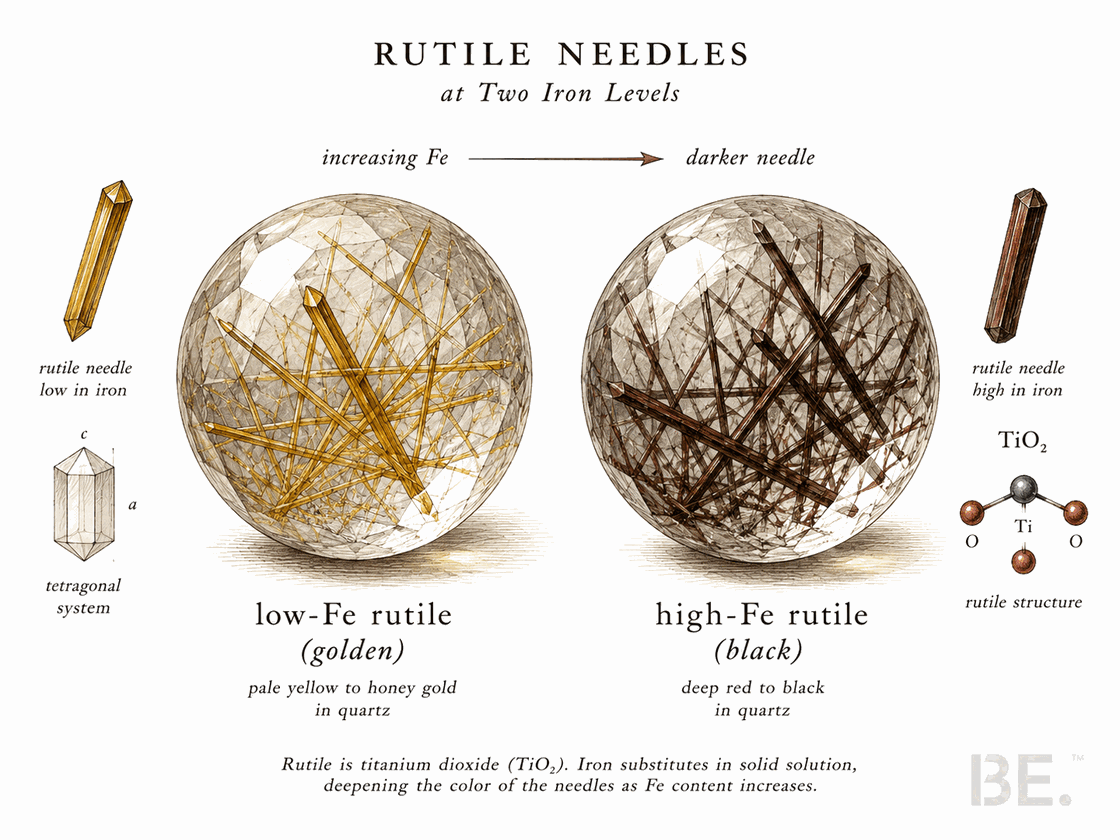
What both stones are
This comparison applies when both samples are verified as quartz hosting rutile (TiO2). The quartz is the wearing surface; the needles are inclusions. Growth sequence and dark colour cause can vary by specimen and should not be inferred from a trade label alone.
What differs is the iron content of the rutile. Pure or low-iron rutile transmits and reflects a bright golden colour. As iron substitutes into the rutile structure, the needles deepen through amber and coppery red toward a dark, near-black red. So “golden” and “black” rutilated quartz are two points on a single compositional line, not two species.
The important caveat: genuinely jet-black needles can be tourmaline (schorl), a separate boron-bearing mineral, and the stone is then not a rutilated quartz. That makes the stone tourmalinated quartz. Material sold as “black rutilated quartz” can be tourmalinated quartz, or quartz with very dark red rutile that reads black to the eye.
Black vs golden, side by side
| Feature | Golden rutilated | Black / dark rutilated |
|---|---|---|
| Needle mineral | Rutile (TiO2), low iron | Rutile, high iron (or tourmaline) |
| Colour | Bright gold to amber | Coppery red to near-black |
| Look | Bright, warm, light-catching | Dramatic, high-contrast |
| Lustre of needle | Metallic, reflective | Metallic (rutile) or matte (tourmaline) |
| Common confusion | “Angel hair” fine gold | Sold as black rutile but often tourmaline |
Metallic flash, a red edge or matte opacity can help screen possibilities, but the observations overlap. If inclusion identity matters, use Raman or equivalent gemmological analysis, since a light test alone cannot settle it.
Where the material forms
| Origin | Typical character | What to look for |
|---|---|---|
| Minas Gerais, Brazil | A documented source of golden rutile in quartz | Bright gold needles in water-clear quartz |
| Bahia, Brazil | Denser, sometimes redder rutile | Coppery to dark red needle networks |
| Madagascar | Mixed; gold and darker material | Confirm whether dark needles are rutile or tourmaline |
Source hints at the likely needle colour but does not guarantee it. Judge the needles and the host in the bead, not the country name.
Reading a rutilated strand
- Needle sharpness. Crisp, straight needles mean the rutile was preserved intact; smeared lines suggest fractured inclusions.
- Host clarity. A clean, glassy quartz host lets the needles read with depth; cloudy hosts mute them.
- Screen the dark needle. Record metallic flash, edge colour, thickness and texture, but treat them as clues that narrow the possibilities and never as a conclusive species test.
- Density you want. Sparse drawn lines or a dense thicket. Both are valid, and a strand should be consistent.
- Bead matching. Needle colour and density should not lurch across the strand.
Trade names, decoded
- Golden rutilated quartz. Low-iron rutile; the bright gold classic.
- Black rutilated quartz. Dark rutile, or tourmaline sold under the rutile name.
- Venus hair stone. Old name for fine golden rutile in quartz.
- Tourmalinated quartz. Black tourmaline (schorl) needles of a different mineral; matte black.
- Sagenite. Criss-crossing radiating needle networks of rutile.
Caring for rutilated quartz
Both gold and dark rutilated quartz have a quartz host at Mohs 7 with the needles enclosed inside, so the wearing surface behaves as quartz and the stone suits daily wear. Store it apart from harder stones to avoid surface scratches, keep it out of the shower and pool, and wipe with a soft damp cloth. The needles, sealed inside, take no wear at all.
How BE. grades it
BE. uses Crystal 4T to read four things: Transparency of the host, Tone of the needles, Texture of the needle network, and Treasure, how hard material of this quality is to find again. For broader rutile context see the rutilated quartz guide and smoky rutilated quartz guide.
Frequently asked questions
Q1.What is the difference between black and golden rutilated quartz?
When both are verified as rutile-bearing quartz, they can be compared by observed needle colour, density and host clarity. A jet-black needle specimen may instead contain schorl tourmaline, so identity comes before colour comparison.
Q2.Is black rutilated quartz the same as tourmalinated quartz?
Not necessarily. Truly black needles can be tourmaline (schorl), a different mineral, which makes the stone tourmalinated quartz. Dark rutile can be very deep red, which the eye reads as near-black.
Q3.Which is rarer or more valuable?
Value is lot-specific and reflects confirmed identity, host clarity, needle pattern, condition, cut, provenance and demand. Dark colour alone does not prove rutile or a rarity premium.
Q4.How do I choose between them?
Pick by look. Golden reads bright, warm and light-catching; dark reads dramatic with high contrast. Neither is better as a material.
Q5.Are they durable for daily wear?
Yes. The host is quartz at Mohs 7 and the needles are enclosed inside it, so the wearing surface behaves as quartz. Store apart from harder stones.
Q6.How do I tell real rutilated quartz?
Use magnification and changing light to screen three-dimensional inclusions, host condition and repeated patterns. These observations do not prove rutile or exclude every imitation; analytical testing may be needed.
References
- Mindat: Rutile
- Mindat: Quartz
- Mindat: Quartz mineral data
- Gübelin & Koivula (2008). Photoatlas of Inclusions in Gemstones, vol. 3.
Field Notes.
One stone at a time: its geology, and how to read quality. The Stone Buying Checklist comes with your first email.
By subscribing you agree to receive emails from BE. Unsubscribe anytime.
Sent. Check your inbox.