
How to Spot a High-Quality Amethyst Bracelet
The four tells of a high-quality amethyst bracelet — saturation, zoning, clarity and cut — plus how Bolivian and Brazilian stones differ and how to read a strand.
In this field note
Most amethyst sold as “bracelet grade” is perfectly real and perfectly ordinary. The gap between an ordinary strand and a high-quality one is not authenticity — it is grade: saturation, evenness, clarity and matching. Knowing the four tells lets you read that gap on a market table or a product photo, before you pay for it.
This guide walks through what gives amethyst its colour, the four quality tells in order of importance, how origin shifts the character of the violet, and how to read a finished strand bead by bead.
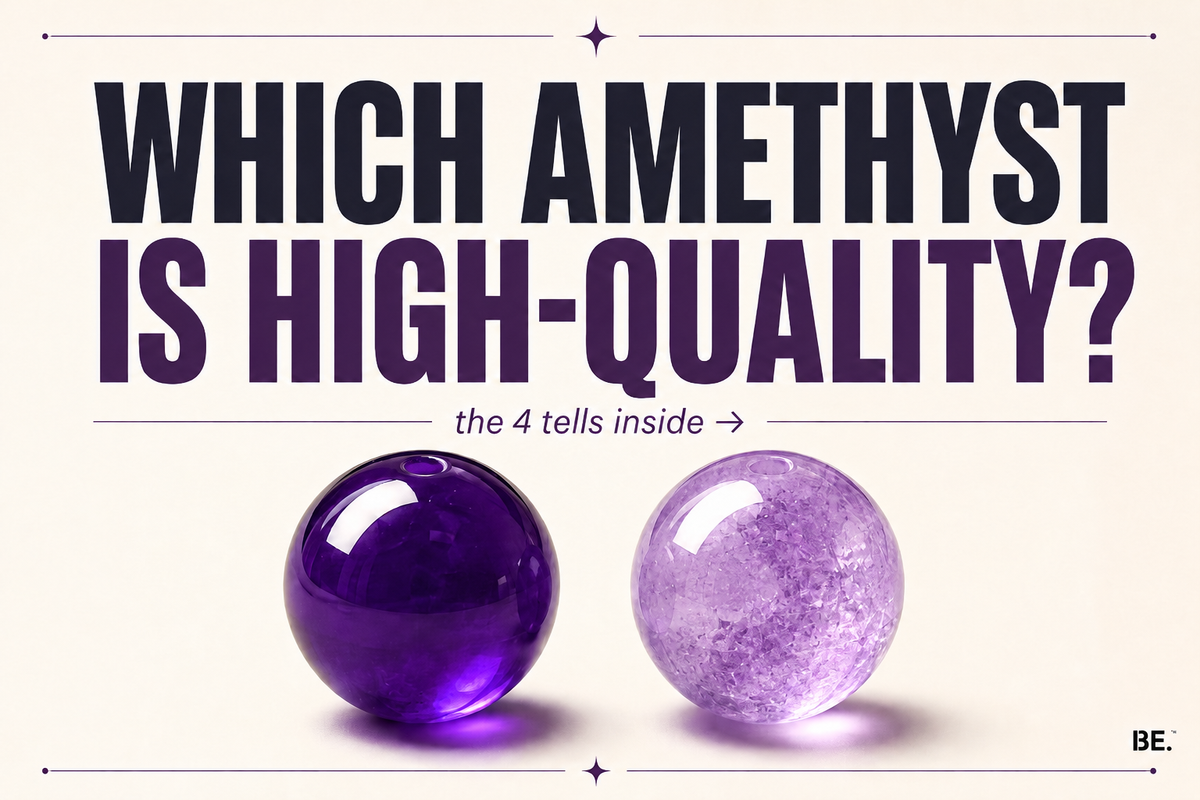
What gives amethyst its colour — and why depth is scarce
Amethyst is the violet variety of quartz. The pure mineral is colourless rock crystal; the violet comes from a colour centre — trace iron (Fe3+) substituted into the silicon dioxide lattice, then activated when the crystal receives a low dose of natural gamma radiation from radioactive isotopes in the surrounding rock over geological time. The irradiation knocks an electron loose and traps it at the iron site, and that trapped-electron defect absorbs in the yellow-green band, transmitting the violet we see.
Two consequences follow, and both bear directly on quality. First, the colour is not evenly available — it depends on how much iron the crystal took up and how much radiation it received, which is why deep, saturated, even amethyst is genuinely scarcer than pale or patchy material. Second, the colour centre is thermally reversible: heat can alter it, but the result depends on the starting material and treatment conditions; no single threshold turns every amethyst yellow. Prolonged direct sunlight can slowly fade high-saturation amethyst for the same reason.
The four quality tells, in order
These factors separate a visually stronger strand from an ordinary one. Saturation and how the finished beads present their zoning often drive appearance, but neither proves natural origin: synthetic amethyst can overlap natural colour, clarity and growth-related features.
| Tell | What high quality looks like | What to be wary of |
|---|---|---|
| 1. Saturation | Deep, rich violet that holds its colour even in the bead’s thinner edges | Pale, washed lavender; colour only visible at the centre |
| 2. Zoning | Colour distributed evenly through the whole bead | Sharp light/dark banding; clear “windows” of near-colourless quartz |
| 3. Clarity | Transparent to lightly included; light passes cleanly | Milky haze, fractures, or heavy white veiling that kills transparency |
| 4. Cut & matching | Beads round, symmetrical, drilled centred, well matched in tone | Wobbly drilling, size variation, beads that don’t match each other |
How origin shifts the character of the violet
Origin is not a price lever in itself — a deep, even Brazilian stone beats a patchy Bolivian one. But origin does shift the character of the colour, and knowing it helps you read what you’re looking at.
| Origin | Typical character | What to look for |
|---|---|---|
| Bolivia (Anahí) | Deep red-violet, sometimes with natural amethyst-citrine zoning | Even deep violet without harsh windowing |
| Brazil | Bright, clean purple; very wide quality range from pale to deep | Saturation — Brazilian runs the full spectrum, so grade carefully |
| Uruguay | Often the most intensely saturated, slightly bluish-violet | Depth of colour; usually a premium character |
| Zambia / Africa | Strong, slightly reddish saturated violet | Even saturation, good transparency |
Reading a finished strand
- Hold it to a window. Daylight, not a shop spotlight — spotlights flatter pale stones. High-quality violet holds in the thin parts of each bead.
- Look for windows. Rotate each bead; near-colourless patches mark uneven colour distribution and pull quality down.
- Check the haze. A milky or cloudy bead is heavily included; the best material reads transparent.
- Compare bead to bead. A high-quality strand is matched — tone and size consistent across all beads, not one deep bead carrying ten pale ones.
- Look at the drill holes. Centred, clean drilling signals careful cutting; off-centre holes and chipping signal volume production.
Trade names, decoded
- “Deep Siberian.” A grade descriptor, not an origin — the top saturation tier (richest violet with red/blue flashes). Rarely literally Siberian.
- “Rose de France.” Pale lilac amethyst sold under a flattering French name. Genuine amethyst, but the lowest saturation tier — priced accordingly.
- “Bolivian / Anahí amethyst.” From the Anahí mine; often shows natural amethyst-citrine zoning (ametrine comes from the same deposit).
- Heated amethyst sold as citrine or prasiolite. Suitable amethyst can shift toward yellow-to-orange or, under specific conditions, green when heated. The result is material- and process-dependent, so no single temperature identifies every treated sample. An honest seller discloses heat.
Caring for amethyst
Because the violet is a radiation-activated colour centre, the one real risk is prolonged direct sunlight, which can slowly fade high-saturation stones. Store out of direct sun. Warm soapy water and a soft cloth are safe; avoid ultrasonic cleaners on heavily included beads and avoid sustained heat. Amethyst is Mohs 7, hard enough for daily wear, but still benefits from being stored apart from harder stones to avoid surface scuffing.
How BE. grades amethyst
BE. grades every strand on the Crystal 4T standard — Transparency, Tone, Texture and Treasure — which maps directly onto the four tells above: Tone captures saturation and zoning, Transparency captures clarity, Texture and Treasure capture cut, matching and the character of the individual lot. Each strand carries a Stone Origin Record recording origin and the colour mechanism, so the violet you’re wearing is documented as a radiation-activated iron colour centre, not left as a vague claim.
Frequently asked questions
Q1.What makes an amethyst bracelet high-quality?
Four material tells: depth and evenness of the violet (saturation and zoning), clean transparent quartz (clarity), and consistent, well-matched cutting. Saturation and zoning matter most.
Q2.Is darker amethyst always better?
Up to a point. The premium is for deep and even violet. Over-dark stones that read near-black, or stones with harsh light/dark banding, are not higher quality — evenness matters as much as depth.
Q3.Is Bolivian amethyst better than Brazilian?
Not automatically. Bolivian tends to a deep red-violet and Brazilian spans pale to deep, so a top Brazilian stone beats an average Bolivian one. Grade the stone in front of you, not the country on the label.
Q4.How can I tell if amethyst is dyed or synthetic?
Visual clues can raise questions but do not prove origin. Colour concentrated in fractures may suggest dye, while zoning and inclusions can guide examination; synthetic hydrothermal amethyst can still overlap natural clarity and colour. Secure separation may require laboratory microscopy, twinning observations and spectroscopy.
Q5.Is colour zoning a flaw?
Mild zoning is natural and normal. The quality question is whether the finished bead reads even — good cutting orients the colour so the bead looks saturated, even if the rough was zoned.
Q6.Will an amethyst bracelet fade?
Some amethyst can fade under prolonged intense light, but the rate and outcome vary by material and exposure. Store it away from strong direct light and high heat; no storage claim can guarantee unchanged colour indefinitely.
References
- GIA — Amethyst Quality Factors
- Mindat — Amethyst (quartz variety)
- Wikipedia — Amethyst
- Webster, R. Gems: Their Sources, Descriptions and Identification, 5th ed. Butterworth-Heinemann.
- Nassau, K. The Physics and Chemistry of Colour, 2nd ed. Wiley.
- BE. Crystal 4T Grading System
Field Notes.
One stone at a time: its geology, and how to read quality. The Stone Buying Checklist comes with your first email.
By subscribing you agree to receive emails from BE. Unsubscribe anytime.
Sent. Check your inbox.