
Crystal Hardness Chart: Which Bracelets Survive Daily Wear
A Mohs hardness chart for 17 crystal-bracelet stones, with a plain-English daily-wear verdict for each, plus why hardness alone does not decide durability.
In this field note
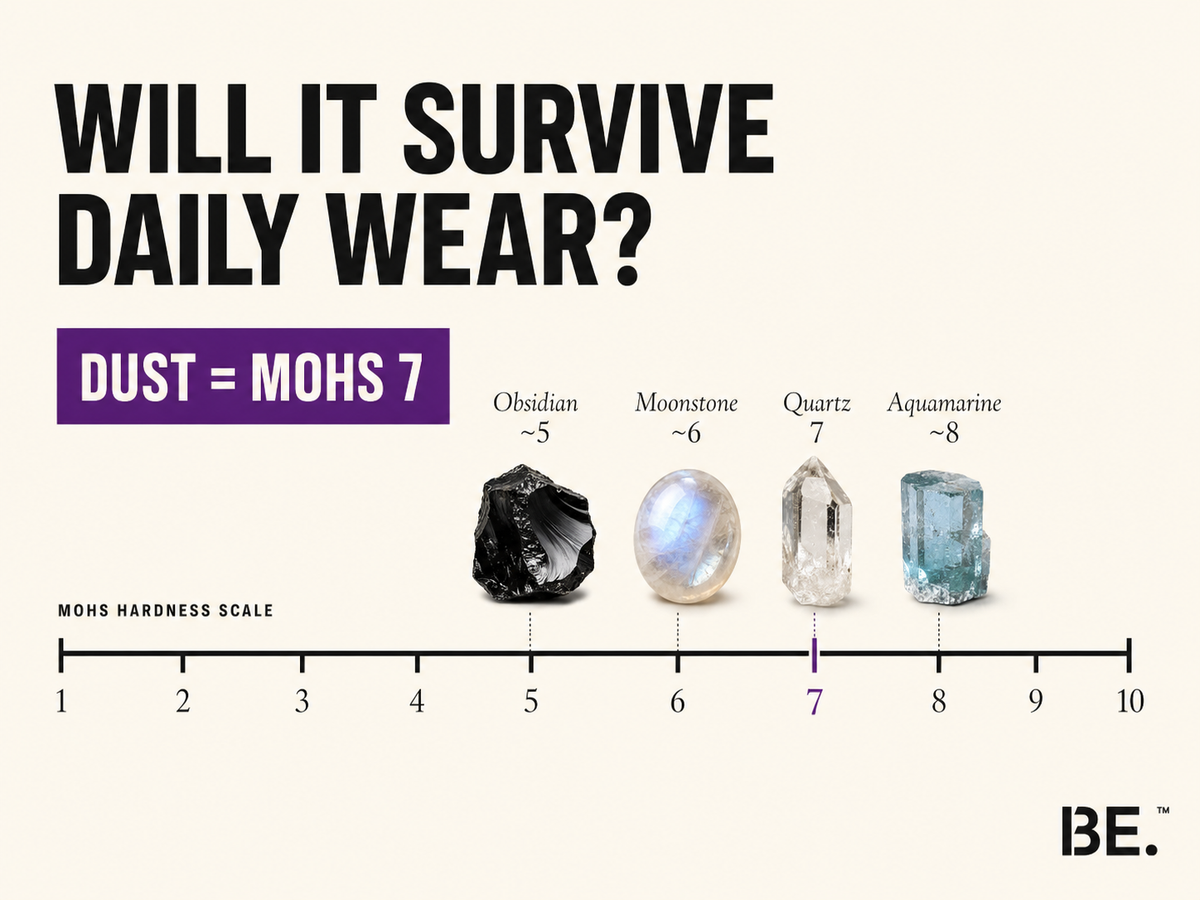
Ask which crystal bracelet will still look good in five years and you will get a lot of vague answers. The honest one is a number. The Mohs scale ranks how well a mineral resists scratching, and it quietly decides whether a strand stays glossy or slowly hazes over. The single most useful fact in this whole guide: household dust is full of fine quartz at hardness 7, so anything softer than 7 can be abraded just by wiping it.
Below is a hardness chart for the 17 stones BE. works with, each with a plain-English daily-wear verdict, followed by why hardness alone doesn’t tell the whole durability story.
What the Mohs scale measures
Devised by Friedrich Mohs in 1812, the scale ranks minerals 1 (talc) to 10 (diamond) by scratch resistance: a higher number scratches a lower one, never the reverse. It is relative and non-linear: the jump from 9 (corundum) to 10 (diamond) is far larger than from 1 to 2. For jewellery the key threshold is 7, the hardness of quartz and therefore of the dust in the air around you. The same comparison answers whether crystal bracelets can scratch watches, phones or screens.
Crystal hardness chart (17 BE. stones)
| Stone | Mineral | Mohs | Daily-wear verdict |
|---|---|---|---|
| Aquamarine | Beryl | 7.5–8 | Hardest here; excellent for daily wear. |
| Garnet (almandine) | Garnet group | 7–7.5 | Tough and durable; very wearable. |
| Amethyst | Quartz | 7 | Ideal; resists everyday scratching. |
| Citrine | Quartz | 7 | Ideal; durable for constant wear. |
| Clear Quartz | Quartz | 7 | Ideal; hard and stable. |
| Rose Quartz | Quartz | 7 | Ideal; very forgiving. |
| Smoky Quartz | Quartz | 7 | Ideal; tough everyday stone. |
| Hematoid Quartz | Quartz + iron oxide | 7 | Durable; mind exposed iron veins. |
| Rutilated Quartz | Quartz + rutile | 7 | Durable; dense needles slightly fragile. |
| Blue Smoky Quartz | Quartz, SiO₂ | 7 | Durable quartz host. |
| Emerald / Green Phantom | Quartz + fuchsite / chlorite | 7 | Durable; phantoms are internal. |
| Super Seven | Quartz + varied inclusions | 7 | Quartz host; inclusions and fractures can lower impact resistance. |
| Moonstone | Feldspar | 6–6.5 | Wearable; cleavage means handle gently. |
| Prehnite | Phyllosilicate | 6–6.5 | Wearable; softer than dust, clean with care. |
| Kyanite | Aluminosilicate | 5.5–7* | Two values; protect from knocks (see below). |
| Obsidian | Volcanic glass | 5–5.5 | Softest here; avoid abrasion, store apart. |
*Kyanite is anisotropic: about 5.5 along the crystal’s length and about 7 across it.
Why hardness isn’t the whole story
Hardness predicts scratching, but two other properties decide whether a stone chips or breaks:
- Toughness. Resistance to breaking under impact. Garnet is only modestly hard but quite tough; nephrite (not in this chart) is famously tough despite middling hardness.
- Cleavage. A built-in plane of weakness. Kyanite and moonstone have easy cleavage, so a sharp knock can split them cleanly even though they aren’t especially soft. Quartz has no cleavage, which is part of why it wears so well.
Reading durability in a strand
- Start with the Mohs number. 7+ means you can wear it with little worry; below 7, plan to handle it gently.
- Check for cleavage. Feldspars (moonstone) and kyanite reward extra care around the clasp and knocks.
- Mind included stones. Where iron veins or dense needles reach the surface, durability dips locally.
- Match the stone to your day. A hands-on, active wearer is better served by quartz or beryl than by obsidian.
- Clean to the hardness. Anything under 7 should be cleaned with water, not wiped dry, to avoid dust-scratching.
Care implications by hardness band
Stones at Mohs 7 and above (quartz family, aquamarine, garnet) tolerate normal handling and a soft cloth. Stones at 6–6.5 (moonstone, prehnite) prefer water cleaning and a soft pouch. The softest, obsidian at 5–5.5, should be stored separately so harder beads and dust don’t dull its mirror. Kyanite sits across bands and is best protected from sharp impact regardless of its scratch numbers. For the broader material context, see the Obsidian material and properties guide.
How BE. grades for durability
BE. reads every strand against the Crystal 4T framework: Transparency, Tone, Texture, Treasure. Hardness sits squarely under Texture: polish quality, surface integrity and how a stone will hold up in wear. Each bracelet ships with a Stone Origin Record stating the mineral and its hardness, so durability is a recorded fact.
Frequently asked questions
Q1.What hardness should a crystal bracelet be for daily wear?
As a rule, Mohs 7 and above resists everyday scratching, because airborne dust contains quartz at hardness 7. Quartz-family stones are ideal. Softer stones at 5–6.5 are still wearable but need more care.
Q2.What is the Mohs scale?
It ranks a mineral’s resistance to scratching from 1 (talc) to 10 (diamond). It is relative and non-linear: a higher number scratches a lower one, but the gaps are uneven.
Q3.Is a harder crystal always more durable?
No. Hardness measures scratch resistance; durability also depends on toughness and cleavage. A hard stone with easy cleavage, like kyanite, can still chip from a knock.
Q4.Which crystal bracelet is most scratch-resistant?
Aquamarine at Mohs 7.5–8 is the hardest here, followed by almandine garnet at 7–7.5 and the quartz family at 7.
Q5.Why does dust scratch some crystals?
Household dust contains fine quartz at Mohs 7. Any stone softer than 7 can be abraded by wiping dust off dry, which is why softer stones should be cleaned gently with water.
Q6.Is kyanite suitable for a bracelet?
Yes, with awareness. It has two hardness values, about 5.5 along the blade and about 7 across, plus perfect cleavage. It makes a striking bracelet but should be protected from sharp knocks.
References
- Mohs scale of mineral hardness: Wikipedia
- Gem Durability: Hardness, Toughness & Stability: GIA
- Mineral hardness data: Mindat.org
- Hurlbut & Klein (1993). Manual of Mineralogy, 21st ed. Wiley.
- Anderson, B. W. (1990). Gem Testing, 10th ed. Butterworth-Heinemann.
Field Notes.
One stone at a time: its geology, and how to read quality. The Stone Buying Checklist comes with your first email.
By subscribing you agree to receive emails from BE. Unsubscribe anytime.
Sent. Check your inbox.