
How to Spot a High-Quality Citrine Bracelet
The first test of a high-quality citrine bracelet is natural versus heated — plus saturation, evenness and clarity. How to read the tells before you pay.
In this field note
The complete citrine guide explains the quartz identity, formation and colour history behind these checks.
“Real” is not one question
The word real often hides four different questions:
| Question | What a clear answer sounds like | What it does not prove |
|---|---|---|
| What is the material? | Quartz or a named non-quartz material | Whether quartz grew naturally or in a laboratory |
| Where did it grow? | Natural quartz or laboratory-grown synthetic quartz | That natural quartz is untreated |
| What treatment is known? | Natural colour, heated, irradiated, dyed, coated, another treatment, or unknown | That the seller knows the geological locality |
| Is the bracelet well made? | Bead, drilling, polish, stringing, clasp, and repair details | That the material claim is correct |
CIBJO’s trade guidance lists citrine, or yellow quartz, as a material that is very commonly heated and requires the treatment description Heated when applicable.[5] The noun citrine by itself should therefore never be read as a promise of natural colour.
Five material states that should stay separate
- Natural-colour citrine: natural quartz whose yellow-to-orange colour formed in nature. GIA describes natural citrine as rare.[1]
- Heated citrine: mined natural quartz—often amethyst—whose colour was changed after mining by human-applied heat. It is not synthetic quartz, but the treatment should be disclosed.[1][5]
- Synthetic yellow quartz: quartz grown in a laboratory. This is a different origin question from heat treatment. Gem-A notes that synthetic citrine can be difficult to identify with traditional methods.[4]
- Dyed, coated or irradiated quartz: the underlying quartz may be natural or synthetic, while the colour or surface has a separate treatment history. Record material identity, growth origin and treatment independently.
- Imitation: glass or another non-quartz material used to resemble citrine. A photograph alone cannot establish the host material.
The authenticity evidence ladder
Each evidence level answers a different question. Record what it establishes and keep its stated limit attached.
| Level | Evidence | Useful for | Limit |
|---|---|---|---|
| 0 | A colour name, lifestyle image, low price, or “natural” in a marketplace title | Finding candidates | Marketing language is not material evidence |
| 1 | Item-specific photos and a full rotation video in neutral light, with a white or grey reference | Checking whether the delivered bracelet resembles the listing; spotting obvious surface or workmanship problems | Colour and camera settings cannot prove treatment history or locality |
| 2 | Non-destructive close inspection of every bead, drill hole, surface, and closure | Finding chips, abrasion, inconsistent coating, poor drilling, exposed wire, or weak finishing | Visual clues cannot by themselves separate natural colour, heat treatment, and synthetic quartz |
| 3 | A written seller declaration naming material, known treatment, construction, and whether the claim applies to this bracelet or lot | Making the commercial claim specific and recoverable | A seller declaration remains first-party evidence |
| 4 | Traceable lot records, supplier documents, known-sample photography, and a dated chain of custody | Connecting the bracelet to a defined batch and claim history | Provenance is not automatically an independent gemmological test |
| 5 | An independent gemmological report whose scope and report number match the item | Testing natural versus synthetic origin and reporting treatments that the laboratory can detect | A report is method- and scope-limited; “natural” must not be expanded into “never heated” unless the report actually says so |
GIA notes that a laboratory report can be useful but may cost more than many ordinary citrine items.[3] Reserve it for a claim or value that justifies the cost, and read the result field by field instead of treating the word certificate as a universal guarantee.
Before buying, ask the seller to put four points in writing: material identity, known treatment, whether the claim applies to this bracelet or a documented lot, and the identifiers for any supporting report or record. CIBJO places treatment disclosure before the transaction and in commercial documents.[5]
A five-minute, non-destructive bracelet check
1. Read the claim before reading the colour
Save the exact product wording. Does it say natural quartz, natural-colour citrine, untreated, heated, synthetic, or merely citrine? If treatment is unknown, the honest answer is unknown—not an inference from the shade.
2. Ask for item-specific views
Look at the entire bracelet under diffuse daylight and a neutral indoor light. Ask for a slow rotation rather than one saturated product image. This can expose camera inconsistency, coating wear, chipped holes, or severe mismatch, but the hue remains an observation rather than proof.
3. Inspect the bead surface and drill holes
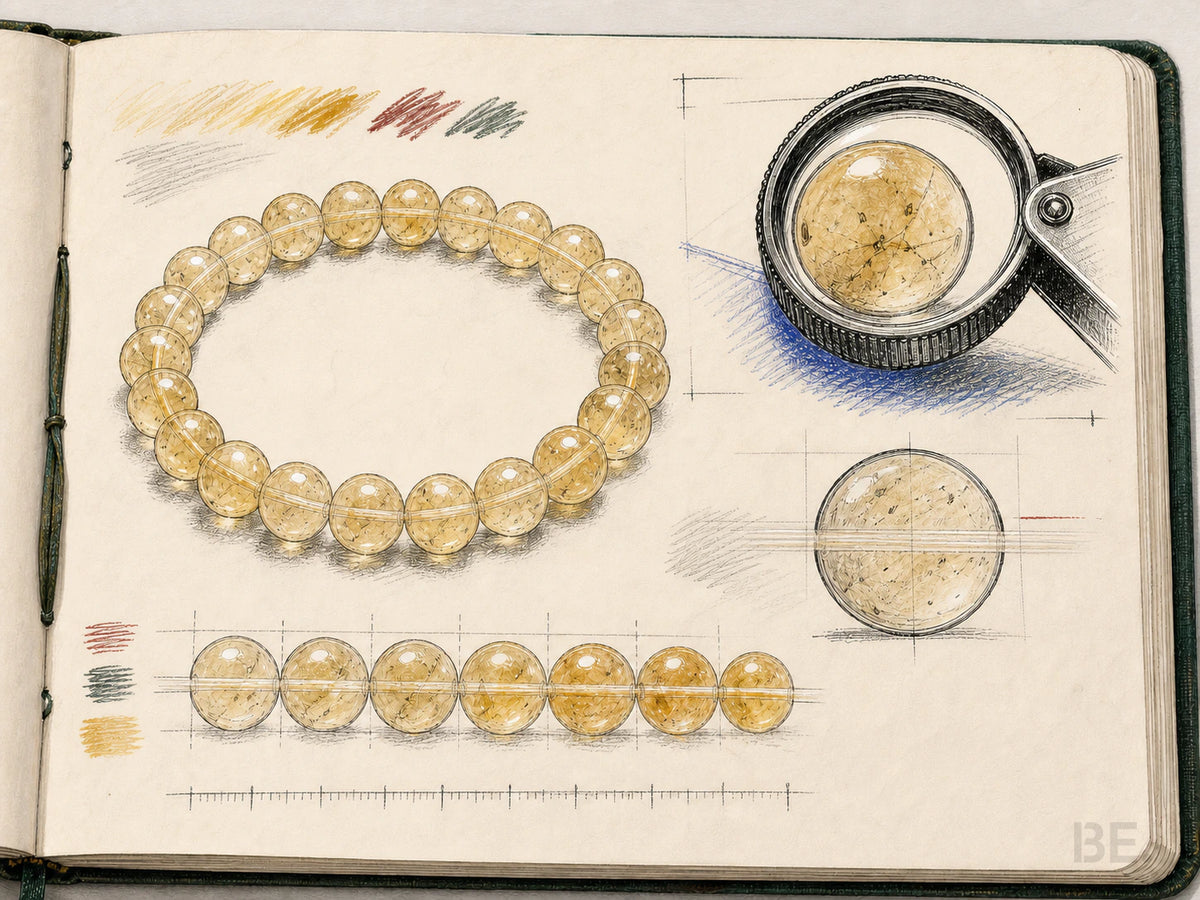
Use a loupe or phone macro lens without scratching the stone. Check for:
- flaking, patchy surface colour, or abrasion concentrated at edges;
- chips or radial fractures around drill holes;
- scratches that interrupt the polish;
- glue residue, exposed wire, frayed cord, or crushed crimp components;
- one bead that behaves visually unlike the rest of the strand.
These findings can justify a closer question or a return. They do not establish a geological origin or treatment history.
4. Compare the whole strand, not one “perfect” bead
Matching colour and clarity can be a sign of careful selection. It is not proof of untreated material. GIA evaluates colour, clarity, cut, and weight as quality factors, and notes that citrine is often expected to be eye-clean; clarity therefore belongs to quality grading, not an authenticity verdict.[2]
5. Check construction and recourse
A credible material description does not excuse weak workmanship. Confirm the wearable length or finished inner circumference, bead diameter, core material, clasp or elastic construction, repair terms, and written return conditions. For a full comparison of fit, bead size, construction, and price, use the citrine bracelet buying guide.
Common clues that are not proof
| Observation | A defensible reading | An overclaim to avoid |
|---|---|---|
| Pale smoky-yellow, honey, orange, or reddish colour | A colour description | “This colour proves natural” or “every orange stone is heated” |
| White material near a base or drill hole | A feature worth documenting | “White at the hole proves heated amethyst” |
| Colour zoning or banding | A possible growth or colour-history clue in a particular sample | “Zoning proves untreated citrine” |
| Very clean beads | A possible quality and selection feature | “Eye-clean means natural” |
| A highly uniform strand | Strong visual matching may have commercial value | “Uniform means synthetic” or “uniform means treated” |
| A bubble-like feature | A reason for expert inspection | “One bubble proves glass”; a photograph alone cannot establish whether the feature belongs to glass or to an inclusion in quartz |
| Country or mine name | A provenance claim that needs traceable support | “Origin alone proves treatment status” |
| High or low price | A commercial signal to investigate | “Expensive proves natural” or “cheap proves fake” |
Gem-A’s review describes multiple proposed colour-producing pathways and makes clear that appearance is a screening clue, not a stand-alone treatment determination.[4] Natural vs Heat-Treated Citrine explains how those clues relate to treatment labels and laboratory limits.
Rarity is a separate supply question, not an authenticity shortcut. The geological and market distinction is explained in why natural citrine is rarer than amethyst.
Do not use destructive home tests
Do not scratch a finished bead, apply a flame or hot needle, use household chemicals, or strike one bead against another. These actions can damage the polish, cord, coating, setting, or adjacent components. Even an apparent hardness result would not reconstruct whether yellow colour formed in nature, by heating, or in a laboratory.
A home inspection can answer practical questions—Does this match the listing? Is the finish damaged? Is the clasp secure?—but it cannot certify treatment history.
What “high quality” should mean
Judge the bracelet on two separate axes:
- Evidence quality: specific identity wording, treatment disclosure, item or lot traceability, and appropriately scoped independent testing when justified.
- Making quality: even bead geometry, clean drill holes, consistent polish, deliberate matching, sound stringing or setting, and a closure appropriate to the design.
A bracelet may be beautifully made from disclosed heated citrine. Another may carry an ambitious “untreated” claim but weak documentation and poor drilling. The better choice depends on which claim you are paying for and whether the evidence supports it. For price guidance, wrist fit, bead-size selection, style comparison, and cost drivers, use the citrine bracelet buying guide.
Frequently asked questions
Q1.What can item-specific bracelet photos verify?
They can document listing conformity, visible surface condition, drill holes, colour distribution and construction at the moment photographed. They cannot by themselves establish quartz identity, natural versus laboratory growth, treatment history or locality.[4]
Q2.What should a citrine bracelet listing disclose?
Ask for material identity, natural or laboratory growth, colour treatment, the scope of any origin claim and whether each statement applies to the item or only to a lot. A seller or supplier statement is first-party evidence; it should not be presented as an independent laboratory conclusion.[5]
Q3.Can I identify real citrine at home?
You can check listing consistency, surface condition, drill holes, stringing, and closure quality. You cannot prove treatment history from a colour, scratch, torch, phone photograph, or single inclusion.
Q4.Do bubbles prove that a bead is glass?
A bubble-like feature in a photograph is a reason to examine, not a verdict. A qualified examination must establish what the feature is, identify the host material, and consider other properties together.
Q5.Does an eye-clean bracelet prove natural citrine?
No. GIA treats clarity as a quality factor; eye-clean appearance is not evidence that colour formed naturally.[2]
Q6.Is a seller’s Stone or Origin Card the same as a laboratory report?
Not automatically. A seller card can be useful first-party provenance, but it should be labelled as such. An independent report should name the laboratory, report number, scope, and item tested. Neither should be interpreted beyond its stated fields.
Q7.When does independent laboratory testing add useful evidence?
GIA notes that the cost of a report may exceed the value of many citrine items.[3] Independent testing becomes more relevant when a premium depends on natural origin, natural colour, a rare locality, or another claim that cannot be supported at lower evidence levels.
Q8.What should I inspect at drill holes and bead surfaces?
Look for chips, radial fractures around drill openings, abrasion, interrupted polish, coating wear and residue. These observations help assess condition and workmanship; none of them alone proves geological origin or treatment history.
References
- Gemological Institute of America — Citrine Gemstone. Supports natural citrine rarity, the prevalence of heat-treated amethyst in the market, the colour range, quartz identity, and overview-level distinctions among natural, treated, synthetic, and imitation material.
- Gemological Institute of America — Citrine Quality Factors. Supports colour, clarity, cut, and carat weight as quality dimensions and eye-clean appearance as a quality observation, not an authenticity test.
- Gemological Institute of America — Citrine Buyer’s Guide. Supports report-cost context and conservative citrine cleaning and heat-risk guidance.
- Gem-A, Juliette Hibou — Understanding and Testing for Rare Natural Citrine. Supports the complexity and uncertainty of citrine colour origins, multiple proposed mechanisms, appearance as a clue rather than proof, treatment context, and the difficulty of identifying some synthetic citrine by traditional methods.
-
CIBJO — The Gemstone Book (2022), pp. 15–16 and 69. Supports pre-sale treatment disclosure, the
H / Heatedcode, and the citrine/yellow-quartz treatment table. It does not prove the history of an individual bracelet.
Field Notes.
One stone at a time: its geology, and how to read quality. The Stone Buying Checklist comes with your first email.
By subscribing you agree to receive emails from BE. Unsubscribe anytime.
Sent. Check your inbox.