
Do Crystal Bracelets Scratch Watches, Phones and Screens?
Quartz beads are harder than most things they meet. Which surfaces a bracelet can mark, which it cannot, and why grit does more damage than the bead itself.
In this field note
A bracelet spends the day at the exact height of a desk edge, a laptop palm rest and a phone held in the other hand. Anything hard enough to survive that will also be hard enough to mark what it meets.
Quartz is hard enough. The useful question is not whether a strand can leave marks but which surfaces are actually softer than it, and that turns out to be most of them.
Can a quartz bracelet scratch a phone screen?
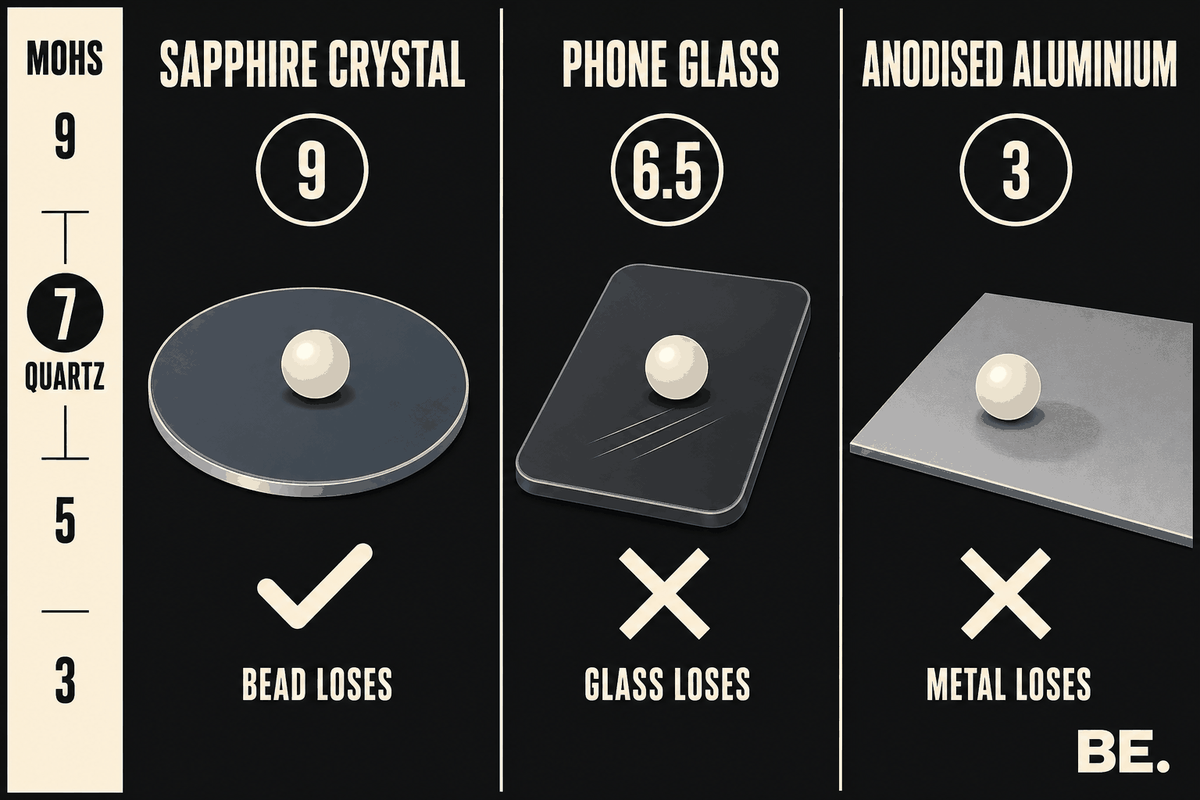
Yes. Chemically strengthened phone glass tests at roughly 6 to 6.5 on the Mohs scale, and quartz sits at 7. Harder marks softer, so the geometry is settled before anything else is considered. In practice the marks appear as fine hairlines rather than gouges, visible when the screen is off and light crosses it at an angle.
The one that surprises people is the back of the phone. Glass backs are the same material as the front, and they meet a bracelet far more often, because that is the surface a hand rests against while holding the device. A phone in a case removes the question entirely.
Will it scratch a watch crystal?
Only if the crystal is not sapphire. Watch glass comes in three materials with three completely different outcomes, and the answer changes from harmless to inevitable depending on which one a watch happens to use. It is worth finding out once, because it decides whether a bracelet and a watch can share a wrist at all.
| Surface | Approximate hardness | At risk from Mohs 7 beads? |
|---|---|---|
| Sapphire watch crystal | 9 | No |
| Mineral or hardened glass crystal | 5 to 6 | Yes |
| Acrylic watch crystal | About 3 | Yes, easily |
| Aluminosilicate phone glass | 6 to 6.5 | Yes, and grit makes it certain |
| Stainless steel case | 5.5 | Yes |
| Anodised aluminium laptop | 2.5 to 3 | Yes |
| Painted or lacquered surface | 3 to 4 | Yes |
| Untreated leather or fabric | Not applicable | No, but it abrades the strand |
Two of those rows deserve a note. Steel is softer than most people assume, which is why watch cases show hairlines within months regardless of what else is on the wrist. And anodised aluminium — the material of most laptop palm rests — is soft enough that a bracelet resting there while typing will polish a shine into the finish over a year.
Which stones are the risky ones, and which are not?
The whole quartz family is the risk side: clear, amethyst, citrine, smoky, rose, rutilated, hematoid, phantom and Super Seven all sit at or very near 7. Aquamarine sits slightly higher at 7.5 to 8. These are the stones that mark other things.
Several stones are on the receiving end instead. Obsidian is volcanic glass at 5 to 5.5, moonstone sits at 6 to 6.5 with two cleavage directions, prehnite at 6 to 6.5, and kyanite runs from 5.5 to 7 depending on which direction is tested. Against a steel watch case or a metal ring, these are the ones that lose. The full ladder is in the hardness chart, and the specific question of metal against beads is answered in the gold and silver guide.
What does the damage — the bead or the grit on it?
Mostly the grit. Ordinary household dust contains a large fraction of fine quartz particles, which are the same hardness as the bead carrying them and far more aggressive because they are angular rather than polished. A smooth sphere rolling across glass does very little; the same sphere with a film of dust between it and the glass behaves like fine abrasive paper.
This changes what prevention looks like. Being careful with a bracelet helps less than keeping it clean, because a clean polished bead is a poor cutting tool and a dusty one is a good one. A dry microfibre wipe every few days removes most of it. Cleaning method by stone is set out in the care chart.
How do you wear a bracelet near a watch without leaving marks?
- Put the bracelet on the non-dominant wrist and the watch on the other, which removes the contact entirely.
- If they share a wrist, leave a finger's width of gap and keep the bracelet on the elbow side.
- Wipe the beads dry before a day at a desk, because the grit does more than the stone.
- Take the strand off before typing for long stretches; a magnetic clasp makes that a one-handed motion.
- Check what the watch crystal is made of once, and stop worrying if the answer is sapphire.
Sensor readings, magnets and docking pads are a separate set of questions that come up as soon as the watch is a smart one. Those are handled in the smartwatch guide.
What about laptops, desks and car interiors?
These are softer than a phone screen and take marks faster. An anodised aluminium palm rest sits around 2.5 to 3 and will show a burnished patch where a wrist rests. Lacquered wood, piano-black plastic trim and painted door cards all sit in the 3 to 4 band, well under quartz.
Car interiors are the quiet one. A hand resting on a gear selector or a door pull puts a bracelet against the same small patch of trim thousands of times, and the result appears as a dulled area rather than an obvious scratch. None of this argues against wearing a strand. It argues for knowing which surfaces are softer than the stone, so the two meet on purpose rather than by accident.
Frequently asked questions
Q1.Do crystal bracelets scratch phone screens?
Quartz beads can. Phone glass tests around 6 to 6.5 on the Mohs scale and quartz sits at 7, so the beads are the harder material. The marks appear as fine hairlines visible at an angle when the screen is off. A case removes the risk.
Q2.Will crystal beads scratch a watch crystal?
It depends on the watch crystal: quartz beads can scratch mineral glass and acrylic, but not a sapphire crystal. Mineral glass at 5 to 6 and acrylic at around 3 both scratch readily. Finding out which one a watch uses answers the question permanently.
Q3.Is a sapphire watch crystal safe with a crystal bracelet?
Yes. Sapphire is corundum at 9 on the Mohs scale, well above quartz at 7, so no stone in a bracelet can mark it. The steel case around it is a different matter, since steel sits near 5.5 and does show hairlines.
Q4.Which crystal bracelet stones are too soft to scratch anything?
Obsidian at 5 to 5.5, moonstone at 6 to 6.5, prehnite at 6 to 6.5 and kyanite in its softer direction are all below common screen glass. Against steel or a metal ring these are the stones that take the damage rather than cause it.
Q5.How do I stop my bracelet marking my watch?
Wear them on opposite wrists, or keep a finger's width of gap with the bracelet on the elbow side. Wiping the beads clean matters more than being careful, because most marks come from grit carried on the bead rather than the bead itself.
Q6.Does dust on the beads make scratching worse?
Considerably. Household dust contains fine quartz particles that are as hard as the bead and much more angular, so a dusty bead behaves like abrasive paper while a clean polished one barely cuts at all. A dry microfibre wipe every few days is the effective prevention.
References
- Wikipedia — Mohs scale of mineral hardness
- Wikipedia — Gorilla Glass
- Wikipedia — Sapphire
- Mindat — Quartz mineral data
- Anderson, B. W. and Jobbins, E. A. (1990). Gem Testing, 10th ed. Butterworth-Heinemann.
Field Notes.
One stone at a time: its geology, and how to read quality. The Stone Buying Checklist comes with your first email.
By subscribing you agree to receive emails from BE. Unsubscribe anytime.
Sent. Check your inbox.