
Can You Wear Crystal Bracelets With Gold or Silver? Will Metal Scratch the Beads?
Stacking crystal bracelets with gold or silver: what scratches what, why quartz wins at Mohs 7, and how to pair warm and cool stones with each metal.
In this field note
People rarely wear one bracelet on its own any more. A crystal strand ends up next to a gold chain, a watch, a signet band, a stack of thin silver bangles. The worry that follows is reasonable: put a polished stone against metal all day and something has to give. The question is which one.
The answer comes straight from the hardness scale, and it is the opposite of what most people assume. This guide covers what actually scratches what, how to keep a mixed stack looking clean for years, and which stone colours flatter a gold stack versus a silver one.
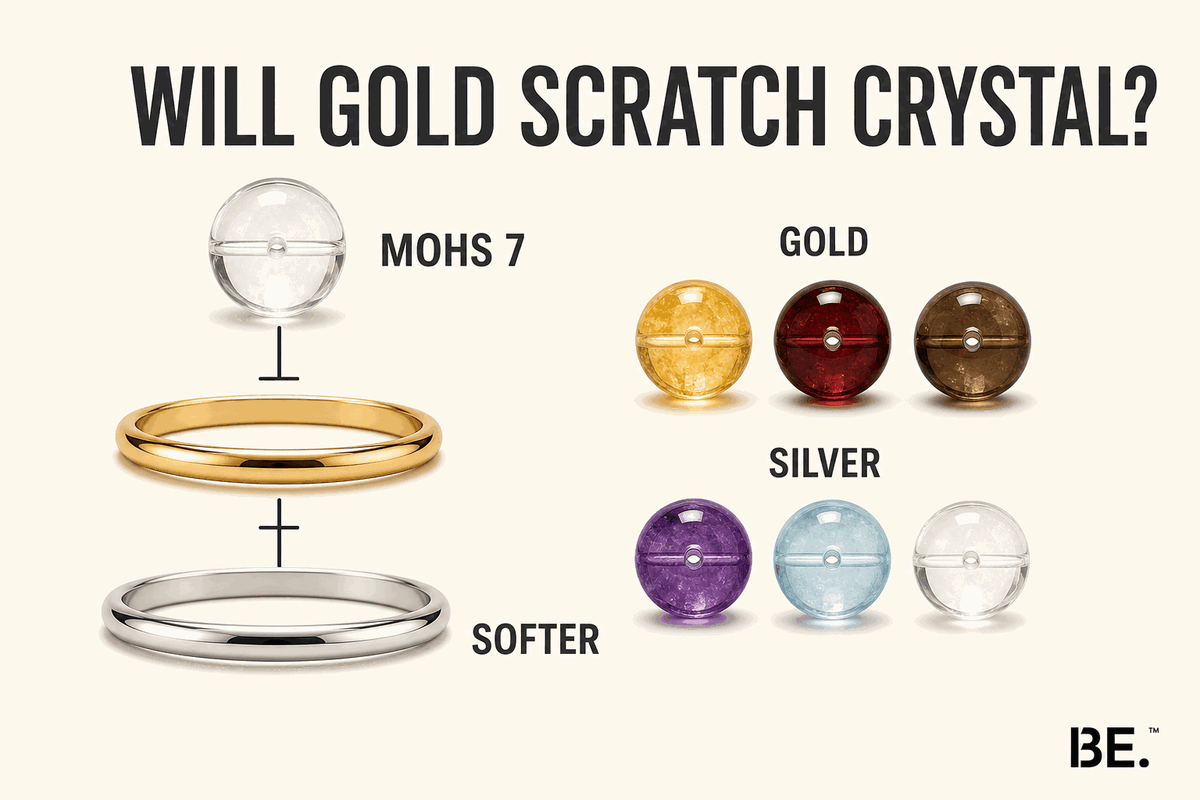
Will gold or silver scratch crystal beads?
No. On a mixed wrist, gold and silver are the softer materials, so they lose that contest. Quartz-family stones — clear quartz, amethyst, citrine, rose quartz, rutilated and hematoid quartz — sit at Mohs 7. Garnet runs 7 to 7.5, aquamarine 7.5 to 8. Every one of those is harder than the metals people usually stack them with.
| Material | Mohs hardness | Harder or softer than quartz |
|---|---|---|
| Quartz beads (amethyst, citrine, clear, rose, rutilated) | 7 | Reference point |
| Garnet | 7–7.5 | Harder |
| Aquamarine (beryl) | 7.5–8 | Harder |
| Stainless steel (watch case, clasp) | 5.5–6 | Softer |
| Titanium | ~6 | Softer |
| Platinum | 4–4.5 | Softer |
| 18k gold | 2.5–3 | Much softer |
| Sterling silver | 2.5–3 | Much softer |
| Gold sheen obsidian | 5–5.5 | Softer (the exception) |
Hardness is a ranking of what can scratch what: a higher number marks a lower one, never the reverse. A gold chain rubbing against an amethyst bead all day leaves a faint line on the gold. The amethyst is untouched. This is also why jewellers warn against tumbling diamonds loose with coloured stones, and it is the same logic on your wrist, one rung down. The same hardness comparison also answers whether crystal bracelets can scratch watches, phones or screens.
So what actually gets worn down?
The metal does, at the points where it rubs. A soft yellow gold bangle worn every day against a hard bead will, over months, pick up fine marks along the contact edge. On plated pieces the risk is higher, because the thin plating can thin further where it meets a harder surface. Solid gold and silver just develop the soft, used surface that most people file under patina rather than damage.
Three habits keep a mixed stack clean:
- Give the watch a buffer. A watch case and its sapphire crystal are the hardest things in most stacks. Keep a bead strand from grinding directly against a watch by placing a smoother band between them.
- Split the stack across two wrists. Two strands on one side, the metal on the other, reads as deliberate and halves the contact wear.
- Take everything off for the gym and manual work. Most contact damage happens during movement under load, not during a normal day. More on that in the gym, sauna and beach guide.
Which crystal colours suit a gold versus a silver stack?
Match the stone's undertone to the metal's. Yellow gold is warm, so it lifts stones with warm colour: honey, red, brown, gold-flecked black. Silver and white gold are cool, so they suit translucent and cool-toned stones: violet, blue, grey, water-clear. Rose quartz and clear quartz are the neutrals that bridge either way.
| Metal tone | Stones that sit well with it | Why |
|---|---|---|
| Yellow gold (warm) | Citrine, hematoid quartz, golden rutilated quartz, garnet, smoky quartz, gold sheen obsidian | Warm body colour and gold flecks echo the metal |
| Silver / white gold (cool) | Amethyst, aquamarine, moonstone, clear quartz, kyanite, blue smoky quartz | Cool and translucent tones read crisp against a cool metal |
| Either (neutral) | Rose quartz, clear quartz | Soft neutral colour works with both |
This is a starting point, not a rule to obey. A warm citrine against silver can look intentional if the rest of the stack agrees with it. If you want a shortcut to a stone in the right colour family, the Stone Finder sorts strands by colour and hardness.
How to stack so nothing gets damaged
The beads look after themselves. The two things worth planning are the soft exception and the order of the strands.
- Keep obsidian away from the metal. Gold sheen obsidian is volcanic glass at Mohs 5 to 5.5, softer than a steel clasp or watch case. Wear it at the end of a stack, next to a bead strand rather than a metal one, so nothing harder rubs its surface. The full picture is in the obsidian guide.
- Use clear quartz as a buffer. A plain clear-quartz strand between a hard stone and a soft one, or between beads and metal, spreads the contact and keeps polish intact.
- Think about the colour order as well. The same principles that make an all-crystal stack work apply here; the stacking guide covers bead size, weight and tone.
The magnetic clasp: build the stack you want
BE. Strands close with a magnetic clasp rather than elastic, and that changes what you can do with a stack. A magnetic clasp shuts with one hand — no fighting a tiny lobster catch against your own wrist — and it comes apart just as easily. That turns a fixed bracelet into something you rebuild.
Two strands can clasp end to end into a single wrap or a short necklace. A crystal strand can join a metal chain into one continuous piece. You can reorder beads by colour for a gold day or a silver day, then take it apart that evening. The stack is not decided once at the checkout; it is yours to reset whenever the rest of the outfit changes.
How BE. reads a strand for a mixed stack
Every BE. strand is graded on the Crystal 4T framework — Transparency, Tone, Texture and Treasure — and ships with a Stone Origin Record recording the material and any treatment. For a stack that mixes metal and stone, the number that matters most is hardness: it tells you where a stone sits in the pecking order on your wrist, and whether it needs the buffer that obsidian does.
Frequently asked questions
Q1.Will gold or silver scratch my crystal beads?
No. Quartz-family stones are Mohs 7, harder than 18k gold and sterling silver (both around 2.5 to 3), platinum, and stainless steel. Where they rub, the metal takes the mark, not the stone.
Q2.Will my crystal bracelet damage my gold jewellery?
It can, slowly, at the contact points. Because gold is softer, a hard bead rubbing against it every day leaves fine marks over months, and plated pieces are more exposed than solid gold. Adding a smoother band between the stone and the metal reduces it.
Q3.Can I stack obsidian with metal bracelets?
With a little care. Gold sheen obsidian is volcanic glass at Mohs 5 to 5.5, softer than steel, so a metal clasp or watch case can scratch it. Wear obsidian at the end of a stack, next to a bead strand rather than a metal one.
Q4.What crystal colours go with gold jewellery?
Warm-toned stones suit yellow gold: citrine, hematoid quartz, golden rutilated quartz, garnet, smoky quartz and gold sheen obsidian all echo the metal's warmth.
Q5.What crystal colours go with silver?
Cool and translucent stones read well against silver and white gold: amethyst, aquamarine, moonstone, clear quartz, kyanite and blue smoky quartz. Rose quartz and clear quartz work with either metal.
Q6.Can I join a crystal strand to a metal bracelet?
With a magnetic clasp, yes. BE. Strands clasp end to end, so a crystal strand can link to another strand or a metal chain to make a wrap or a short necklace, then come apart again by hand.
References
- Wikipedia — Mohs scale of mineral hardness
- GIA Gem Encyclopedia
- Gem-A — The Gemmological Association of Great Britain
- Read, P. G. (2005). Gemmology, 3rd ed. Butterworth-Heinemann.
Field Notes.
One stone at a time: its geology, and how to read quality. The Stone Buying Checklist comes with your first email.
By subscribing you agree to receive emails from BE. Unsubscribe anytime.
Sent. Check your inbox.