
Stone Finder: Choose a Crystal Bracelet by Colour & Hardness
A decision table to choose a crystal bracelet by colour, hardness and budget, matching what you want to look at with how it needs to be cared for.
In this field note
The crystal aisle is usually sorted by mysticism. It’s far more useful to sort it the way you actually decide: by the colour you’ll wear, how tough it needs to be, and what you want to spend. Use the table below as a finder: read across from a colour to the stone, its hardness, and the practical note that tells you how to live with it.
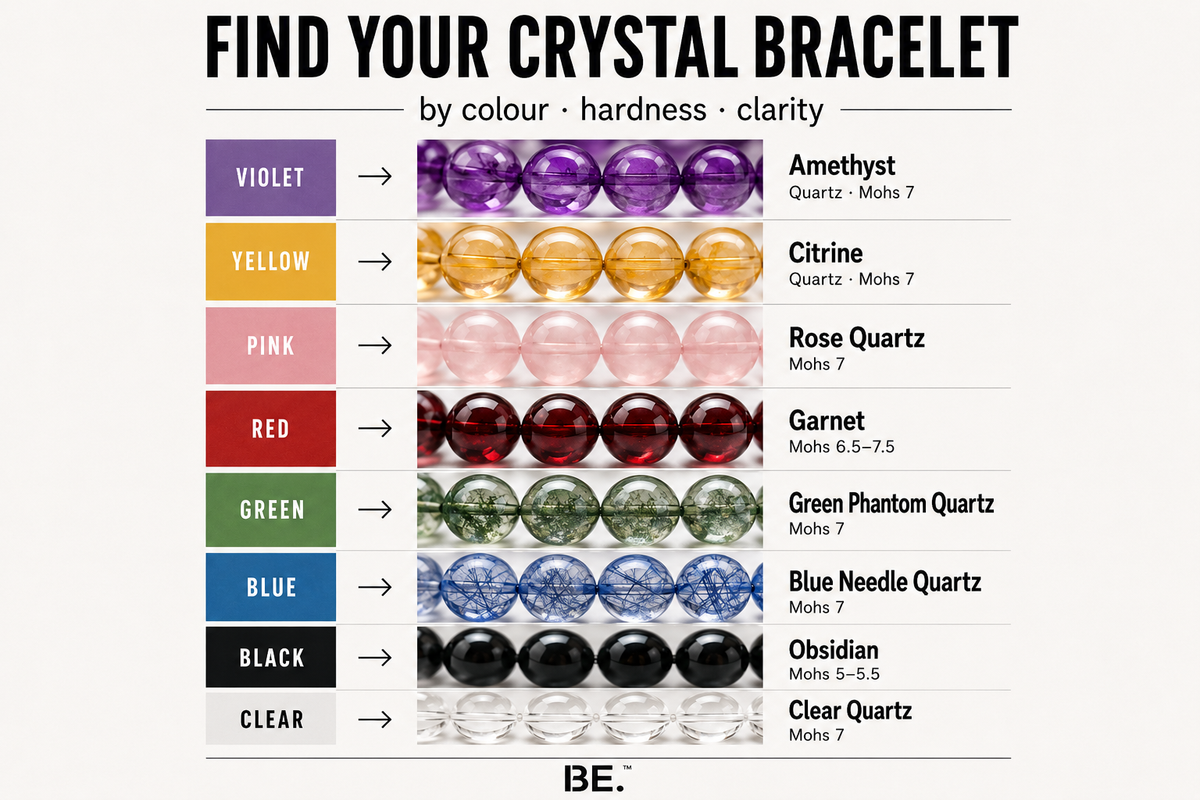
Find your stone by colour
| Colour | Stone(s) | Mohs | Practical note |
|---|---|---|---|
| Violet / purple | Amethyst | 7 | Easy-care; keep out of long sun. |
| Yellow / gold | Citrine, golden rutilated quartz | 7 | Durable; check natural vs heated. |
| Pink | Rose quartz | 7 | Forgiving; soft cloudy pink. |
| Red / rust | Garnet, hematoid quartz | 7–7.5 | Tough; mind exposed iron veins. |
| Green | Prehnite, green phantom | 6–7 | Prehnite softer; handle gently. |
| Blue | Kyanite, aquamarine, blue smoky quartz | 5.5–8 | Kyanite has cleavage; aquamarine hardest. |
| Black | Obsidian | 5–5.5 | Softest; store apart, no abrasion. |
| Clear / white | Clear quartz, moonstone | 6–7 | Quartz hard; moonstone has cleavage. |
| Smoky / brown | Smoky quartz | 7 | Durable; avoid strong heat/UV. |
Then filter by hardness (lifestyle)
- Very active / hands-on. Choose Mohs 7+: quartz family, aquamarine, garnet. They shrug off daily contact.
- Everyday but careful. Mohs 6–6.5 stones (moonstone, prehnite) are fine with a little awareness around knocks.
- Occasional / statement wear. Softer or cleavage-prone stones (obsidian, kyanite) suit lighter, considered wear.
Finally, filter by price
Within a single maker, price tracks material quality, not markup: clarity, colour saturation, bead-to-bead matching and rarity. A more accessible strand and a premium one can be the same mineral; the difference is in the grade. Decide which of those qualities you care about most (even colour? flawless clarity? perfectly matched beads?) and choose at the level that delivers it. Every BE. strand lists its price so you can compare like for like.
Putting the three filters together
- Colour first. You’ll wear what you like looking at, so start there.
- Hardness as reality check. Make sure the stone suits how you live, or adjust how you wear it.
- Care fits habits. If you won’t baby a soft stone, choose a quartz.
- Price last. Pick the grade that delivers the quality you care about most.
- Confirm the size. Measure your wrist so the one you choose actually fits.
How BE. grades what you choose
Whichever stone the finder lands you on, BE. reads that strand against the Crystal 4T framework (Transparency, Tone, Texture, Treasure) and ships it with a Stone Origin Record recording mineral, hardness and source. So the choice you make on colour and lifestyle is backed by a written record of the material.
Frequently asked questions
Q1.How do I choose a crystal bracelet?
Filter on three things in order: the colour you want to wear, the hardness your lifestyle needs, and your price range. Match colour to stone, check Mohs against your wear, then choose the grade within your range.
Q2.What colour should I get?
The colour you’re drawn to and will wear most. As a first guide, purple points to amethyst, yellow to citrine, green to prehnite or green phantom, blue to kyanite or aquamarine, red to garnet or hematoid, black to obsidian, clear or milky white to quartz or moonstone; colour alone does not confirm the stone.
Q3.Best for an active lifestyle?
A Mohs 7 or harder stone, such as one from the quartz family or aquamarine, resists everyday scratching. Softer stones like obsidian and moonstone suit gentler wear.
Q4.How should price factor in?
Price tracks rarity, grade and matching, not a fixed rule. Within one maker, more accessible and premium strands differ in clarity, saturation and consistency. Choose the qualities that matter most to you.
Q5.Colour or hardness first?
Colour first, because you’ll wear what you like looking at, then hardness as the practical filter. A softer favourite can still work with adjusted wear and care.
Q6.Easiest to care for?
Quartz-family bracelets at Mohs 7 (clear quartz, amethyst, citrine, smoky) are hardest, have no cleavage, and tolerate brief water cleaning.
References
- Gem Encyclopedia: GIA
- Mohs scale: Wikipedia
- Mineral data: Mindat.org
- BE. Journal (2026). Crystal Hardness Chart: Which Bracelets Survive Daily Wear.
- Hurlbut & Klein (1993). Manual of Mineralogy, 21st ed. Wiley.
Field Notes.
One stone at a time: its geology, and how to read quality. The Stone Buying Checklist comes with your first email.
By subscribing you agree to receive emails from BE. Unsubscribe anytime.
Sent. Check your inbox.