
Are Crystal Bracelets Still in Style? (2026)
As of 10 August 2026, gemstone bracelets fit visible styling signals, but selected examples do not prove universal adoption.
In this field note
The direct answer is yes, crystal bracelets can look current in 2026, but “current” is not the same claim as “universally popular”. The evidence available to us is a selected set of runway reports, fashion editorials, brand presentations and retail supply. We did not obtain a reproducible 2026 search-interest export, an independent category-sales series or a population survey showing how many people wear crystal bracelets.
This article therefore treats style as a set of observed design signals, not a vote count. It does not use BE. product availability as evidence that the market is growing, and it does not turn a dated fashion snapshot into a reason to buy.
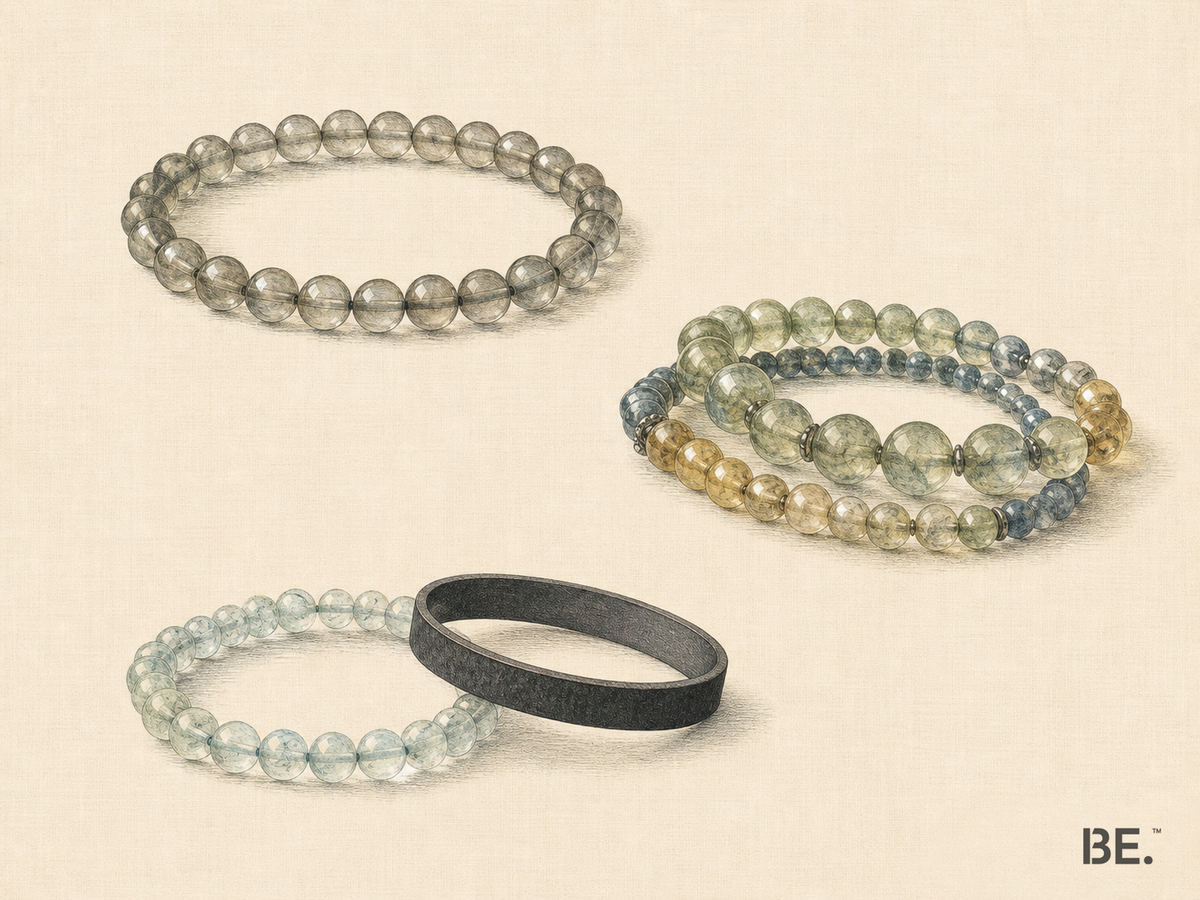
The 2026 answer: current, not universal
Selected Spring and Summer 2026 coverage includes beads, gemstones, crystals, bracelet stacks and coloured or crafted strands. Those appearances are enough to show that beaded wrist jewellery has not disappeared from the current design vocabulary. They are not enough to establish that crystal bracelets are the year’s largest trend, that most people wear them or that demand is accelerating.
“Still in style” is best read as permission to wear what suits you. A stone bracelet can sit naturally beside a plain shirt, tailoring, knitwear or other jewellery. It does not need a trend label to justify its material, proportion or construction.
What does the 2026 evidence actually show?
Runway and editorial signals
As of 2026-08-10: Vogue’s Spring 2026 survey identifies stacked strands and a movement from humble beads towards gemstones and crystals in selected collections. NET-A-PORTER’s commercial editorial highlights large beads and stacked bracelets, while Harper’s Bazaar and Marie Claire feature selected examples of colourful, semiprecious, crafted or mixed-bead jewellery. These are curated observations, not random samples of the population.
Celine’s Spring 2026 presentation describes charms designed to be collected, combined and layered. That supports modularity as one current styling signal within one brand’s offer. It does not show that unrelated bracelet systems connect, and it does not establish an industry-wide mechanism or preference.
Retail supply is not demand
Current retail assortments include stone-bead bracelets in materials such as onyx, malachite, tiger’s eye and lapis lazuli. Availability confirms that the form is being offered. It cannot reveal sell-through, market share, growth or consumer prevalence without separate data.
The strongest responsible conclusion is therefore limited: crystal and gemstone bracelets are present across selected 2026 fashion and retail signals. The size of the audience and direction of sales remain unverified.
Which styling routes make sense in 2026?
A restrained single strand
BE.’s first styling route is a single strand with a clear material identity. This is a brand recommendation, not a measured trend statistic. It keeps colour, translucency, inclusions and bead scale visible without asking the bracelet to carry an entire outfit.
An intentional stack
Selected 2026 editorials show bracelet stacking, but a useful stack still needs decisions. Repeat one element (colour temperature, bead scale, metal tone or surface finish) and vary another. Leave enough physical space to reduce abrasion and prevent the combination from becoming an undifferentiated band. The full material and hardness rules belong in our stacking guide.
Colour and material contrast
Selected 2026 sources show coloured and mixed materials, but contrast does not require maximalism. A dark stone against a pale sleeve, a translucent strand beside a matte watch strap or one mineral colour repeated elsewhere in the outfit can make the choice deliberate. These are styling options, not a universal 2026 dress code.
Are round beads themselves dated?
Selected 2026 collections contain both round and irregular beads, so the round bead cannot be dismissed as inherently obsolete. A sphere is a geometry, not a decade. What changes the reading is the whole object: material disclosure, bead diameter, polish, clasp, spacing, finish and the way it is worn.
A bracelet may look generic when its material is vague, its proportions fight the wrist or every element competes equally. The remedy is not to chase a different trend word. It is to choose a clearer material, scale and relationship to the rest of the wardrobe.
How do you choose beyond a dated trend?
Start with facts that survive the season: what the material is, how the surface behaves, how the bracelet fits, how the components are constructed and whether the seller’s description is specific enough to check. Then decide whether you prefer one quiet strand, a controlled stack or a stronger colour contrast.
A trend can supply a fresh viewing angle; it should not replace a buying standard. If a bracelet only makes sense while a 2026 label is attached to it, it is more fragile than a choice grounded in material, proportion and repeated wear.
The evidence, layer by layer
| Evidence layer | Dated observation | What it supports | What it does not support |
|---|---|---|---|
| Runway editorial | As of 2026-08-10: Vogue’s Spring 2026 survey includes stacked strands and selected movement from beads towards gemstones and crystals. | Beads, stones and layered wrist forms are visible in selected collections. | Consumer prevalence, category sales or a claim that all crystal bracelets are fashionable. |
| Commercial editorial | As of 2026-08-10: NET-A-PORTER presents large beads, bracelet stacking and multi-stone pieces in its 2026 jewellery coverage. | Bead scale and stacks are present in a current retailer-editorial selection. | Independent demand evidence, unbiased sampling or market growth. |
| Affiliate editorial | As of 2026-08-10: Harper’s Bazaar and Marie Claire show selected coloured, semiprecious, crafted and mixed-bead jewellery. | Colour and bead material are visible editorial styling signals. | A majority preference, long-term adoption or evidence for every demographic. |
| Brand primary source | As of 2026-08-10: Celine presents charms intended for collecting, combining and layering. | Modular collecting is one current direction within that brand. | Compatibility between unrelated products or an industry-wide consensus. |
| Retail supply | As of 2026-08-10: stone-bead bracelets remain offered in current high-end retail assortments. | The product form is available for purchase. | Sell-through, sales growth, market share or how many people wear it. |
| Missing quantitative layer | As of 2026-08-10: no reproducible search-interest export, independent category-sales series or wearer-prevalence survey was obtained for this article. | The conclusion must remain qualitative and bounded. | “Everyone is wearing them”, “sales are surging” or any growth curve. |
Current strands are listed in the BE. collection, and every strand ships with a Stone Origin Record that states its lot, its four Crystal 4T™ readings and what those readings do not claim.
Frequently asked questions
Q1.Are crystal bracelets fashionable in 2026?
As of 2026-08-10, selected runway, editorial and retail sources include beads, gemstones, crystals and bracelet stacks. That supports “current as a styling option”, not “universally popular” or “rising in sales”.
Q2.Should I wear one strand or a stack?
Both routes fit the selected evidence. Choose one strand when you want the material to read clearly; choose a stack when you can repeat one visual element, vary another and keep the pieces from abrading each other.
Q3.Are round bead bracelets dated?
Selected 2026 collections still include round beads, so the shape is not inherently obsolete. Material disclosure, bead scale, surface, clasp and the rest of the outfit determine how the bracelet reads.
Q4.Can coloured stones work with minimal clothing?
Selected 2026 jewellery coverage includes colour, but a minimal outfit does not require a loud stack. One controlled mineral colour against a neutral sleeve can provide enough contrast.
Q5.Are bead bracelets current for men?
The available evidence does not justify a gender-exclusive rule. Choose by wrist fit, bead proportion, material, finish and personal wardrobe, and set aside any stereotype attached to the wearer.
Q6.Will this look remain in style after 2026?
As of 2026-08-10, that is unknown. Trend evidence is time-sensitive. Material identity, sound construction, comfortable proportion and a place in your regular wardrobe are more durable buying criteria than a forecast.
References
Field Notes.
One stone at a time: its geology, and how to read quality. The Stone Buying Checklist comes with your first email.
By subscribing you agree to receive emails from BE. Unsubscribe anytime.
Sent. Check your inbox.