
A Short History of Bead Bracelets
No single inventor or straight global lineage is verified. Follow separate evidence from shells, original strings, wrist finds and glass-bead networks.
In this field note
A bead is durable. Its string usually is not. That imbalance shapes almost everything we think we know about the history of bead bracelets: shell, stone, faience, glass and metal can survive for millennia while fibre decays, arrangements disperse and later museum stringing makes a group look more certain than it is.
A careful history therefore asks several narrower questions. How old is a perforated ornament? Is an assembly still on its original string? Was it found on a wrist, or is “bracelet” a later catalogue judgement? Each answer can be valuable without being turned into a single origin story.
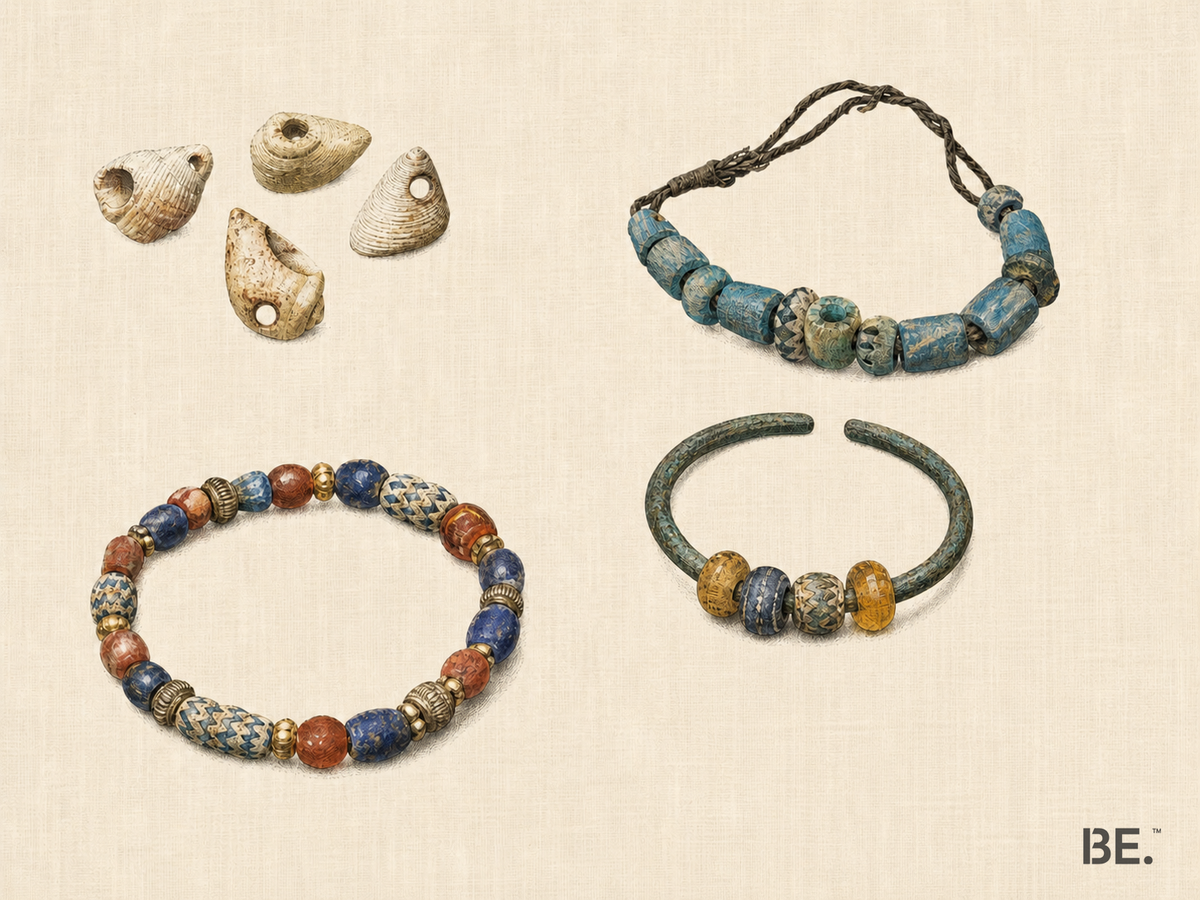
Why is there no single verified origin?
The oldest bead, bracelet assembly and wrist context are different questions
A pierced object may have been sewn to clothing, suspended from a cord, worn at the neck, attached to hair or used in another arrangement. It becomes stronger evidence for a bracelet when the position or construction is preserved. That is why “old bead” and “old bead bracelet” are not interchangeable claims.
The global record is also uneven. Burial practice, soil chemistry, excavation history and museum collecting all affect what survives and what was documented. Naming one object as the universal first bracelet would require a dedicated comparative review, not a single impressive catalogue entry.
What decay and reconstruction remove
Organic cords disappear far more readily than beads. The Metropolitan Museum of Art makes the problem explicit in its record for ancient gold-glass beads: the displayed groups are modern stringings because most ancient stringing patterns were lost when the strings decayed. A modern loop can preserve beads while obscuring their original order, length and body placement.
Before a secure bracelet: early personal ornaments at Bizmoune
A 2021 Science Advances study reports 33 perforated marine shells from Bizmoune Cave in south-west Morocco. Many came from deposits dated to at least about 142,000 years ago. Their modification and use-wear support interpretation as personal ornaments and as evidence of social signalling.
The responsible term here is personal ornament. The find does not establish a wrist position, a flexible bracelet construction or crystal jewellery. It expands the deep history of perforated objects worn or displayed by people without answering which part of the body carried them.
When original string or wrist context survives
Deir el-Bahri: original string, uncertain body position
The Met catalogues a blue-faience object from Deir el-Bahri, Egypt, dated to about 2051–1981 BCE, as a “bead bracelet or anklet”. Its original string survives. That is unusually strong construction evidence, yet the museum keeps the body position open. Preserving that label is more accurate than shortening it to a definite bracelet.
The bracelet of Hepy: a named excavated burial
Another Met object, dated to about 1950–1885 BCE, is catalogued as the Bracelet of Hepy. Gold spacers and lapis lazuli beads were recorded in a specific burial excavated at Lisht South. The named findspot and museum identification make it a well-documented bracelet case; they do not authorise a claim about the meaning of all Egyptian bead jewellery.
Matmar: beads recorded on a wrist
British Museum object EA63445 is a mixed-material bracelet from Matmar, Grave 1213, assigned to Egypt’s First Intermediate Period. Its catalogue records lapis lazuli, glazed composition, gold, carnelian, steatite and silver, and states that it was found on the wrist of a woman. That wrist-find record is direct contextual evidence for use as a bracelet in this one burial.
It does not tell us that all people of the period wore the same combination, that the materials carried a universal protective meaning, or that the object belongs to a continuous line ending in today’s gemstone strands.
Different constructions are not a ladder of progress
British Museum object ML.1427, dated to about 250–150 BCE and associated with Somme-Bionne in France, takes a different approach: a penannular copper-alloy bangle threaded with four glass and amber beads. It combines a rigid metal form with movable beads rather than using a fully flexible strand.
This is not a missing step between an ancient shell and a modern bracelet. It is evidence that bead and bracelet technologies were combined in more than one way. Different forms can coexist, disappear and return without descending from one another.
How glass production and trade expanded the possibilities
Glass changed what makers could repeat: colour, translucency, patterned surfaces and bead shapes could be engineered rather than found in a natural material. The Met describes gold-glass beads from Egypt dated 100 BCE–200 CE as colourless glass tubes combined with gold foil, while warning that the surviving beads are now on modern strings.
The Corning Museum of Glass’s Life on a String exhibition brought together 3,500 years of glass beads and beaded objects. Its scope included ornament, fashion, ritual, power, wealth, production and exchange across distinct cultures. It also states that beads manufactured in Europe and distributed in Africa and North America embody economic and political relationships, especially during European colonisation.
That last boundary matters. “Trade beads” were not simply a neutral global currency, and their meanings cannot be merged across regions. Manufacturing, exchange, coercion, local production and later collecting each require their own provenance.
Case studies and the strength of their evidence
| Date and context | Object and material | Bracelet evidence | What is secure | What remains uncertain |
|---|---|---|---|---|
| At least about 142,000 years ago; Bizmoune Cave, Morocco | Thirty-three perforated marine shells reported as personal ornaments | None specific to the wrist | Human modification, wear and an early personal-ornament context | Body position, string arrangement and any relation to bracelets |
| About 2051–1981 BCE; Deir el-Bahri, Egypt | Blue-faience beads with original string | Construction survives; museum labels it bracelet or anklet | Date, findspot, material and original string | Whether it was worn at the wrist or ankle |
| About 1950–1885 BCE; burial of Hepy, Lisht South, Egypt | Gold spacers and lapis lazuli beads | Met catalogue identification as a bracelet in a named burial | Excavated context, date range, material and museum identification | Any wider social or symbolic meaning beyond this object |
| First Intermediate Period; Matmar Grave 1213, Egypt | Mixed lapis lazuli, glazed composition, metals, carnelian and steatite beads | British Museum records it as found on a woman’s wrist | Wrist context, materials and excavated grave record | Universal meaning, identity rule or continuous descent |
| About 250–150 BCE; Somme-Bionne, France | Copper-alloy penannular bangle threaded with glass and amber beads | Rigid bracelet form survives | Construction, materials, dimensions and broad date range | Specific wearer, burial context and intended symbolism |
| 100 BCE–200 CE; Egypt | Gold foil between drawn colourless glass tubes | No original bracelet arrangement; current strings are modern | Glass technique, date range and loss of ancient stringing patterns | Original order, length and body placement |
| A 3,500-year exhibition frame across multiple regions | Glass beads and beaded objects made by different cultures | Many object types, not one bracelet lineage | Varied technologies and uses, including trade and colonial political economy | Any single shared meaning or uninterrupted global tradition |
What modern strands do—and do not—inherit
A modern bead bracelet shares a basic engineering idea with many older objects: repeated perforated units arranged on a support around the body. That similarity is real but broad. It does not prove that a contemporary gemstone strand inherits the beliefs, identity or authority of any particular archaeological object.
Modern construction has its own evidence trail: drilled tolerances, steel wire or cord, clasps, standardised wrist sizes, supply chains and commercial naming. Those practical questions belong in the material and stringing guide. Obsidian-specific history belongs in the obsidian history and care guide. Keeping those owners separate prevents ancient objects from becoming modern sales provenance.
Frequently asked questions
Q1.What is the oldest known bead?
The Bizmoune Cave study reported 33 perforated marine shells, many from deposits at least about 142,000 years old, as exceptionally early personal ornaments. No global record is permanently fixed. They do not establish a bracelet or a wrist position.
Q2.What is the oldest bead bracelet?
There is no agreed oldest bead bracelet. A responsible claim must distinguish a perforated bead from an assembled strand and an actual wrist context. Museum cases with original string or a recorded wrist find are stronger evidence, but a global “first” requires a comparative review beyond one object.
Q3.Why are ancient beads often restrung?
Fibre and other organic supports decay more readily than shell, stone, glass or metal. Museums may restring surviving beads for storage or display, but a modern arrangement does not prove the ancient order, finished length or body placement.
Q4.Were bead bracelets always spiritual?
No. Documented bead objects have served ornament, identity, exchange, power, fashion, ritual and other local purposes. Meaning must come from the individual object and its context, not from a universal claim about beads.
Q5.When did glass beads become widespread?
Glass beads were present at eastern Mediterranean production sites by the second millennium BCE, but they became widespread at different times in different regions. Distribution and meaning changed by place and period.
Q6.Is a modern gemstone strand part of the same ancient tradition?
Not in any continuous, globally proven sense. Modern strands share the broad act of arranging perforated units around the body, but their materials, supports, clasps, sizing, supply chains and meanings require their own documentation.
References
- Sehasseh et al. (2021) — Early Middle Stone Age Personal Ornaments from Bizmoune Cave, Essaouira, Morocco, Science Advances
- The Metropolitan Museum of Art — Bead Bracelet or Anklet, object 25.3.248
- The Metropolitan Museum of Art — Bracelet of Hepy, object 34.1.156a–e
- British Museum — Bracelet, Bead, Spacer-Bar, EA63445
- British Museum — Bracelet, ML.1427
- The Metropolitan Museum of Art — Gold-Glass Bead, object 10.130.3225a
- Corning Museum of Glass — Life on a String: 35 Centuries of the Glass Bead
Field Notes.
One stone at a time: its geology, and how to read quality. The Stone Buying Checklist comes with your first email.
By subscribing you agree to receive emails from BE. Unsubscribe anytime.
Sent. Check your inbox.