
Is Wearing Crystals Religious?
Mineral jewellery is not inherently religious. Intent, symbols, use and community context distinguish ordinary, personal and devotional meanings.
In this field note
A polished quartz bead is a mineral object. It does not disclose why somebody chose it. Two visually similar strands can play very different roles: one may be worn for colour and texture, another may carry private spiritual meaning, and a third may be used within a documented devotional practice.
That is why the question cannot be answered by labelling every crystal bracelet religious or non-religious. The useful answer separates the material from the meaning people give it, then keeps theological and legal decisions with the communities and authorities responsible for them.
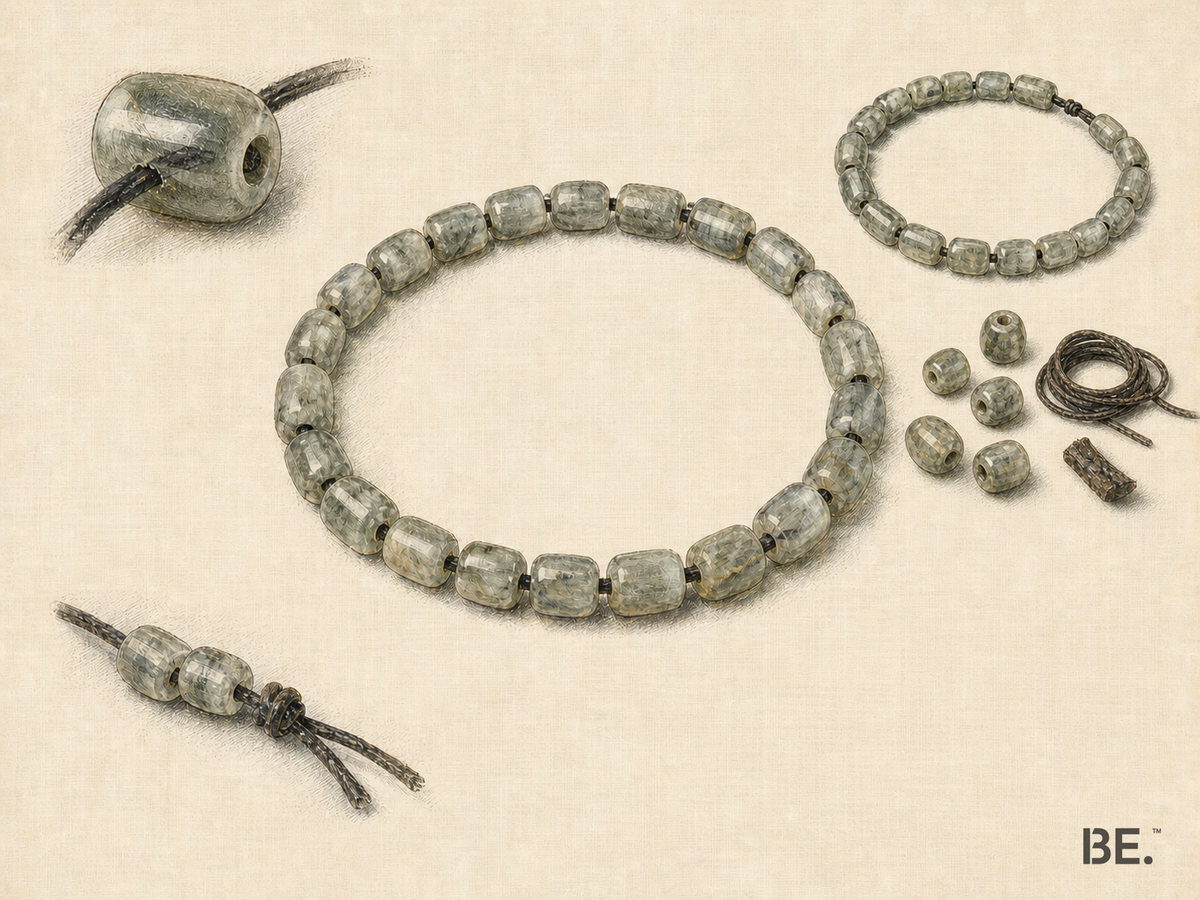
What can make an act of wearing religious?
Whether wearing a stone is religious depends on four things: the wearer’s purpose, any symbols attached to it, how it is used, and the tradition it is used in.
This is also why appearance is a poor guide to belief. A plain strand may be spiritually significant to one wearer and entirely secular to another. A recognisable devotional object may carry a defined use within a particular tradition, but that does not turn every loop of beads into the same kind of object.
Four contexts that are often mixed together
Material and fashion
A bracelet can be chosen for mineral identity, colour, optical effect, bead scale, construction or how it sits beside other jewellery. In this context, the stone is being treated as a material. Wearing it makes no statement about religion unless the wearer chooses to make one.
Personal spirituality
Some people give crystals a private spiritual role without describing that role as membership in an organised religion. Pew Research Center’s 2023 U.S. survey found both overlap and separation between the words spiritual and religious; 12% of U.S. adults in that survey said they possessed crystals for spiritual purposes. That figure describes responses to one U.S. survey. It does not classify every crystal owner, country or practice.
A qualitative study of crystal wearing in Estonia likewise documents one New Spirituality setting in which meaning develops through everyday practice. It is evidence that such a context exists, not evidence that all people who wear crystals share it.
Devotional and religious practice
Beads can become part of religious practice when a community gives them a defined structure and use. The Smithsonian’s account of Catholic rosaries, for example, describes beads or knots arranged at regular intervals to support a specific sequence and rhythm of prayer, often with a cross or medals. The devotional role comes from that sourced form and practice, not from round beads as a universal category.
Other communities have their own counting objects, terms and rules. Those should be described from sources within the relevant tradition rather than blended into one generic story about “spiritual beads”.
Commercial brand presentation
A brand can market mineral jewellery through supernatural promises, cultural references, fashion language or material documentation. That presentation tells you about the brand’s claims; it still does not reveal the private beliefs of every customer. BE. uses geology, optics, provenance, construction and care as its public language.
How context changes the answer
| Context | Where meaning comes from | What may be observable | What can be said responsibly | Boundary |
|---|---|---|---|---|
| Material or fashion jewellery | The wearer’s preference for a mineral, colour, scale or construction | A strand with no defined devotional sequence or sourced sacred symbol | It can be worn as ordinary jewellery | Appearance cannot prove that the wearer has no private spiritual meaning |
| Personal spirituality | The individual’s own interpretation or ritual | Often nothing that an outside observer can classify reliably | Spiritual self-description can overlap with religion or remain separate | One survey or local study cannot define every person or region |
| Devotional or religious practice | A specific tradition, prayer sequence, symbol, rule or community use | Documented grouping, counting rhythm, symbols or prescribed handling may be present | The object may be religious within that particular sourced context | Do not transfer one tradition’s meaning to all bead objects |
| Commercial presentation | The claims and language chosen by a seller | Product descriptions, disclosures and brand position | A brand can state what it does and does not claim | A seller cannot assign beliefs to the wearer |
Are prayer beads the same as bead bracelets?
No. They may share materials or a repeated bead form, but function is not determined by geometry alone. A devotional string can use bead groups or knots to count a named prayer sequence. A bracelet can use similar components simply to make a wearable loop. Documented symbols, handling and community practice carry more information than the presence of beads.
The careful comparison is therefore object by object. A museum catalogue can identify a rosary because it records form, provenance and use. An unmarked mineral bracelet without that context should not be given a religious identity by an observer.
What if my faith has rules about charms or stones?
Use a current source from your own tradition and ask a trusted religious authority who understands the intended use. The distinction between “I wear quartz because I like the material” and “I expect this object to exercise supernatural power” may matter within a particular teaching, but this article cannot decide that teaching for the wearer.
One official Catholic example shows why specificity matters: paragraph 2117 of the Catholic Catechism addresses magic, sorcery and wearing charms within Catholic teaching. It is evidence for that document’s position. It is not a ruling about every Christian, every mineral jewel or any other religion.
What about a workplace or school?
Rules and legal protections depend on jurisdiction and facts. In U.S. employment guidance, the Equal Employment Opportunity Commission says that the same outward practice can be religious for one person and secular for another because motivation and context matter. The same page also states that the guidance does not itself have the force of law.
That principle is useful for understanding why an employer or school should not classify a person by appearance alone. It is not a promise that a particular bracelet will receive an accommodation. Check the current policy, explain the actual practice where appropriate, and seek qualified local advice for a legal dispute.
BE.’s material-first position
BE. is not a religious or spiritual authority. We describe what can be checked: mineral species, formation, inclusions, optical behaviour, source disclosure, bead scale, construction and care. BE. does not promise healing, protection, manifestation or a change in the body.
A wearer may still give a bracelet private cultural, spiritual or personal meaning. That meaning belongs to the wearer. The reasons for keeping it separate from product claims are set out in Why BE. Avoids Crystal Claims, while the material definition of a crystal is covered in Crystals Are Not Magic — They Are Geology.
Anyone can wear crystal jewellery, with a religion or without one.
Frequently asked questions
Q1.Is a crystal bracelet a religious symbol?
Not by itself. A mineral bracelet can be ordinary jewellery, personally meaningful or part of a specific religious practice. Intent, documented symbols, use and community context determine the role; bead shape alone does not.
Q2.Can crystals be spiritual but not religious?
Yes, some people describe their crystal use that way. U.S. survey evidence shows overlap between spiritual and religious identities as well as people who identify as spiritual but not religious. That is a personal description, not a universal category for crystal wearers.
Q3.What if my faith discourages charms?
Ask a trusted authority within your own tradition and explain how you intend to use the object. A material-only jewellery choice and a claim that an object has supernatural power may be treated differently, but only the relevant community can give faith-specific guidance.
Q4.Are prayer beads the same as bead bracelets?
No. They can share beads and string, but prayer beads have a documented devotional use, often including a counting sequence, grouped structure or specific symbols. An ordinary bracelet should not be classified as devotional without that context.
Q5.Can a workplace or school treat a crystal bracelet as religious?
Possibly, if the wearer connects it to a sincerely held religious practice, but rules and legal protections vary by jurisdiction and case. Appearance alone is not enough. Check current policy and obtain qualified local advice where a legal right is disputed.
Q6.Is BE. a spiritual or religious brand?
No. BE. is geology-led. We describe mineral identity, optics, provenance, construction and care, and BE. does not promise supernatural, medical or religious effects. Any private meaning remains the wearer’s own.
References
- Pew Research Center — Spirituality Among Americans
- National Museum of American History — Beads of Faith: Exploring the Diversity of American Rosaries
- U.S. Equal Employment Opportunity Commission — Section 12: Religious Discrimination
- Teidearu, T. (2019) — The Practice of Wearing Crystals in Contemporary New Spirituality in Estonia
- Catechism of the Catholic Church — Part Three, Section Two, Chapter One, Article 1, paragraphs 2110–2117
Field Notes.
One stone at a time: its geology, and how to read quality. The Stone Buying Checklist comes with your first email.
By subscribing you agree to receive emails from BE. Unsubscribe anytime.
Sent. Check your inbox.