
Citrine in Feng Shui: Cultural Reading & Material Truth
A cultural reading of citrine in Chinese feng shui tradition — colour symbolism, historical use, and what the material actually is behind the label.
In this field note
Feng shui (“wind and water”) is a Chinese geomantic system documented from at least the Han dynasty, codified in classical texts on landscape, architecture, and burial siting. Modern interior-design feng shui is one branch of a much older tradition that originally addressed where to build a city, where to dig a well, and where to put a tomb. The colour-element-direction grid — yellow / earth / southwest — is taken from the same Five Phases (wuxing) framework used in traditional Chinese medicine and Han cosmology.
Citrine, as a saturated yellow stone, slots into this grid neatly. That is why it appears in contemporary feng shui recommendations as a “wealth corner” placement object. The slot is cultural and symbolic. Whether placing a yellow stone in the southwest of a room affects the inhabitants’ finances is not a material-science question.
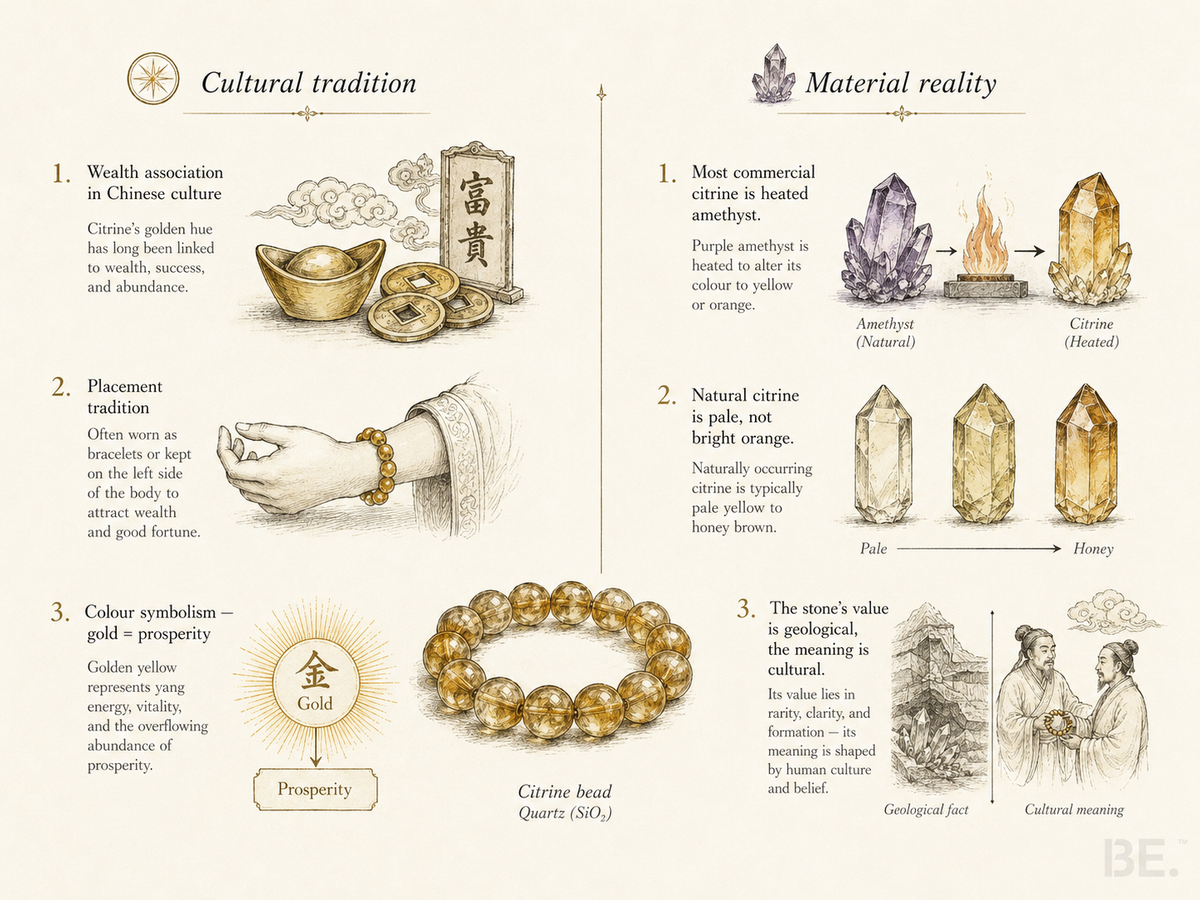
What citrine actually is
Citrine is quartz (SiO2) with a colour ranging from pale lemon to deep amber. The chromophore is trace iron, but the colour mechanism is different from amethyst: in citrine, dispersed Fe3+ and finely distributed iron-oxide particles produce yellow without requiring the radiation-induced Fe4+ centre that gives amethyst its violet.
Natural citrine is geologically rare. Most material sold as citrine on the global market is heat-treated amethyst or smoky quartz — above roughly 400°C the violet Fe4+ centre breaks down and the iron rearranges into a yellow-orange phase. The colour is real and stable; the provenance is heat-treated, not direct-from-the-vein. Genuine unheated citrine comes mostly from a few deposits, most famously the Anahí mine in Bolivia (where it grows alongside amethyst as ametrine) and from parts of Madagascar and the DR Congo.
Yellow in the Five Phases framework
The wuxing system assigns five phases (often called “elements”) to a network of correspondences: wood, fire, earth, metal, water. Each phase has a colour, direction, season, organ, and cardinal virtue. The grid is internally consistent and is the structural backbone of feng shui placement logic.
| Phase | Colour | Direction | Common material readings |
|---|---|---|---|
| Wood (mu) | Green | East | Jade, malachite, living plants |
| Fire (huo) | Red | South | Carnelian, red jasper, candles |
| Earth (tu) | Yellow / ochre | Centre & southwest | Citrine, tiger’s eye, yellow jade |
| Metal (jin) | White / metallic | West | Clear quartz, pyrite, silver objects |
| Water (shui) | Black / dark blue | North | Obsidian, lapis, dark glass |
Within this grid, citrine reads as an earth-phase object: warm, saturated yellow, dense, mineral. The southwest sector of a room (the kun trigram, associated in modern feng shui interpretations with prosperity and the matriarch) is the canonical placement. The reading is symbolic; the placement is composition.
The wealth-corner reading: a cultural framing, not a guarantee
Contemporary feng shui literature — particularly the popular branch sometimes called “black sect” or BTB — mapped the eight trigrams onto a nine-square bagua diagram and tied each square to a life domain: wealth, fame, partnership, family, health, creativity, knowledge, career. The southwest square (or, in BTB, the back-left corner from the entrance) became “wealth.” Yellow objects, gold-toned objects, and water features were folded into the standard recommendation list.
Citrine fits this language because of its colour, not because of any material property that links a piece of quartz to a bank balance. The honest reading is: the placement is a small daily reminder of intention, and intention plus consistent attention is a behavioural mechanism that can change how the inhabitant thinks about money, work, and time. That is not a stone effect. It is a ritual-cue effect that happens to be marked by a yellow stone.
We are happy to participate in the cultural reading — the colour symbolism is rich and the design composition is genuine. We do not endorse the claim that citrine, on its own, brings wealth.
What to actually look for in a citrine strand
- Saturation, not just brightness. A deep, even amber holds visual weight at a distance; pale lemon material reads as washed out under household light.
- Even colour zoning. Heat-treated material often has a colour-pooling effect at the tips of points; in beads, look for even tone across the bead surface.
- Disclosed treatment. Most market citrine is heat-treated amethyst. Disclosure is the gemmological convention; ask. Unheated material is rarer and usually more expensive.
- Bolivian ametrine connection. If the strand mixes citrine and amethyst zones, it is almost certainly Anahí-mine ametrine — a recognised single-deposit material.
- Clarity. Quartz citrine is usually transparent to translucent; opaque yellow material is sometimes sold as citrine but is more often heat-treated smoky or, in the worst cases, dyed.
Caring for citrine
Citrine is quartz — Mohs 7, chemically inert, hard enough for daily wear. The single caveat is UV: heat-treated citrine fades less than amethyst but is not immune, and prolonged sun exposure dulls the saturation over years. Clean with warm soapy water, store separately from harder gems, and keep display pieces out of window light. Standard quartz care applies; see our jewellery care guide for the full routine.
How BE. thinks about citrine
BE.’s Crystal 4T framework grades citrine on transparency (clarity through the bead), tone (depth of yellow), texture (polish and surface), and treasure (how difficult the material is to obtain at this quality). The feng-shui reading travels with the wearer; the material grading travels with the strand.
Frequently asked questions
Q1.Does citrine bring money?
The stone is quartz; it has no financial property. The placement is symbolic. The behavioural mechanism by which any ritual cue can change spending, saving, or earning habits is real but generic — it works through attention, not through the mineral.
Q2.Where should I place citrine in feng shui?
The classical mapping is the southwest of a room (earth phase) or the wealth corner of the bagua (back-left from the entrance, in BTB tradition). Treat this as cultural composition, not a guarantee.
Q3.Is heat-treated citrine real citrine?
Gemmologically, yes — it is still SiO2 with iron-induced yellow colour. The colour is real and stable. The treatment is disclosable, and reputable sellers disclose it.
Q4.How do I tell natural from heat-treated citrine?
Natural citrine usually has even colour distribution; heat-treated material often shows red-orange tips on points, or sharp colour zoning. For a strand, ask the seller and look for disclosure.
Q5.What is ametrine?
A single-crystal mix of amethyst and citrine zones, almost exclusively from the Anahí mine in Bolivia. The bicolour is formed in situ by a temperature gradient across the growth front.
Q6.Does citrine fade like amethyst?
Less dramatically, but yes — prolonged direct sun dulls the colour over years. Display pieces should be kept out of window light.
References
- Mindat — Citrine data
- GIA — Citrine description
- Wikipedia — Citrine (quartz)
- Wikipedia — Feng shui
- Bruun, O. (2008). An Introduction to Feng Shui. Cambridge University Press.
- Schumann, W. (2009). Gemstones of the World, 4th ed. Sterling.
Field Notes.
One stone at a time: its geology, and how to read quality. The Stone Buying Checklist comes with your first email.
By subscribing you agree to receive emails from BE. Unsubscribe anytime.
Sent. Check your inbox.