
Obsidian: Volcanic Glass, History & Surface Care
A geology-first guide to obsidian — volcanic glass formation, surface behaviour, conchoidal fracture, and why it has been culturally valued.
In this field note
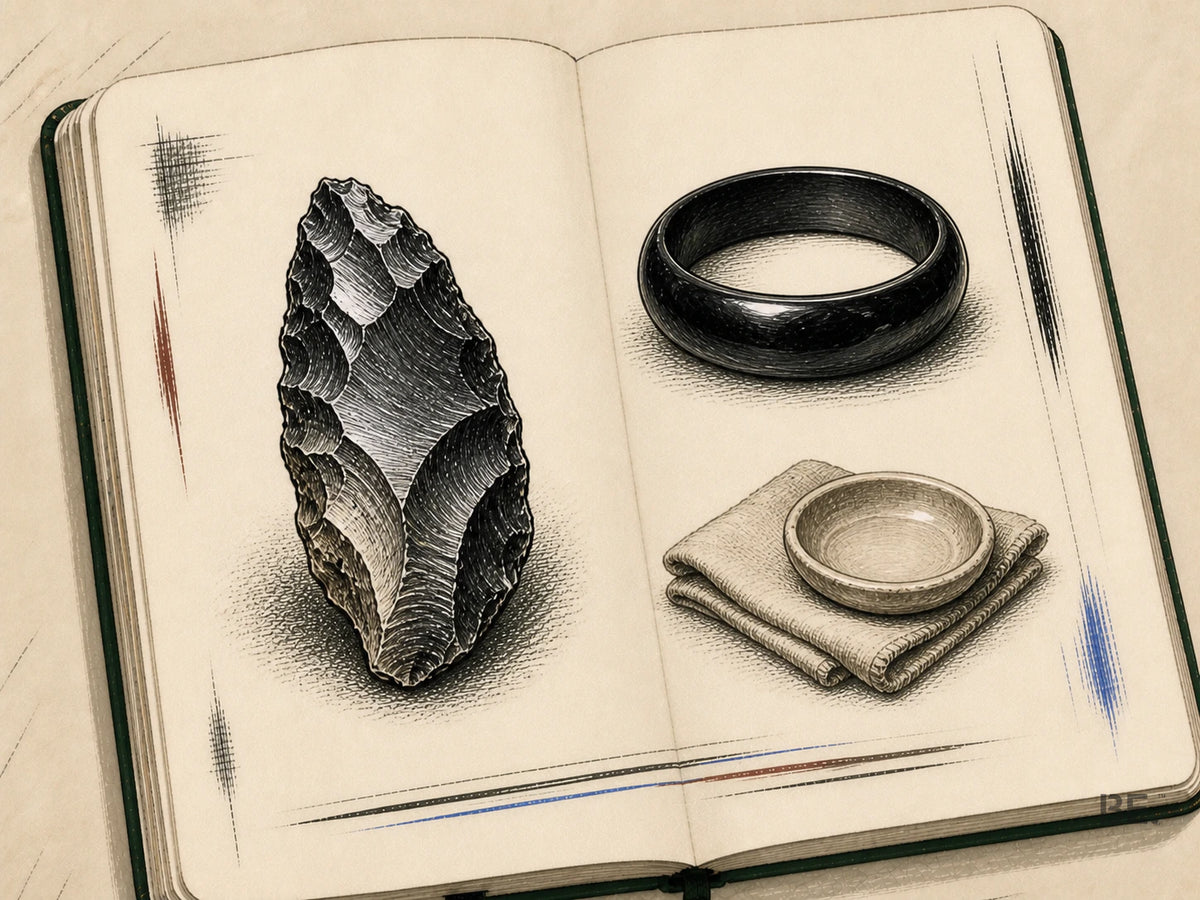
Why obsidian is called protective
The modern phrase compresses several different histories. Obsidian can fracture into extremely sharp edges, so it served as a practical cutting material. Its polished black surface can also work as a dark mirror. Those physical facts are real, but neither automatically proves the later language of psychic shielding or energy absorption.
A careful reading separates three layers: what the material does physically, what a documented culture did with a particular object, and what a present-day wearer finds personally useful. Mixing the layers makes the story sound simpler than the evidence.
The functional history: edge, tool and trade
Obsidian’s conchoidal fracture can produce sharp edges. Archaeological material and volcanic-source studies also show that communities moved obsidian away from its original flows. In that context, value came from workable glass, source access, craft knowledge and exchange—not from a universal mineral meaning.
The edge is also a safety fact. A polished bead is not a blade, but a chipped bead or specimen can expose a sharp curved fracture. Do not deliberately chip obsidian to confirm identity.
The reflective history: mirrors and dark surfaces
Museums hold polished obsidian mirrors associated with different places and periods. The British Museum’s John Dee mirror is made from Mexican obsidian, while Mesoamerican collections include objects connected with Tezcatlipoca, whose name and imagery are linked with smoking mirrors. These are specific records. They should not be flattened into the claim that every culture gave every piece of obsidian the same protective meaning.
A dark mirror can invite projection because it returns less literal detail than a bright silvered mirror. That perceptual experience may help explain later language about reflection, concealment or seeing inward. It is an interpretation grounded in use and appearance, not evidence for an invisible shield.
What the evidence supports—and what it does not
| Claim | Evidence status | Safe wording |
|---|---|---|
| Obsidian is natural volcanic glass | Material fact | State directly when identity is established |
| Obsidian was used for tools and mirrors | Documented for specific objects, places and periods | Name the collection, culture or source |
| Obsidian blocks negative energy | No established physical measurement for the claim | Describe it as belief or personal practice |
| Holding obsidian feels grounding | Personal experience | Attribute the experience to the person |
This boundary does not ridicule symbolic use. It gives the object a more durable story: geology can remain geology, history can remain specific, and personal meaning can remain personal.
Using obsidian as a personal practice
If the word protection is useful, define the action it represents. It might mean pausing before replying, noticing a boundary, leaving a noisy room or returning attention to the body. The object becomes a cue for a chosen behaviour. The agency stays with the person rather than being assigned to a passive piece of glass.
For a quieter material reading, continue to What Obsidian Knows About Stillness. For formation, varieties and identification boundaries, use the Types of Obsidian guide.
Placement, wear and care
Place an obsidian object where it is stable, visible enough to serve its purpose and unlikely to fall. For jewellery, inspect the polish, drill holes, chips and stringing. Obsidian is less scratch-resistant than quartz and brittle under impact, so separate it from harder stones in storage.
Clean with a soft damp cloth and mild soap when the construction permits, then dry it. Avoid aggressive chemicals, steam and ultrasonic cleaning when coatings, fractures or mixed materials are uncertain.
Frequently Asked Questions
Q1. Why is obsidian called a protection stone?
The reputation combines obsidian’s practical history as a cutting material, its use in dark reflective objects and later symbolic traditions. Those histories explain the name; they do not demonstrate a measurable energy shield.
Q2. Did ancient cultures use obsidian for protection?
Obsidian had documented practical, ritual and reflective uses in several cultures, but those uses differed by place and time. A modern universal protection claim should not be projected backwards without a specific source.
Q3. Can obsidian block negative energy?
There is no established physical measurement showing that obsidian blocks a category called negative energy. Some people use it as a personal reminder for boundaries or attention; that is a practice, not a mineral property.
Q4. Where should I place obsidian?
Place it where the object supports a chosen routine and cannot fall, chip or cut someone. Placement advice is personal and practical, not evidence of a field emitted by the glass.
Q5. Is obsidian safe to wear?
A polished, intact piece is generally wearable, but obsidian is brittle. Check chips, drill holes and construction, and remove it before impact-heavy activities.
Q6. How should I clean obsidian jewellery?
Use a soft damp cloth and mild soap when the construction permits, then dry thoroughly. Avoid abrasion, sharp impacts, steam and ultrasonic cleaning when treatments or mixed components are uncertain.
References
Field Notes.
One stone at a time: its geology, and how to read quality. The Stone Buying Checklist comes with your first email.
By subscribing you agree to receive emails from BE. Unsubscribe anytime.
Sent. Check your inbox.