
Which Wrist Should You Wear a Crystal Bracelet On? The Non-Dominant One
Left or right is a cultural question with a practical answer underneath. A stone-by-stone table of which crystals survive the dominant wrist.
In this field note
The question comes up early, usually before the first strand has even been chosen, and it arrives with a lot of confident answers attached to it.
- Check the stone's Mohs hardness. At 7 and above, such as quartz, agate and amethyst, either wrist is fine.
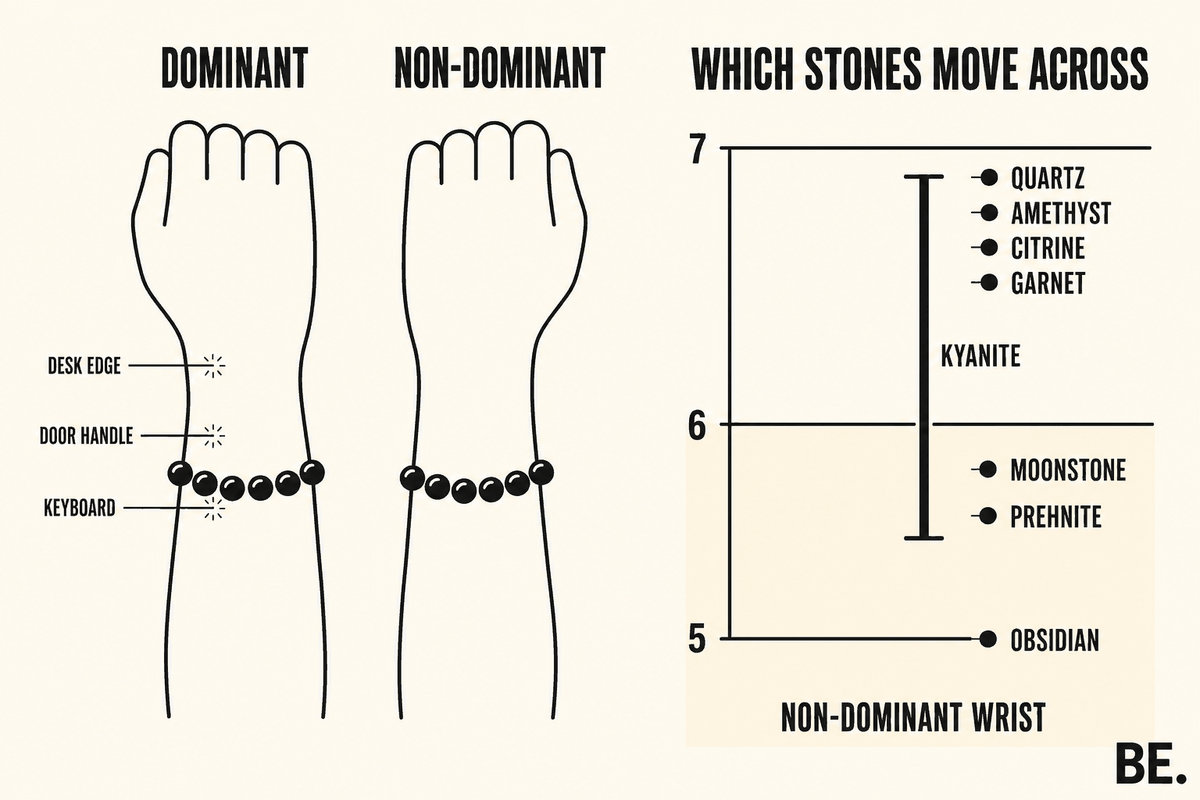
- Below Mohs 6, or any stone with cleavage such as kyanite, fluorite or moonstone, wear it on the non-dominant wrist.
- If tradition matters more to you than wear, left is the receiving side in Ayurvedic and several Chinese systems, and right is the giving side.
Does it matter which wrist you wear a crystal bracelet on?
Materially, no. Quartz does not know which arm it is on, and no property of a mineral changes with the side of the body. Practically, yes, and the difference is larger than most people expect once it is counted rather than guessed.
The dominant hand does the reaching. It opens doors, pulls drawers, carries bags, rests on desk edges and spends hours beside a keyboard. Over a year that adds up to thousands of small contacts a bracelet on the other wrist never experiences. For a stone at Mohs 7 the difference barely shows. For a stone at 5 with a glassy fracture, it shows within months.
Why do traditions say left is receiving and right is giving?
Because several long-standing systems map the body that way, and the idea travelled. Ayurvedic practice and some Chinese traditions treat the left side as the passive or inward side and the right as the active or outward one, and jewellery convention picked that up. It is a cultural inheritance with real history behind it and no mineralogical content whatsoever.
The tradition is interesting as tradition. It explains why the advice is so widespread and why it feels like it should have a reason. It does not predict anything measurable about a stone, and nothing here treats it as though it does. Where BE. stands on claims of that kind is set out in Crystals Are Not Magic.
Which wrist takes less wear and tear?
The non-dominant one, by a wide margin. Three sources of damage account for most of it, and all three favour the working hand.
- Desk and table edges. A forearm resting on a hard edge grinds the same three or four beads against it for hours.
- Door handles and drawer pulls. Metal at exactly wrist height, met at speed, dozens of times a day.
- Keyboards and laptop palm rests. Constant low-grade abrasion on the underside beads, which is where most dulling appears first.
None of these is dramatic. They are the reason a strand looks different after two years rather than the reason one breaks. The beads that lose their polish first are almost always the ones on the underside of the working wrist.
Does the stone change which wrist suits it?
It does, and this is the part worth acting on. Two properties matter: hardness, which decides whether a stone gets scratched, and cleavage, which decides whether a knock chips it. A stone can be reasonably hard and still fragile. Kyanite is the clearest case: it tests at about 5.5 along one direction and up to 7 across another.
| Stone | Mohs | Cleavage or toughness | Suggested wrist |
|---|---|---|---|
| Clear quartz | 7 | No cleavage, good toughness | Either |
| Amethyst | 7 | No cleavage, good toughness | Either |
| Citrine | 7 | No cleavage, good toughness | Either |
| Smoky quartz | 7 | No cleavage, good toughness | Either |
| Rose quartz | 7 | No cleavage, fine fractures common | Either |
| Hematoid quartz | 7 | Inclusion planes | Either |
| Garnet | 6.5 to 7.5 | No cleavage, brittle | Either |
| Rutilated quartz | 7 | Needles reach the surface | Non-dominant |
| Green phantom quartz | 7 | Phantom surfaces are weak planes | Non-dominant |
| Super Seven | 7 | Mixed inclusions, mixed toughness | Non-dominant |
| Prehnite | 6 to 6.5 | Fair toughness | Non-dominant |
| Moonstone | 6 to 6.5 | Two cleavage directions | Non-dominant |
| Kyanite | 5.5 to 7 | Perfect cleavage, direction dependent | Non-dominant |
| Obsidian | 5 to 5.5 | Conchoidal fracture, sharp chips | Non-dominant |
Read the last column as a default rather than a rule. Anyone who works at a desk with both forearms down gets less benefit from switching sides than someone who carries things all day.
What about wearing a crystal on a finger instead?
A finger is a harder posting than a wrist, whichever hand it is on. Hands lead: they reach into bags, grip handles, get washed a dozen times a day and take the first impact against every surface in a room. A stone that is comfortable on a wrist can look tired on a finger within a year.
The hardness threshold is therefore higher. Quartz at 7 copes. Moonstone, prehnite, kyanite and obsidian do not, and the left-versus-right question does not rescue them. A soft stone on a non-dominant index finger still meets more than a hard stone on a dominant wrist. The searches that bring people here usually attach a meaning to a particular finger, and that meaning comes from the same cultural traditions described above. The mineral has no say in it.
Should a bracelet stack share a wrist with a watch?
Preferably not. A watch case is steel at about 5.5 and its crystal is either sapphire at 9 or glass at 5 to 6, so on one side of the case something is always harder than the other. Splitting them across two wrists removes the contact altogether.
Where they must share, the bracelet goes on the elbow side with a finger's width of gap. Which surfaces a bead can mark is covered in the scratch guide, and the sensor and magnet questions that come with a smartwatch are in the smartwatch guide. For stacking several strands together, tone and bead size matter more than the side of the body, and that is the subject of the stacking guide.
Frequently asked questions
Q1.Does it matter which wrist you wear a crystal bracelet on?
Not to the stone. No mineral property changes with the side of the body. It matters for wear, because the dominant hand meets door frames, desk edges and keyboards far more often, so softer stones last noticeably longer on the other wrist.
Q2.Why do people say left is for receiving and right is for giving?
The idea comes from Ayurvedic and some Chinese traditions that map the left side of the body as passive and the right as active, and jewellery convention absorbed it. It has real cultural history and no measurable effect on a stone.
Q3.Do bracelets wear out faster on the dominant hand?
Yes, and visibly. The working wrist collects thousands of small contacts a year against desks, handles and keyboards. The beads on the underside of that wrist lose their polish first, and stones below Mohs 7 show it soonest.
Q4.Which wrist should moonstone and obsidian go on?
The non-dominant one. Moonstone has two cleavage directions and sits at 6 to 6.5, obsidian is volcanic glass at 5 to 5.5 that chips with a sharp edge. Both are among the stones where the choice of wrist changes how they age.
Q5.Can I wear a bracelet on the same wrist as my watch?
It works if the bracelet sits on the elbow side with a finger's width of gap. A steel case sits near Mohs 5.5, so the two are always mismatched in one direction or the other, and separating them across two wrists is the simpler answer.
Q6.Does it matter which finger a crystal ring goes on?
For wear, the finger matters more than the hand. Fingers lead into every surface a room contains, so anything below Mohs 7 ages quickly there regardless of side. The meanings attached to particular fingers come from cultural tradition rather than the mineral.
References
- Mindat: Quartz mineral data
- Mindat: Kyanite mineral data
- GIA Gem Encyclopedia: Quartz
- Wikipedia: Cleavage (crystal)
- Hurlbut, C. S. and Klein, C. (1985). Manual of Mineralogy, 20th ed. Wiley.
Field Notes.
One stone at a time: its geology, and how to read quality. The Stone Buying Checklist comes with your first email.
By subscribing you agree to receive emails from BE. Unsubscribe anytime.
Sent. Check your inbox.