
How to Stack Crystal Bracelets: 3 Rules That Always Work
A material-first guide to layering crystal bracelets — combining hardness, colour, bead size and finish for stacks that read coherent on the wrist.
In this field note
A bracelet stack should look planned. The way most stacks fall apart is not aesthetic taste — it is material drift: a Mohs 5 moonstone sitting next to a Mohs 7 garnet that quietly chips it over a year of wear, or a 6mm strand crowded between two 10mm strands that swallow it visually, or four faceted beads competing for the same light. The fixes are not styling tricks; they are decisions about hardness, diameter, finish and colour weight made before the bracelets meet the wrist. Before setting the order, choose which wrist will carry the bracelet; dominant-hand activity changes contact and movement.
This guide is a working framework for combining crystal bracelets. It draws on the same material logic BE. uses to assemble its four strand series — Anchor, Flow, Prism and Void — but the principles apply to any stack, regardless of where the individual strands come from.
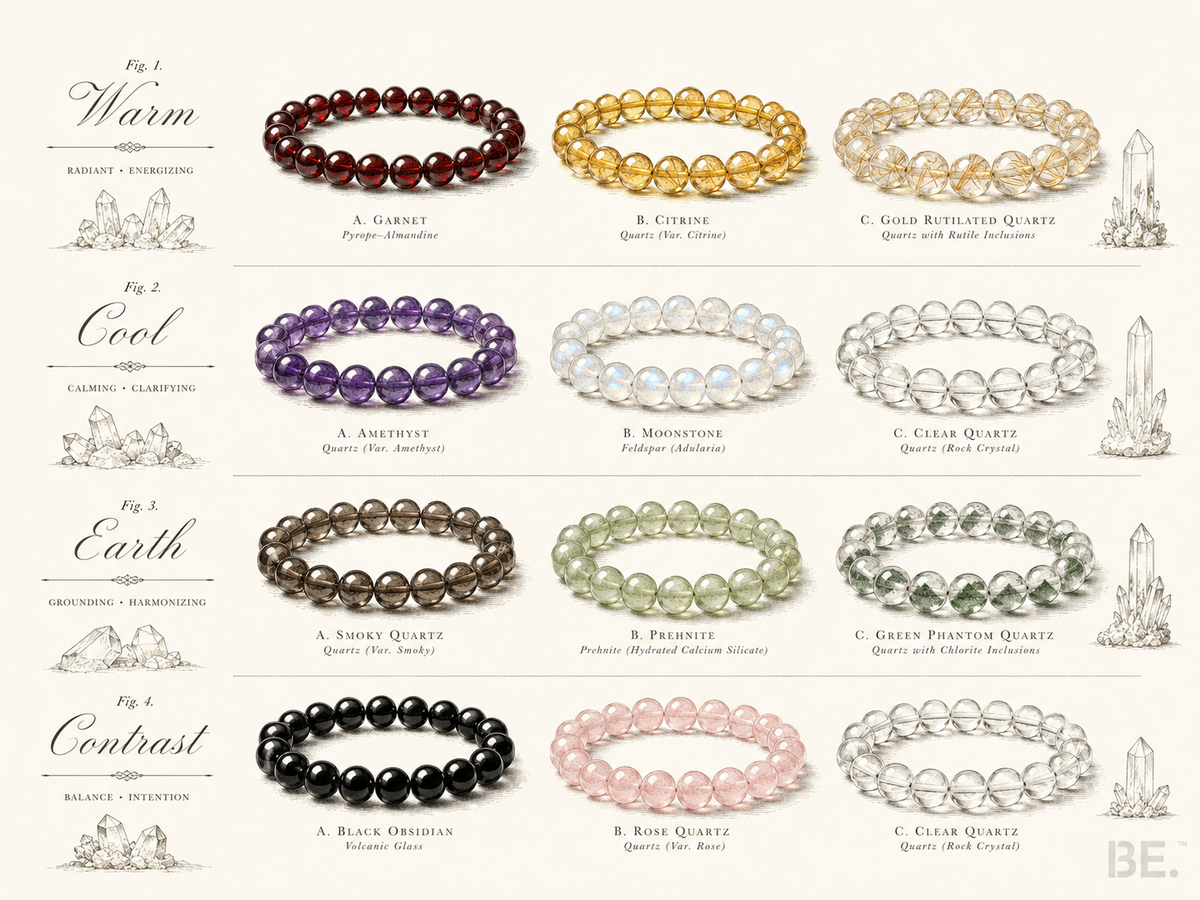
The five principles of a coherent stack
Most layering advice online is colour-first — pair warm with cool, neutral with statement, and so on. That is the last decision, not the first. The first decisions are material. If hardness, diameter and finish are wrong, no colour palette will save the stack. Closure belongs in the same material check; a magnetic clasp has its own safety and wear considerations.
- Hardness order. Place harder stones (Mohs 7+) on the outside of the stack and softer stones (Mohs 5–6.5) protected between them, or worn closer to the wrist where contact with surfaces is reduced.
- Bead diameter. Either group identical diameters (clean, modern read) or grade smoothly from one end to the other. Random size jumps break the visual line.
- Finish family. Matte, polished and faceted each have their own light behaviour. Pick one as the dominant finish and use the others as accents — not in equal measure.
- Colour weight. Treat each strand as a tonal block. Three blocks of similar weight read as composition; one heavy strand surrounded by light strands reads as imbalance.
- Total count. Three to four strands suits most wrists. Five works only if at least two are visually quiet (clear quartz, white agate, smoky quartz at low saturation).
Hardness order, in practice
Mohs hardness is the scratch resistance of a mineral on a scale of 1 to 10. It is the single most underrated variable in stacking because the damage it predicts — a softer bead being abraded by a harder neighbour over months of wear — is slow and invisible until the bead surface goes matte where it should be polished.
| Mohs band | Common stones | Layering note |
|---|---|---|
| 8–9 | Topaz, spinel, corundum | Wear anywhere in the stack; will scratch softer neighbours. |
| 7–7.5 | Quartz family, tourmaline, garnet, jadeite | The safe zone — layer freely. |
| 6–7 | Moonstone, labradorite, peridot | Protect from quartz contact; pair with similar hardness. |
| 5–6.5 | Apatite, opal, turquoise, lapis | Wear adjacent to soft metals or pearls, not quartz. |
| 3–5 | Pearl, coral, malachite | Treat as occasion pieces; stack with care. |
The simplest rule: do not directly adjacent two stones more than two Mohs points apart. A 5.5 turquoise next to a 7.5 garnet will lose. A 5.5 turquoise next to a 6.5 labradorite is fine.
Bead diameter and visual weight
Bead diameter is the second axis of the stack. Standard sizes are 6mm, 8mm and 10mm; less common are 4mm and 12mm. Each size carries a different visual weight: 6mm reads delicate and reads well under sleeves; 8mm is the standard middle weight and the easiest to layer; 10mm reads as a statement and works best on its own or paired with one quieter strand.
Two reliable diameter strategies: monosize stacking (all 8mm, all 6mm) for a clean, deliberate look, or graded stacking (10mm → 8mm → 6mm across the wrist) for a sculpted, asymmetric line. The combination that almost never works is the random one — 6mm, 10mm, 6mm, 8mm in arbitrary order reads as a collection of accidents.
Finish: matte, polished, faceted
Finish controls how each bead handles light. Polished beads carry a small bright highlight and a softer reflected halo. Faceted beads break light into many small specular highlights, which reads as energy and movement. Matte beads absorb light, which reads as weight and stillness.
Mixing all three in equal proportion produces visual noise. The reliable approach is a dominant finish with one or two accents — for example, two polished strands as the base, one faceted strand as the focal point, and an optional matte strand for contrast. Reverse the proportion if the wrist will be photographed often; faceted as the dominant finish performs better in flash and ring light, polished performs better in soft daylight.
Colour, last
With the material decisions made, colour becomes the easy part. Useful frames:
- Monochrome stacks. Multiple shades of the same colour family — smoky quartz, brown jasper, golden rutilated quartz — read as a single sculpted object.
- Neutral plus one. Two clear or white strands flanking one saturated colour (amethyst, garnet, lapis) lets the colour carry without competition.
- Analogous palette. Adjacent colours on the wheel (blue / blue-green / green; red / red-orange / amber) read as a planned gradient.
- Complementary pop. One strand of the opposite colour — a single carnelian beside green aventurine, or citrine beside amethyst — used sparingly, anchors the stack.
- Series logic. BE.’s four strand series — Anchor (earth tones), Flow (blues / aquatics), Prism (warm spectrum), Void (smoky / black) — are deliberately built so that any two from the same series will agree on tonal weight.
Stacks that work, and why
The minimal stack (two strands): one neutral, one saturated. Clear quartz + amethyst, smoky quartz + carnelian, white agate + lapis. Both at 8mm, both polished. The neutral lets the saturated strand do its work.
The architectural stack (three strands): all 8mm, all polished, three related tones. Smoky quartz + golden rutilated quartz + tigereye. Reads as one continuous sculpted form across the wrist.
The graded stack (three strands, sized): 10mm anchor bead + 8mm middle + 6mm finish. Most flattering on narrower wrists; mimics the natural taper of the arm.
The four-strand stack: two neutrals + one colour + one finish accent. Clear quartz + white agate + garnet + faceted smoky quartz. The faceted strand earns its place by adding light, not colour.
Frequently asked questions
Q1.How many bracelets is too many?
For most wrists, four is the working maximum before the stack starts reading as bulk rather than composition. Wider wrists tolerate five. Slimmer wrists look balanced at three.
Q2.Can I mix gemstone and metal bracelets in the same stack?
Yes — metal bangles act as visual rest between gemstone strands, similar to how clear quartz behaves. Keep the metal hardness in mind: gold (Mohs ~2.5) and silver (~2.5) are softer than most gemstones, so they will scratch where they touch.
Q3.Do I need to wear them all on the same wrist?
No. Splitting the stack — two strands on the dominant wrist, one on the other — reads as deliberate and reduces wear on individual pieces. It also lets a watch occupy the dominant wrist without crowding.
Q4.What stones should I not stack with quartz?
Direct contact between Mohs 7 quartz and softer stones (pearls, opals, turquoise, malachite) shortens the life of the softer bead. Position them on different parts of the stack, or wear them on different occasions.
Q5.Should the bracelets be tight or loose?
Loose enough to rotate on the wrist by about a centimetre. Tight bracelets concentrate abrasion at fixed points and shorten the life of the elastic cord. Loose bracelets distribute wear evenly.
Q6.How do I rotate a large collection?
Group bracelets by series or by occasion (work, weekend, evening) rather than by single stone. A rotation of three stacks of three is more wearable than nine individual decisions every morning.
References
- Mindat — Mohs hardness scale
- GIA Gem Encyclopedia — hardness and durability
- Wikipedia — Mohs scale of mineral hardness
- GIA Gems & Gemology archive
- Webster, R. (2002). Gems: Their Sources, Descriptions and Identification, 5th ed. Butterworth-Heinemann.
- Schumann, W. (2009). Gemstones of the World, 4th ed. Sterling.
Field Notes.
One stone at a time: its geology, and how to read quality. The Stone Buying Checklist comes with your first email.
By subscribing you agree to receive emails from BE. Unsubscribe anytime.
Sent. Check your inbox.