
Amethyst at Night: Colour, Habit & Bedside Reading
A material-first reframe of why amethyst is often associated with sleep — colour psychology, ritual habit, and what the science actually says.
In this field note
The idea that amethyst “promotes restful sleep,” “eases insomnia” or “calms the mind before bed” comes from mid-twentieth-century crystal literature. Mineralogy and sleep science give it no support.
The link people feel has three real sources: what amethyst actually is, why violet became a calming colour in Western design vocabulary, and how a bedside routine helps sleep.
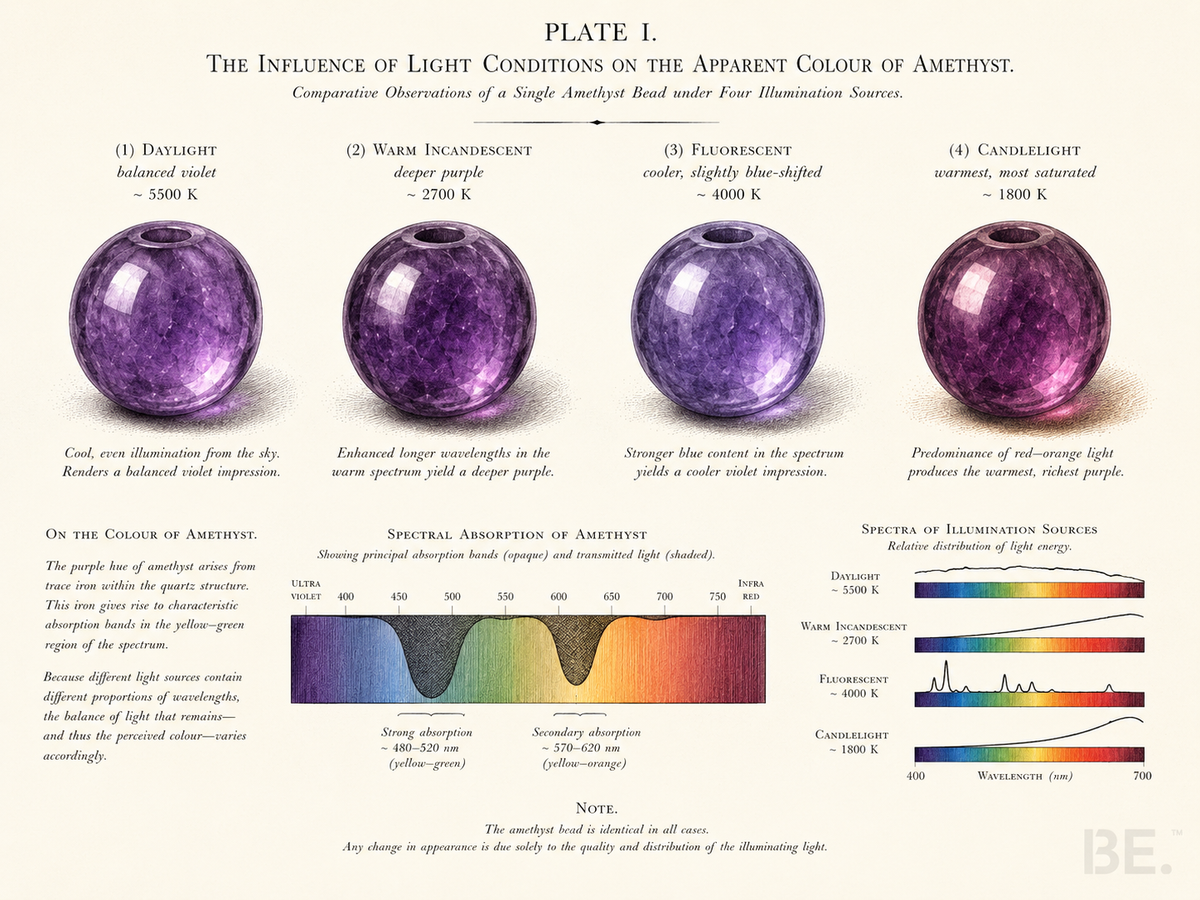
What amethyst actually is
Amethyst is the purple variety of quartz, chemical formula SiO2, hardness 7 on the Mohs scale. Trace iron substitutes for silicon in the tetrahedral lattice. The iron itself is colourless; the violet hue comes from a colour centre formed when natural gamma radiation from nearby rock displaces an electron from Fe3+, producing Fe4+. That defect absorbs in the green-yellow band and transmits violet to the eye.
At the bedside the stone is inert: it gives off nothing and does not react with skin. What a bedside amethyst does for its owner, it does through the eyes, the hand and the routine.
Why violet reads as calm
Colour shapes mood, and the details vary by culture. In Western design vocabulary, violet has been linked to twilight, ecclesiastical robes, and the visible-spectrum boundary between day and night. In self-reported mood studies, people link violet with calm and contemplation; the effect is small.
| Colour | Common self-reported reading | Where it gets cultural reinforcement |
|---|---|---|
| Violet / lavender | Calm, contemplative, twilight | Ecclesiastical robes, dusk imagery, lavender pillow sprays |
| Deep blue | Restful, cool, evening | Night-mode UI, bedroom paint convention |
| Soft pink | Soothing, low-arousal | Holding-cell research; nursery convention |
| Warm white / amber | Cosy, low-blue-light | Bedside lamps, candlelight, sleep hygiene guidance |
A polished amethyst strand on a nightstand sits in this colour vocabulary. So does a lavender-scented sachet, an aubergine throw, or a violet-shaded reading lamp. Each draws on the same colour language the wearer has absorbed since childhood.
Ritual habit as a sleep cue
Sleep researchers have known for decades that consistent pre-bed routines improve sleep onset. The mechanism is associative: a sequence repeated nightly becomes a cue that the body reads as “the day is ending.” The exact steps matter less than doing them every night, away from bright screens, intense conversation and caffeine.
Taking the strand off and setting it on the nightstand, then putting it back on the next morning: small, low-effort actions like these make a good bedtime cue.
Put together, “amethyst helps me sleep” means: placing it there each night is a sleep cue, the violet fits the calm I already link with that colour, and taking off the weight of the strand tells the body the day has shifted.
What the science actually says
No sleep study has found that amethyst changes how people sleep. The research that does exist covers three things: short colour-room mood studies (small effects, mostly for blue and lavender), placebo research on objects with a personal meaning (real effects when the owner believes in them), and the wider work on steady bedtime routines.
In short, the routine around the stone does the work, and amethyst suits the role: at Mohs 7 it is hard-wearing, and its violet is easy to recognise.
Caring for an amethyst bedside piece
An amethyst strand on a nightstand is in low-stress conditions: indoor humidity, soft surface, no impact wear. The one thing to watch is long, direct sunlight, which can pale the violet; our amethyst care guide covers this. Keep it off a sunny windowsill and apart from other jewellery, and the colour holds.
How BE. thinks about amethyst at night
BE. grades every amethyst strand on Crystal 4T™: Transparency, Tone (the violet depth of each bead and how evenly it runs across the strand), Texture and Treasure. The Bolivian amethyst in both BE. strands is recorded as Untreated on its Stone Origin Record. What the strand means at night belongs to the person who wears it.
Frequently asked questions
Q1.Does amethyst help you sleep?
Not chemically. A steady, low-stimulation bedtime routine does help, and the stone can be the object that anchors it.
Q2.Should I sleep with amethyst under my pillow?
A strand is fine there; the only drawback is lying on hard beads. A raw cluster with points is not: the points are fragile and uncomfortable.
Q3.Why is amethyst associated with sleep at all?
A mix of three things: violet reads as calm in Western colour vocabulary, twentieth-century crystal literature assigned amethyst to the third-eye and crown chakras, which some people link with rest, and bedside placement is itself a routine that supports sleep.
Q4.Will my amethyst fade if I leave it on the nightstand?
Only if the nightstand gets direct sun. Long, strong sunlight can bleach the Fe4+ colour centre. A drawer or an inside shelf is safe; a sunny windowsill is not.
Q5.Is there any harm in keeping amethyst near me at night?
No. The mineral is chemically inert and emits nothing. If it helps your routine, keep it there.
Q6.What works better than amethyst for sleep?
Consistent bedtime, lower bedroom temperature, dim warm-toned light in the last hour before bed, and avoiding screens. Sleep research is consistent on these, and a stone on the nightstand can be part of that routine.
References
- CDC: Sleep hygiene tips
- GIA: Amethyst description
- Mindat: Amethyst data
- Wikipedia: Colour psychology
- Stevenson, R. J. (2017). Psychology of Colour. Routledge.
- Walker, M. (2017). Why We Sleep. Scribner.
Field Notes.
One stone at a time: its geology, and how to read quality. The Stone Buying Checklist comes with your first email.
By subscribing you agree to receive emails from BE. Unsubscribe anytime.
Sent. Check your inbox.