
Crystal Grid Basics: Geometry, Materials & Setup
A practical, material-first introduction to crystal grids — common geometric patterns, materials traditionally used, and how to set one up as composition.
In this field note
The phrase crystal grid covers a wide range of practices, from elaborate altar arrangements to a few tumbled stones placed on a printed lotus. Strip the vocabulary back and what remains is geometry plus material: a flat surface, a pattern, and a set of stones arranged on it. That is enough to explain how grids are built, why certain shapes recur, and which stones are typically chosen — without making promises a piece of mineral cannot keep.
This is the short reference. It covers the four geometric figures you will see most often, the materials people tend to reach for, and a step-by-step setup that treats the grid as a composition exercise. For a longer treatment with historical context and more pattern variations, see our full guide to using crystal grids.
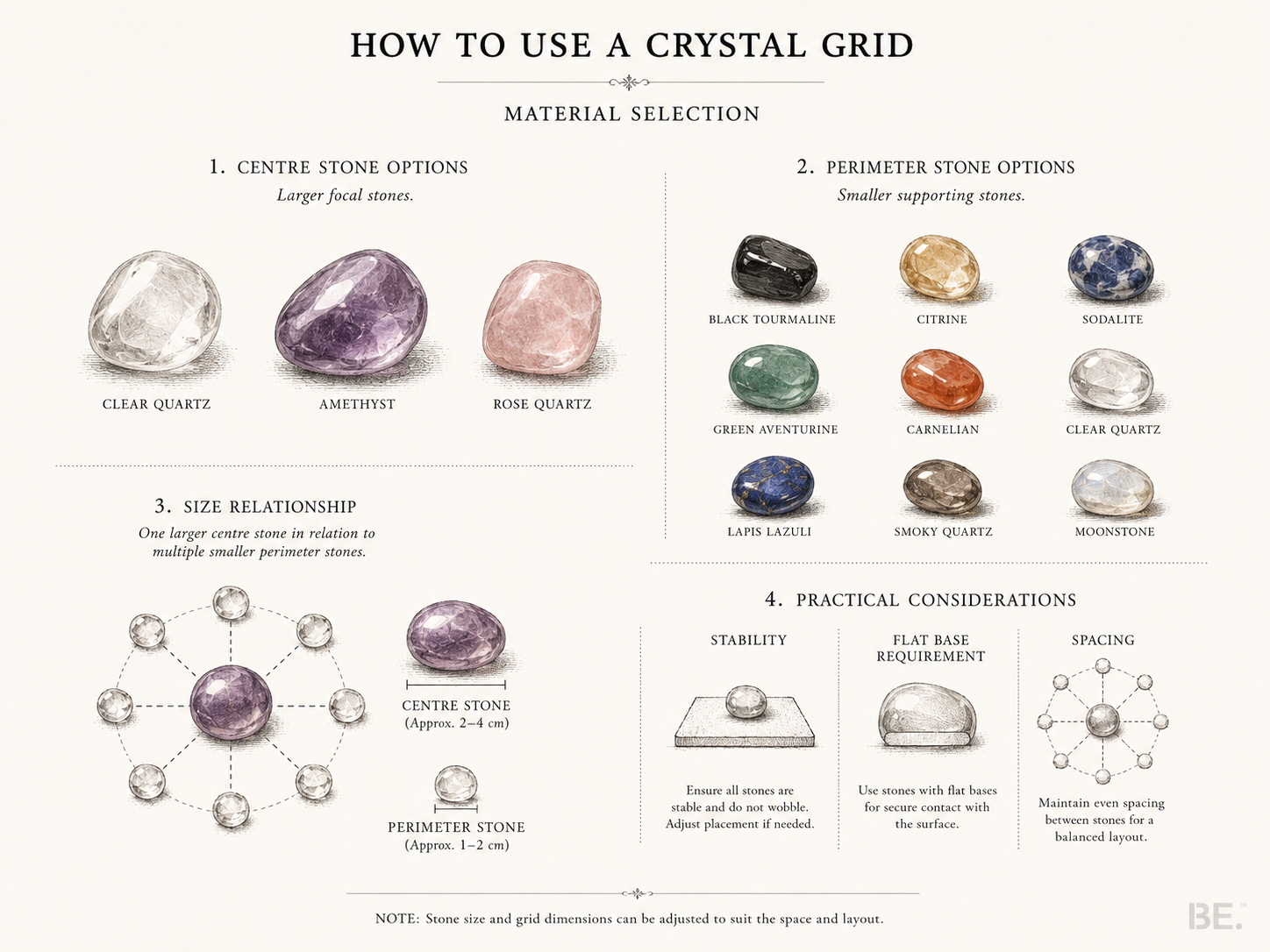
The geometry: four patterns that do most of the work
Crystal grids inherit their shapes from a small family of figures collectively called sacred geometry. The figures are not unique to crystal practice — they appear in Islamic tilework, Gothic rose windows, Buddhist mandalas, and Renaissance architectural drawings. What grids borrow is the visual logic: a centre, a ring, and lines of symmetry.
| Pattern | Geometry | How it is used in grids |
|---|---|---|
| Flower of Life | Overlapping circles on a hexagonal lattice | Most common base pattern; nodes hold smaller stones, centre holds the focus stone |
| Hexagram (Star of David) | Two overlapping triangles, six points | Six perimeter stones plus one centre; balanced and easy to lay out |
| Pentagram | Five-pointed star within a circle | Five perimeter stones; associated with the classical elements in Western tradition |
| Metatron's Cube | Thirteen circles connected by straight lines | More complex; used when stacking many smaller stones around a central piece |
Most beginners start with the Flower of Life because it is forgiving — the hexagonal nodes give natural resting places for stones of varying sizes, and the figure looks complete even with only a few stones placed.
Why these shapes keep coming back: the mathematics of symmetry
The recurrence of the same handful of figures — hexagons, pentagrams, the Flower of Life lattice, Metatron's Cube — is not coincidence and does not require a metaphysical explanation. It is a consequence of how few ways there are to tile a flat plane or build a regular solid. Mathematicians have catalogued these constraints since antiquity. Only three regular polygons tile a flat surface without gaps: triangles, squares, and hexagons. Only five regular convex polyhedra exist in three dimensions: the tetrahedron, cube, octahedron, dodecahedron, and icosahedron — known since Euclid as the Platonic solids. Every "sacred geometry" grid pattern is built from these limited primitives, projected onto a flat surface, decorated with circles.
The Flower of Life lattice, for instance, is the planar arrangement of overlapping circles on a triangular grid. Its underlying symmetry group is the same one that describes the hexagonal close-packing of spheres — the densest possible 2D packing, the structure of honeycomb, the cross-section of graphite, the diffraction pattern of beryl. Metatron's Cube, when drawn correctly, contains the orthogonal projections of all five Platonic solids; this is a geometric fact that medieval mystics noticed and assigned meaning to, but the underlying property is just projective geometry. The hexagram is the convex hull of two interpenetrating equilateral triangles, generated by the dihedral symmetry group D6. The pentagram encodes the golden ratio in its internal proportions — each segment divides the next at φ ≈ 1.618 — which is why it has been used as a proportioning device in classical architecture from the Parthenon onward.
This is the honest distancing frame: the figures look meaningful because they are mathematically extremal — the most symmetric, the most densely packed, the most regular shapes a flat surface allows. A grid built on one of these patterns is borrowing the visual authority of a mathematical limit. Whether that authority extends to anything beyond composition is a question of belief, not of geometry.
Crystal lattices and photonic crystals: where geometry actually does work
It is worth marking a distinction grid practitioners sometimes blur. The word crystal in mineralogy refers to a solid whose atoms are arranged in a periodic three-dimensional lattice — quartz, for example, has a trigonal lattice with hexagonal symmetry, which is why a well-formed quartz point shows six prism faces. In physics, the word photonic crystal refers to an artificial periodic structure (often a hexagonal or face-centred-cubic array of dielectric inclusions) engineered to manipulate light at scales comparable to its wavelength: opals, structural-colour butterfly wings, and modern integrated optics all rely on this principle. Both of these are real geometric effects with measurable consequences.
A crystal grid on a tabletop borrows the visual vocabulary of lattice and symmetry but operates at a scale ten orders of magnitude larger than the wavelengths that would let geometry actually affect light. Stones placed on a Flower of Life pattern do not function as a photonic crystal; they function as an arrangement of decorative objects with mathematically pleasing spacing. We mention this because the analogy is sometimes overused in crystal literature, and the distinction matters: real lattices in mineralogy and photonics do work; tabletop grids are composition. Both can be enjoyed for what they actually are.
The materials: what stones are typically chosen
There is no rule about which stones go into a grid. Choice is usually driven by colour, hardness, and what the maker happens to have. A common structure uses one larger centrepiece stone, six to twelve mid-size stones along the geometry's ring, and small tumbled stones or chips at outer nodes.
- Centrepiece. Often a clear or smoky quartz point, a sphere, or a pyramid — chosen because the shape has a visual centre.
- Perimeter stones. Tumbled stones, raw clusters, or small carved shapes; amethyst, rose quartz, citrine, and clear quartz are the most-reached-for because they are widely available and visually distinct.
- Outer nodes. Chips, points, or small tumbles; sometimes a single material is repeated for visual unity.
- Optional non-stone elements. Dried flowers, shells, small printed cards, or written intentions — composition objects, not minerals.
Setting up a grid: a six-step composition exercise
The setup that follows treats grid-building as visual composition. It does not promise anything beyond what the maker chooses to remember when they look at the finished arrangement.
- 1. Choose a surface. A flat plate, a wooden board, a printed cloth, or a piece of paper with the geometry drawn on it.
- 2. Place the centrepiece. Set the largest or most visually anchoring stone at the geometric centre.
- 3. Lay the perimeter. Place mid-size stones along the figure's primary points — six for a hexagram, five for a pentagram, twelve for an outer Flower of Life ring.
- 4. Fill the outer nodes. Use small tumbles or chips to mark secondary intersections.
- 5. Adjust for balance. Step back. The grid is composition — symmetry, colour balance, and negative space matter visually.
- 6. Leave it. Once placed, a grid is a static arrangement. People sometimes refresh it on a schedule (weekly, monthly, seasonally) — that is ritual habit, not material change.
Caring for a grid: dust, light, and surface contact
A grid that stays in place collects dust and, if it is by a window, sun-fades. Amethyst and rose quartz both lose colour under prolonged UV exposure — the iron and manganese centres responsible for their hues are radiation-sensitive. Citrine fades less dramatically but is not immune. Move the grid out of direct sun, dust the stones with a soft brush, and avoid stacking harder stones (quartz, Mohs 7) directly against softer ones (selenite, Mohs 2; calcite, Mohs 3) — surface contact scratches the soft material.
How BE. thinks about grids
BE.'s grading framework — the Crystal 4T (transparency, tone, texture and treasure) and the Stone Origin Card — is built for individual strands, not for arrangements. A grid is composition; the stones inside it are still graded the same way. If a grid uses a BE. strand as its centrepiece, the strand's origin card travels with it.
Frequently asked questions
Q1.Do crystal grids do anything?
As objects, no — they sit on a surface and reflect light. As ritual focal points, they do what any composed visual object does: they give the maker something to look at and remember. Treat that distinction honestly.
Q2.Does the geometry matter?
For composition, yes. The Flower of Life and hexagram have clear centres and even spacing, which makes them easy to lay out. For anything beyond composition, the geometry is symbolic — it carries the meaning the maker assigns to it.
Q3.How many stones do I need?
Between seven (one centre + six perimeter for a hexagram) and thirteen (Metatron's Cube nodes). More is not better; balance is.
Q4.Can I mix soft and hard stones?
Visually yes, but avoid surface contact between very different Mohs values. Selenite against quartz will scratch on the selenite side.
Q5.Do I need to refresh the grid?
If you enjoy doing it, yes. Materially, nothing changes — the stones do not deplete. The refresh is for the maker, not the mineral.
Q6.Where can I read more?
Our long-form guide to using crystal grids covers historical context, more pattern variations, and a wider discussion of materials.
References
- Wikipedia — Sacred geometry
- Wikipedia — Overlapping circles grid (Flower of Life)
- Wikipedia — Platonic solids
- Wikipedia — Photonic crystal
- Mindat — Quartz data
- GIA — Amethyst description
- Critchlow, K. (1979). Time Stands Still: New Light on Megalithic Science. Gordon Fraser.
- Schumann, W. (2009). Gemstones of the World, 4th ed. Sterling.