
Crystal Grids: Sacred Geometry, Patterns & Practical Use
A practical guide to crystal grids — the geometry behind common patterns, materials traditionally used, and how to read a grid as composition rather than ritual.
In this field note
Crystal grids are usually written about in language BE. does not use — intention, manifestation, ritual. The geometry itself, though, is older and more interesting than that vocabulary. The Flower of Life appears at Abydos and in Leonardo's notebooks. The hexagram is a structural motif in mosques and synagogues. Metatron's Cube emerges from medieval Jewish texts and survives into modern decorative pattern. These are design patterns, repeated across cultures because they have rare visual properties: rotational symmetry, modular tiling, and a centre point that organises everything around it.
This guide treats crystal grids as still-life composition. The geometries are taken seriously as visual structures; the stones are chosen for what they look like in those structures — colour temperature, transparency, size, finish. If the practice means something more to you, that is yours to bring. The geometry will hold either reading.
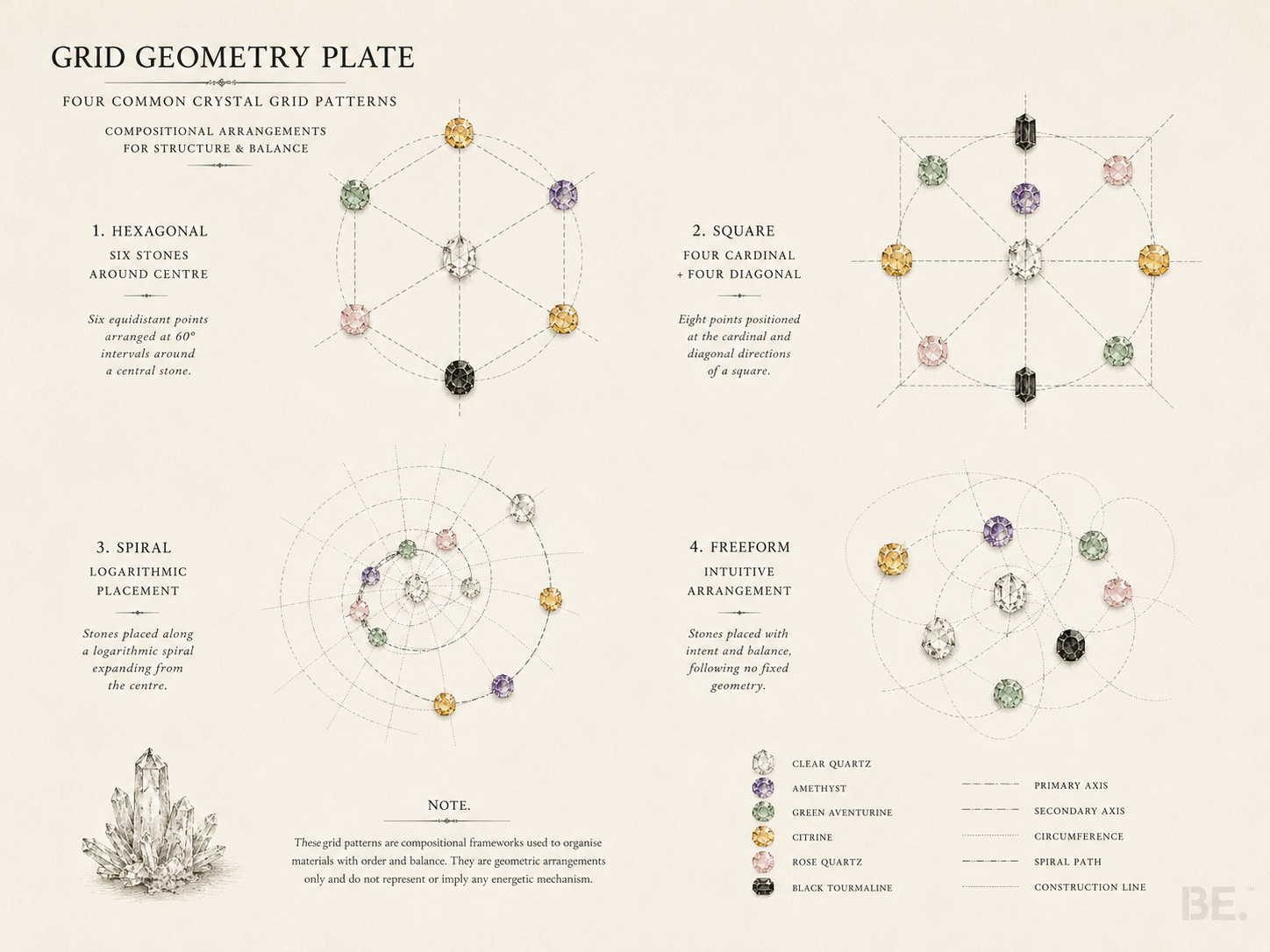
The geometries, decoded as patterns
Five geometries account for the vast majority of grid templates sold today. Each has a different visual logic and a different practical use as a still-life.
| Pattern | Structure | Visual behaviour |
|---|---|---|
| Flower of Life | 19 overlapping circles, sixfold rotational symmetry | Dense, hypnotic, holds many stones evenly across the field. |
| Metatron's Cube | 13 circles connected by straight lines through every centre | Architectural; reads as a 3D solid; suits geometric beads and points. |
| Hexagram (Seed of Life) | Six-pointed star, two interlocking triangles | Strong centre, six radiating arms — ideal for one central stone and six matched outer stones. |
| Pentagram | Five-pointed star, fivefold symmetry | Tighter, more directional; reads as movement rather than stillness. |
| Sri Yantra | Nine interlocking triangles, central bindu | Layered; supports a graded stone palette from centre outward. |
For a first grid, the hexagram is the most forgiving. It requires only seven stones (one centre, six outer) and the geometry does most of the work — small misalignments are absorbed by the strong central point. The Flower of Life is the most photogenic, but it benefits from at least thirteen carefully matched stones to fill the pattern.
What materials traditionally fill a grid
The most common centre stone across published grid traditions is clear quartz. The reason is compositional, not mystical: clear quartz is optically the busiest material in the lineup — it gathers light from its surroundings, refracts it through the bead, and creates a bright focal point without adding colour weight. A coloured stone at the centre dominates the grid; a clear quartz centre lets the outer pattern read.
Outer stones are typically chosen as a matched set of six or twelve. Amethyst, rose quartz, citrine and smoky quartz are the most common because they cover the visible spectrum (violet, pink, gold, brown) while sharing a single mineral host — the visual continuity makes the grid read as one composition rather than a collection.
The role of the centre stone
The centre of a crystal grid is the most photographed point in the composition. Two reliable ways to fill it: with a single clear quartz point (a faceted or naturally terminated crystal that focuses light) or with a small tight cluster of three to four polished beads from a strand. Both work; the point reads as classical, the bead cluster reads as modern.
A point at the centre creates a vertical axis the eye can climb. A flat polished sphere creates a horizontal pool of reflected light. Faceted beads create a constellation of small highlights. None of these is the right answer in the abstract; they are different visual decisions to make consciously rather than by default.
Five rules for a grid that reads well
- One geometry per grid. Mixing the hexagram with the Flower of Life produces visual noise; pick one template and let it dominate.
- Symmetry first. Place the centre stone first and the outer six (or twelve) before adding any optional accent stones. Asymmetry should be a deliberate accent, not the foundation.
- Match the outer set. All six outer stones should share at least one property — same mineral, same colour family, same diameter, or same finish. Without a shared property the grid reads as scattered.
- Negative space. Do not fill every line and intersection. The geometry is most legible when the stones mark a small subset of the available points.
- One light source. Side-lit grids carry the most depth in photographs; overhead light flattens the composition. If the grid will live on a shelf, position the geometry where light hits at an angle.
Using strand beads as a grid set
A loose strand makes an unusually convenient grid kit. Twenty-one identical beads from a single strand share material, colour, diameter and finish — four of the five rules above are met before the geometry is drawn. Pulling six matched beads for a hexagram, or twelve for a Flower of Life, gives a more visually coherent result than buying twelve separate cabochons.
For grids that need a centre stone of different character, BE.'s approach is to use clear quartz at the centre and a coloured strand for the outer ring — amethyst for cool grids, citrine for warm grids, rose quartz for soft grids. The colour temperature of the outer ring controls how the whole composition reads.
Practical grid presets
The minimal grid: hexagram, one clear quartz point at centre, six matched amethyst beads at the points. Reads as still-life; sits well on a side table or shelf.
The radiant grid: Flower of Life template, clear quartz centre, twelve citrine or rose quartz beads on the secondary ring, six smoky quartz beads at outer intersections. More demanding to set up but more photogenic.
The architectural grid: Metatron's Cube, clear quartz centre, twelve identical 8mm beads of a single colour (deep amethyst or smoky quartz) at the nodes. The straight lines do most of the visual work — the stones simply mark vertices.
Frequently asked questions
Q1.Do I have to believe in crystal grids for them to look good?
No. The geometries pre-date their modern crystal-grid use by centuries and survive in classical art and architecture on visual grounds alone. Read them as composition templates and they remain visually rewarding.
Q2.What size stones work in a grid?
For a 30cm template, 8mm to 12mm beads sit at the right scale. Smaller stones disappear into the printed lines; larger stones crowd the geometry. Match the bead size to the line weight of the template.
Q3.Can I use rough crystals instead of polished beads?
Yes — rough points and tumbles read more sculptural, polished beads read more modern. The geometry holds either material; the rule is to stay consistent within one grid rather than mixing rough and polished arbitrarily.
Q4.Why is clear quartz the default centre stone?
Optically, clear quartz is the busiest material in the common lineup — it refracts surrounding light without adding colour. That makes it a bright focal point that does not compete with the coloured outer ring.
Q5.How long should a grid stay set up?
That is a personal decision. Compositionally, grids look best when the stones stay clean and the geometry stays aligned — a weekly reset to dust and re-square the pattern keeps the still-life sharp.
Q6.Is the geometry actually "sacred"?
The term "sacred geometry" describes the recurrence of these patterns across religious art — cathedral floor plans, mosque tiling, Buddhist mandalas. Whether one reads that as sacred or as a deep human preference for symmetry is up to the viewer. The patterns are unusually stable across cultures, which is interesting either way.
References
- Wikipedia — Flower of Life
- Wikipedia — Metatron's Cube
- Wikipedia — Sacred geometry
- Wikipedia — Sri Yantra
- Britannica — Hexagram
- Lawlor, R. (1982). Sacred Geometry: Philosophy and Practice. Thames & Hudson.
- Critchlow, K. (1976). Islamic Patterns: An Analytical and Cosmological Approach. Thames & Hudson.