
Hematoid Quartz Guide: Iron Oxide Inclusions & Jewellery
A geology-first guide to hematoid quartz — quartz with iron oxide inclusions, why colours range from rust to dusky red, top deposits and how to read a strand.
In this field note
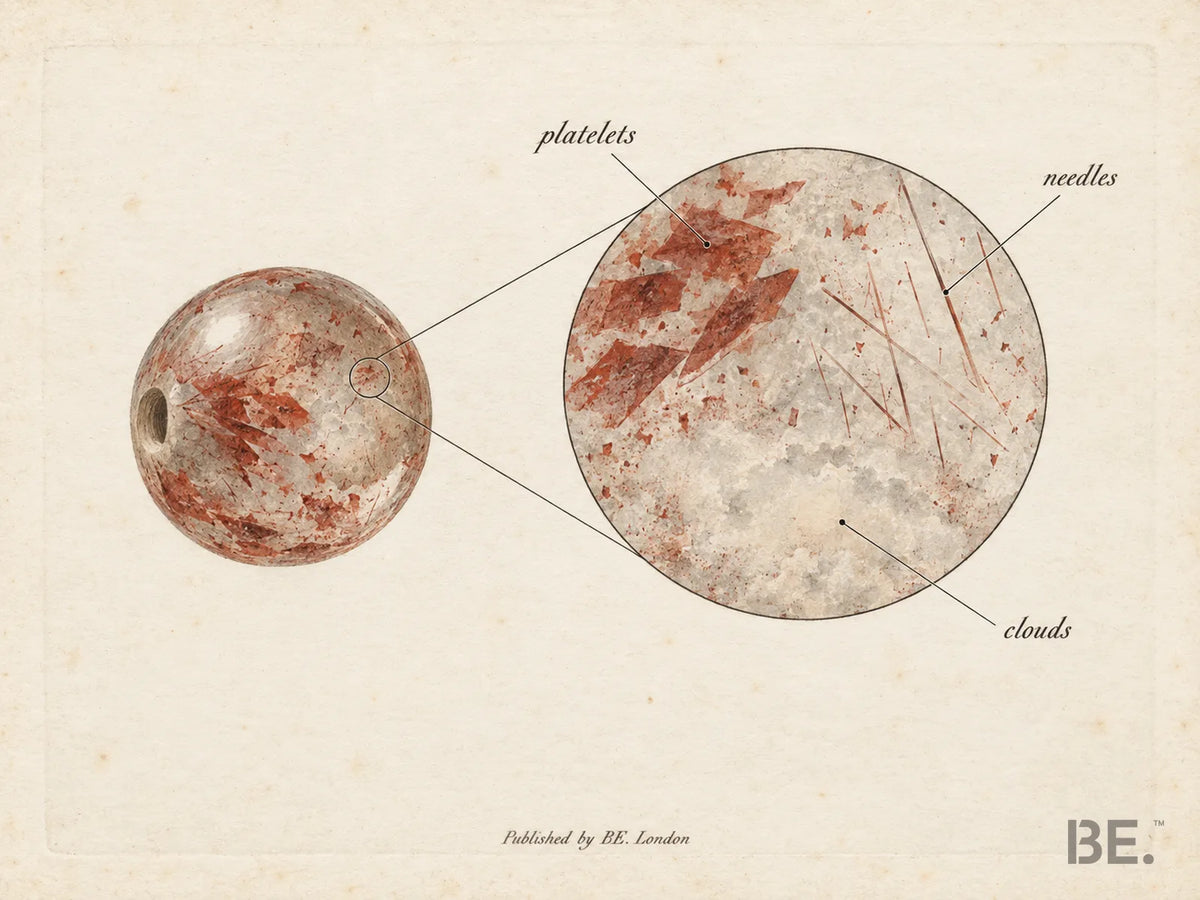
The name covers transparent, translucent and milky quartz with internal clouds, platelets, needles, bands or fracture-bound coatings in rust orange, brown and red. The host remains quartz. What changes is the iron-bearing material, its distribution and when it entered the crystal.
Because the trade name covers so much ground, BE. Crystal Jewellery treats hematoid quartz as a description of inclusions. The species stays quartz.
What is hematoid quartz?
Hematoid quartz is macrocrystalline quartz with visible iron-bearing inclusions or coatings. The species is quartz; the inclusions give it the name. Depending on the specimen, the iron-bearing material may pre-date the quartz, grow with it, or enter later along fractures. Those timings are described as protogenetic, syngenetic and epigenetic.
Physical properties of hematoid quartz
| Property | Description |
|---|---|
| Mineral species | Quartz |
| Host composition | SiO2 |
| Crystal system | Trigonal |
| Mohs hardness | 7 |
| Refractive index | 1.544–1.553 |
| Specific gravity | About 2.65–2.66 for the quartz host |
| Lustre | Vitreous (glassy) |
| Visible colour cause | Iron-bearing inclusions or coatings; exact species needs analysis |
These are primarily the properties of the quartz host. A dense inclusion load, open fracture or surface treatment can change how an individual bead looks and behaves without turning “hematoid quartz” into a separate mineral species.
Hematoid quartz vs hematite
Hematoid quartz is quartz hosting iron-bearing material; hematite is the standalone iron oxide mineral Fe2O3. Quartz has vitreous lustre, Mohs hardness 7 and specific gravity near 2.65. Hematite commonly has metallic to sub-metallic lustre, a red-brown streak and substantially higher specific gravity. So a red quartz bead is still a quartz bead, with iron minerals inside it.
Red platelets in a photograph may be consistent with hematite. Naming the species takes Raman spectroscopy or another analytical method.
What colour can and cannot tell you
| Observed colour or habit | Possible explanation | Limit |
|---|---|---|
| Brick red to deep red | Often consistent with fine hematite particles or platelets | Species, concentration and timing still open |
| Yellow, orange or brown | May reflect goethite or mixtures sold under the field term limonite | Weathering, coatings or mixed phases still possible |
| Dark metallic platelets | May be specular hematite | Species needs analysis |
| Needles or radiating bundles | May be an iron-bearing mineral, but several minerals can form similar habits | Several minerals share this habit |
Colour is useful for describing a strand and comparing bead-to-bead consistency. Describe what is visible, and state separately what analysis has confirmed.
How iron-bearing material enters quartz
Quartz grows in several geological settings, including hydrothermal veins, pegmatitic pockets and cavities in volcanic rocks. Iron-bearing minerals may already be present, crystallise alongside the quartz, or arrive later through fluid-filled fractures. Two beads that look alike can therefore record different sequences; there is no single “hematoid quartz formation story”.
Reading a hematoid quartz strand
For jewellery, read the host and the iron-bearing features separately. Then look at the whole strand before judging any single dramatic bead.
- Host clarity. Backlight the strand and note clear zones, veils and open fractures. Opacity can come from dense inclusions, fractures or both.
- Inclusion distribution. Look for particles, bands or clouds within the bead. Colour that sits only on the surface or along a fracture is worth a question to the seller.
- Bead-to-bead balance. Compare saturation and pattern across the full strand. Variation is expected, but an abrupt jump can indicate mixed offcuts.
- Disclosure. Prefer a seller who distinguishes observed appearance from a laboratory identification and states when treatment history is unknown.
Trade names and the meaning of “hematoid”
Fire quartz, harlequin quartz, strawberry quartz, red phantom quartz and hematite quartz are overlapping retail labels with no formal mineralogical hierarchy behind them. A name points to colour or pattern. Composition, origin and treatment have to be stated separately. For the name-by-name comparison and pricing problem, read Fire Quartz vs Hematoid Quartz.
What does “grounding” mean here?
“Grounding” is a word people attach to hematoid quartz for cultural reasons, mostly its earthy red-brown colour. It describes how the stone is talked about. This page stays with the stone itself: what is inside the quartz, how it got there, and how to read a strand.
Caring for hematoid quartz jewellery
The quartz host is Mohs 7, but beads may contain fractures, exposed iron-bearing material or an undisclosed coating. Clean with lukewarm water, mild soap and a soft cloth. Avoid acids and prolonged chemical contact; skip ultrasonic or steam cleaning when fractures, coatings or treatment history are uncertain. Store the strand away from harder jewellery.
How BE. reads hematoid quartz
BE. grades on what can be observed: host transparency, colour balance, inclusion texture and the traceable information supplied with the material. A trade name carries no premium. A loupe documents pattern and surface condition; species-level wording waits for analytical evidence.
Hematoid strands from BE. Crystal Jewellery are listed in the BE. collection. Each ships with a Stone Origin Record giving the lot, the Crystal 4T™ grading and the inclusion description the record can support.
Frequently asked questions
Q1.Is hematoid quartz the same as hematite?
No. Hematite is the standalone iron oxide mineral Fe2O3, dark grey-black with a metallic lustre and a red streak. Hematoid quartz is clear or milky quartz (SiO2) hosting hematite (or goethite, or limonite) as inclusions. They differ in mineral identity, hardness and appearance.
Q2.What makes hematoid quartz red?
Iron oxide inclusions dispersed through the quartz host. Hematite (Fe2O3) gives brick-red to dusky purple-red tones; goethite (FeO(OH)) gives more orange-brown; limonite gives rust-yellow. The mineral identity and the inclusion density together set the colour.
Q3.Are the iron inclusions natural?
In quality material, yes. The iron minerals are protogenetic: they were already in the host rock when the quartz grew around them. Acid-stained imitations exist. The stain concentrates at fractures and drill holes, while colour that belongs to the stone runs continuously through the bead.
Q4.What is the difference between hematoid quartz, fire quartz, and harlequin quartz?
All three are quartz with iron oxide inclusions. Hematoid quartz is the broad term. Fire quartz usually refers to densely banded red varieties from Brazil. Harlequin quartz refers to specimens with small bright red flecks scattered like polka dots. The geology is the same; the names describe different visual patterns.
Q5.Can hematoid quartz be confused with rutilated quartz?
Yes, especially when the inclusions are goethite needles, which can resemble rutile needles. Under a loupe, rutile needles are usually sharper, more golden, and harder to scratch. Goethite is softer, more brittle, and slightly browner. A gemmologist can separate them definitively with a refractometer.
Q6.Does hematoid quartz fade?
No. Iron oxide chromophores are photostable. You can wear hematoid quartz outdoors indefinitely without colour loss. The only environmental concern is acidic cleaning agents, which dissolve surface iron and leave a whitened halo.
References
Field Notes.
One stone at a time: its geology, and how to read quality. The Stone Buying Checklist comes with your first email.
By subscribing you agree to receive emails from BE. Unsubscribe anytime.
Sent. Check your inbox.