
You Don’t Need a Crystal to Fix You
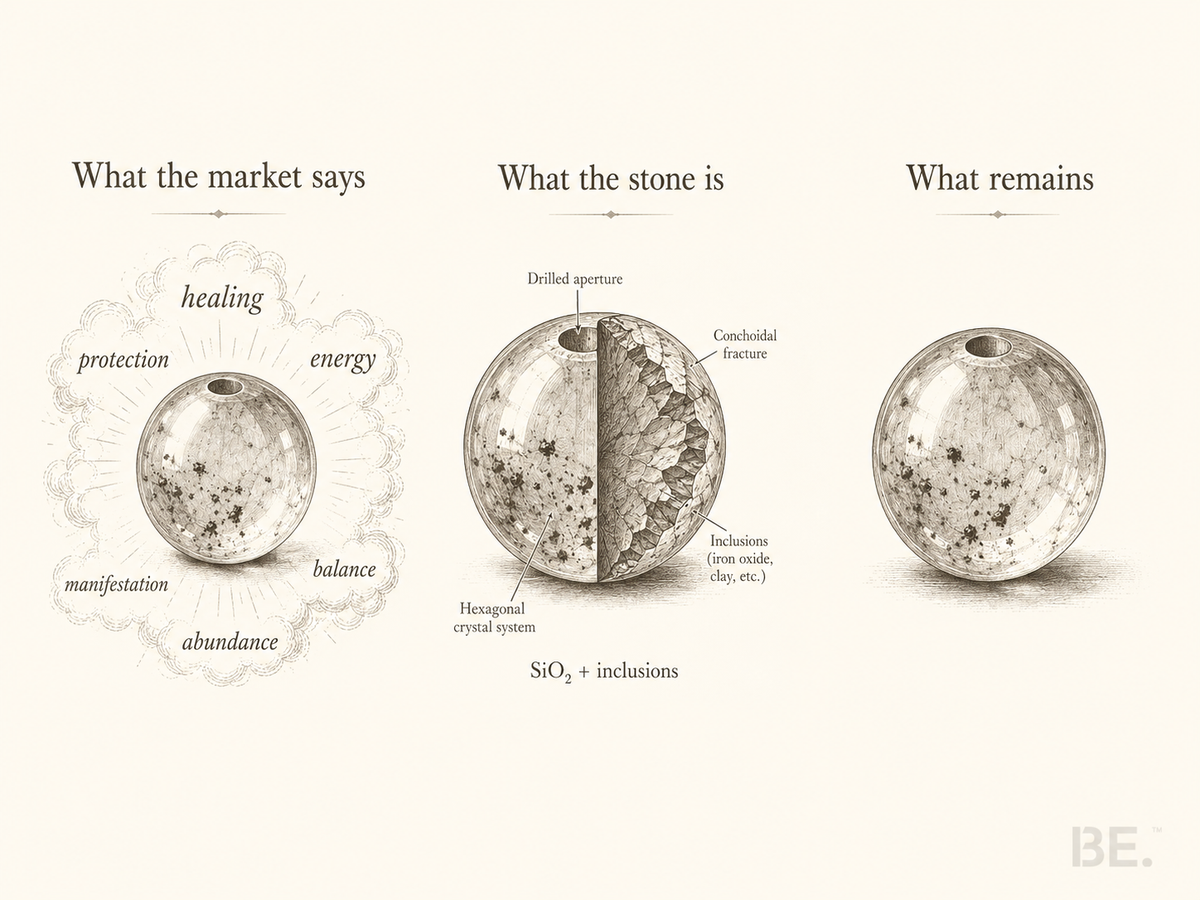
BE. rejects deficiency-based crystal marketing. A stone does not repair a person; it can be chosen for material presence, weight, texture and meaning.
In this field note
The deficit model is easy to sell
Much of the crystal market is built around lack. A stone is placed next to an insecurity, a difficult season, a desired relationship, a future self. The object becomes a solution to a private shortfall. That language creates urgency, but it also quietly teaches the buyer to approach herself as a problem.
BE. does not need that premise. The stone can still matter when the buyer is already whole. In fact, it matters more cleanly: the purchase becomes a question of material attraction, visual weight, tactile comfort and the state a person wants near her body.
A stone can accompany without promising repair
A bracelet can mark a boundary. A clear quartz piece can make a stack feel more structured. Obsidian can give the wrist a black, low-noise line. Moonstone can soften a composition with light. None of that requires a medical promise or a metaphysical guarantee. It only requires attention to what the object physically does: how it looks, how it sits, how often the hand notices it.
That is enough. A stone does not have to become a remedy to have value. It can be a chosen companion, a small piece of geological time carried into ordinary days.
How to choose without self-diagnosis
Start with the object, not the problem. Choose Anchor if you want visual weight and a cleaner edge. Choose Flow if you want softness and air. Choose Prism if you want motion, light and visible internal life. Choose Void if you want restraint and space. This is not a test of what is wrong with you. It is a way to ask what kind of material presence you want near you.
Frequently Asked Questions
Does BE. believe crystals can fix a person?
No. BE. treats crystals as geological objects and design objects, not corrective tools.
Then why wear one?
Because material objects can carry personal meaning, visual structure and tactile presence without making a claim over the body.
What is the best first piece?
For clarity and flexibility, start with clear quartz. For stronger visual boundary, start with obsidian. For softness, start with moonstone or prehnite.
References
[1] FTC — Health Products Compliance Guidance: used as the claim-discipline reference for avoiding unsupported product benefit language.
[2] Google Search Central — Creating helpful, reliable, people-first content: used as the people-first clarity and trust baseline.
[3] BE. — Our Story: the brand’s geology-first founding stance.
[4] BE. Crystal 4T Grading System: the four observable axes used to read a strand.
[5] BE. Geological Codex: material-level reference for the stones in the BE. catalogue.
Field Notes.
One stone at a time: its geology, and how to read quality. The Stone Buying Checklist comes with your first email.
By subscribing you agree to receive emails from BE. Unsubscribe anytime.
Sent. Check your inbox.