
BE. Four Series: Anchor, Flow, Prism, Void
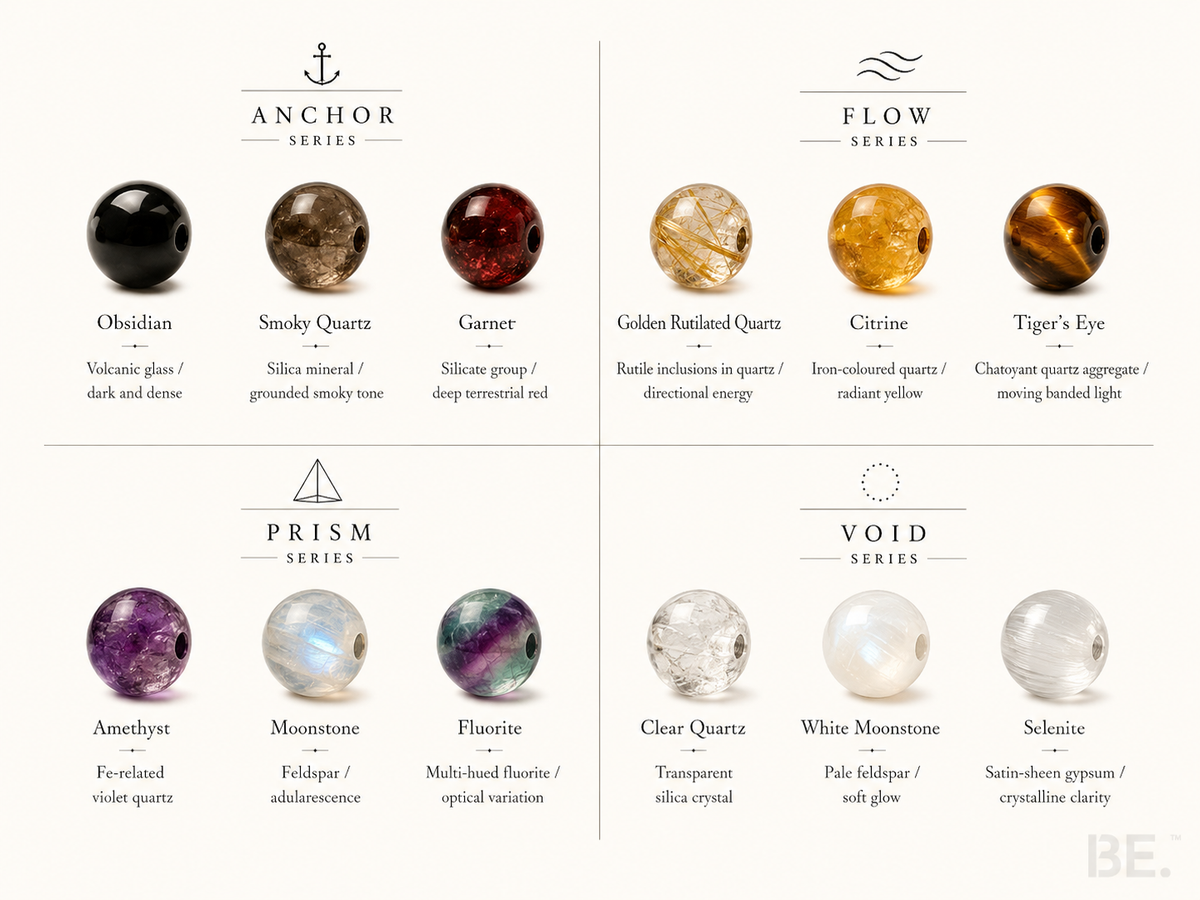
The BE. four-series naming — Anchor, Flow, Prism, Void — what each series represents and which stones belong to each.
In this field note
Most jewellery brands organise their catalogue by stone species, by colour, or by price band. BE. organises by something else: the optical and structural behaviour of the material. The four series — Anchor, Flow, Prism, Void — are physical categories first, and human categories second. Both layers are held together because they line up at the level of form, not because one is dressed up as the other.
This article explains the system: why a series structure exists at all, what each series contains and why, and where the mineral logic and the human logic meet.
Why a series structure at all
Sorting stones by species ("the quartz collection," "the agate collection") describes chemistry but not behaviour. A clear quartz, a smoky quartz, and a rutilated quartz are all SiO2, but they behave very differently in light, on the wrist, and in the eye of someone holding them. Sorting by colour produces an even shallower grouping — green prehnite, green emerald phantom, and green aventurine share a wavelength but almost nothing else.
BE. uses a different axis: how the stone meets light. Optical behaviour turns out to track other things — density, internal structure, formation environment, the way the piece reads at arm’s length — more reliably than species or colour do. Sorting by optical behaviour produces four clean categories that hold together across species. Those four are Anchor, Flow, Prism, and Void.
The same four categories also describe four positions a person can hold in relation to the outside world. As Our Story puts it, the mineral logic and the human logic have to be the same logic, or neither holds. BE. treats this as a structural claim, not a marketing one. The reason it works is explained later in this article.
The four positions — material and human together
Each of the following is the same shape from two sides: how the stone behaves physically, and what human position shares that physical signature. The two are reported in parallel — not so the reader maps themselves onto a category, but so the structure is visible.
Anchor — opacity, density, light absorption
Material. Anchor stones are dense and opaque. Light does not pass through; it is absorbed at the surface or scattered into the body of the stone. The hand feels the weight before the eye reads the colour. Representative species include obsidian, hematoid quartz, garnet, and certain darker forms of tourmaline. The crystal systems vary, but the optical signature is consistent: low transmittance, high specific gravity, surfaces that hold a single tone rather than fracturing it.
Human position. Anchor describes the position for the days when the noise outside is louder than the signal inside. It is the part of a person that does not move when the weather does — the room a person stands in when the worst of it lands. Those who stand in this position are not performing stillness; they are simply not pushed by the room. The optical fact (light absorbed, not transmitted) and the positional fact (input absorbed, not transmitted onward as reaction) share the same shape.
Flow — translucency, directional optics, fluid presence
Material. Flow stones are translucent rather than fully transparent. Light enters, is redirected by internal structures — rutile needles, fibres, inclusions, twinning planes — and exits softened, often along a direction. Representative species include rutilated quartz, prehnite, moonstone, and certain forms of fibrous chalcedony. The optical signature is movement: a stone that does not look the same from two angles, that reads as fluid even when it is still.
Human position. Flow is the practice of letting things pass through rather than being carried off by them. Career, family, the project that cannot be put down — they are worth playing seriously, but none of them are worth being pushed by. Those who stand in this position absorb input, redirect it, and let it leave. The optical fact (light enters, scatters, exits) and the positional fact (input enters, is redirected, exits without lodging) share the same shape.
Prism — full transparency, refraction, light passing through
Material. Prism stones are fully transparent. Light passes straight through, refracts, and emerges on the other side. Internal features — phantoms, ghosts, healings, garden inclusions — remain visible at any angle, because nothing blocks the view. Representative species include clear quartz, citrine, emerald phantom quartz, and high-clarity smoky quartz. The optical signature is clarity that does not collapse: the eye sees through the stone, sees the inside, and the inside is not hidden.
Human position. Prism is the position of someone who has seen the back of the stage and still chooses to show up. The parts of human nature that are not flattering have already been observed; the choice to play hard and laugh easily comes after that observation, not before it. Those who stand in this position have clarity that did not collapse into cynicism — the rarest of the four. The optical fact (light passes through without distortion, and the inside is visible) and the positional fact (input is processed without distortion, and the inside is not hidden) share the same shape.
Void — amorphous, light-blocking, outside the lattice
Material. Void stones are amorphous — they do not have a crystal lattice in the conventional sense. Volcanic glass cooled too quickly to organise into a repeating structure, the material is locked at the moment before crystallisation. Representative forms include gold sheen obsidian, silver sheen obsidian, and certain forms of black obsidian. Light is blocked at the surface and returned as sheen rather than transmitted. The optical signature is reflection without transparency, and presence without lattice.
Human position. Void is the position outside the game. It can see Anchor, Flow, and Prism happening, and is not inside any of them. Nothing is good. Nothing is bad. Everything is angle. Those who stand in this position do not transmit, do not redirect, do not refract — they reflect the room without participating in it. The optical fact (no internal lattice, no transmission, return of the surrounding without internal commitment) and the positional fact (no fixed alignment, no internal investment in the game) share the same shape. The quietest of the four. The hardest to wear.
Why the mineral logic and the human logic align
The pairing above is not metaphor. A metaphor would say this stone is like that feeling, and the resemblance would live in the imagination of the writer. The claim BE. is making is structural: the four optical behaviours and the four human positions share the same form, the same topology of how input is treated.
Read the four together as a system:
- Anchor — input is absorbed and held. No transmission outward, no internal redirection. Stable.
- Flow — input is admitted, redirected along internal structure, released. Through, not into.
- Prism — input passes through and emerges altered. The inside remains visible.
- Void — input meets a surface and returns as reflection. No internal lattice for input to enter.
The same four sentences read truthfully as descriptions of a stone in light and as descriptions of a person in a difficult room. They are not the same thing — a stone is not a person, and BE. does not pretend otherwise. They are isomorphic: the structure of how each handles incoming input is the same. The brand calls this same logic on both sides.
This is also why BE. does not need metaphysical language for the system to hold. No claim is being made that the stone does something to the wearer. The claim is that the stone is built around a particular way of meeting light, and a person can be built around a particular way of meeting the world, and these two ways can share a name without either one acting on the other.
A second reason the structure works: the four positions are not exhaustive of human experience, but they are exhaustive of how form meets force. A surface either absorbs, transmits, refracts, or reflects. There is no fifth option at the physical level. The mineral world has been arranging itself into these four modes for several billion years; the human world is a much younger system, and the four positions found inside it appear to be the same four — not because someone imposed them, but because the underlying physics of form-meets-force does not change between scales. BE. uses the four because they are the four, not because four is a tidy number for a catalogue.
The reader is not asked to accept this on faith. The mineral side is verifiable — refractive indices, transmittance percentages, density values, and crystal-system classifications are all measurable, and the BE. Geological Codex records them. The human side is a position the reader can recognise or not. Neither side depends on the other being true. The structure is offered as a way of organising stones; whatever the reader does with it after that is the reader’s own work.
The four series at a glance
| Series | Optical behaviour | Density signature | Representative stones | Human position |
|---|---|---|---|---|
| Anchor | Opaque, low transmittance, light absorbed at surface | High specific gravity, weight before colour | Obsidian, hematoid quartz, garnet, dark tourmaline | Holds shape when the room shifts; input absorbed, not transmitted |
| Flow | Translucent, directional optics, light redirected by internal structures | Medium, often fibrous or included | Rutilated quartz, prehnite, moonstone, fibrous chalcedony | Lets input pass through and leave; through, not into |
| Prism | Fully transparent, high refraction, internal features visible at any angle | Low to medium, clarity-led | Clear quartz, citrine, emerald phantom quartz, high-clarity smoky quartz | Clarity without cynicism; inside remains visible |
| Void | Amorphous, no crystal lattice, light blocked and returned as sheen | Medium, glass-like | Gold sheen obsidian, silver sheen obsidian, black obsidian | Outside the game; reflects without internal commitment |
The table is not a prescription. It is a way of seeing the catalogue all at once, so the reader can locate the stones they already own and understand why they sit where they sit.
How to read a strand in this system
A strand on a BE. PDP carries the series label as part of the material description, alongside species, formation, optical grade, and Lot ID. The label is not a mood. It is a way of saying this stone behaves like this in light, and by extension, this stone belongs to this family of behaviour.
A practical example: a rutilated quartz strand and a clear quartz strand are both SiO2, both transparent in chemistry. But the rutilated quartz contains directional rutile needles that scatter and redirect light along the needle axes — Flow behaviour. The clear quartz transmits light end-to-end without internal redirection — Prism behaviour. Same chemistry, different optics, different series. The classification carries information that species and colour alone cannot.
A reader who wants to think about a strand has two questions available: what is this stone made of, and how does this stone meet light. The first is answered by the species and the chemistry. The second is answered by the series. Whether the reader then chooses to think about themselves in the same terms is a separate, private question, and BE. has no claim on the answer.
Layering across series is allowed and common. A wrist with one Anchor strand and one Prism strand is not a contradiction; it is two different physical behaviours sitting next to one another, and the human reading of that pairing is whatever the wearer makes of it. BE. notes the behaviours on the PDP; the rest is left open. The brand’s only ask is that the labels remain accurate — that what is called Anchor is opaque and dense, that what is called Prism is transparent and refractive. Once those are correctly identified, the wearing is the wearer’s.
Frequently asked questions
Q1. Are the four series personality types?
No. They are categories of optical and structural behaviour in stones. The four names also describe four positions a person can stand in, but the series do not assign a position to the reader. A reader can wear stones from any series, or from all four, without choosing an identity.
Q2. Why not sort by stone species or by colour?
Species and colour describe chemistry. Optical behaviour describes how the stone reads in the world. Two stones of the same species can behave very differently in light — rutilated quartz (Flow) and clear quartz (Prism) are both SiO2. The series structure captures what species and colour cannot.
Q3. Can the same stone belong to more than one series?
Rarely. Most stones have a dominant optical mode, and that mode places them. Edge cases exist — a particularly translucent obsidian, or a clear quartz with heavy phantoms — and these are decided case by case, recorded in the Lot ID notes, and explained on the PDP.
Q4. Is Void only obsidian?
In practice, Void is dominated by volcanic glass forms because the amorphous, no-lattice condition is rare. Other amorphous or near-amorphous materials may enter the series if their optical behaviour matches. The criterion is structural, not species-based.
Q5. Where does the four-position language come from?
From Our Story. The founder describes the four as positions held over many years, and asks for them to share names with the mineral classification because the structure is the same on both sides.
Q6. Does the series tell the reader which stone to buy?
No. The series tells the reader how the stone behaves. What to buy is a separate question that involves wear, layering, budget, and private preference. The PDP and the 4T Grading System are the tools for the buying question; the series is the tool for the seeing question.
References
- BE. — Our Story — the origin of the four-position language, in the founder’s first-person voice.
- BE. Crystal 4T Grading System — the four-axis grading framework used inside every series.
- BE. Geological Codex — formation paths, optical and structural references for the stones in each series.
- BE. Strands — the full strand catalogue, organised by series.
- A Brand That Asks Nothing of You — the position behind why the series is a classification, not a request.
- Why BE. Avoids Crystal Claims — why the series is material, not meaning.
Field Notes.
One stone at a time: its geology, and how to read quality. The Stone Buying Checklist comes with your first email.
By subscribing you agree to receive emails from BE. Unsubscribe anytime.
Sent. Check your inbox.