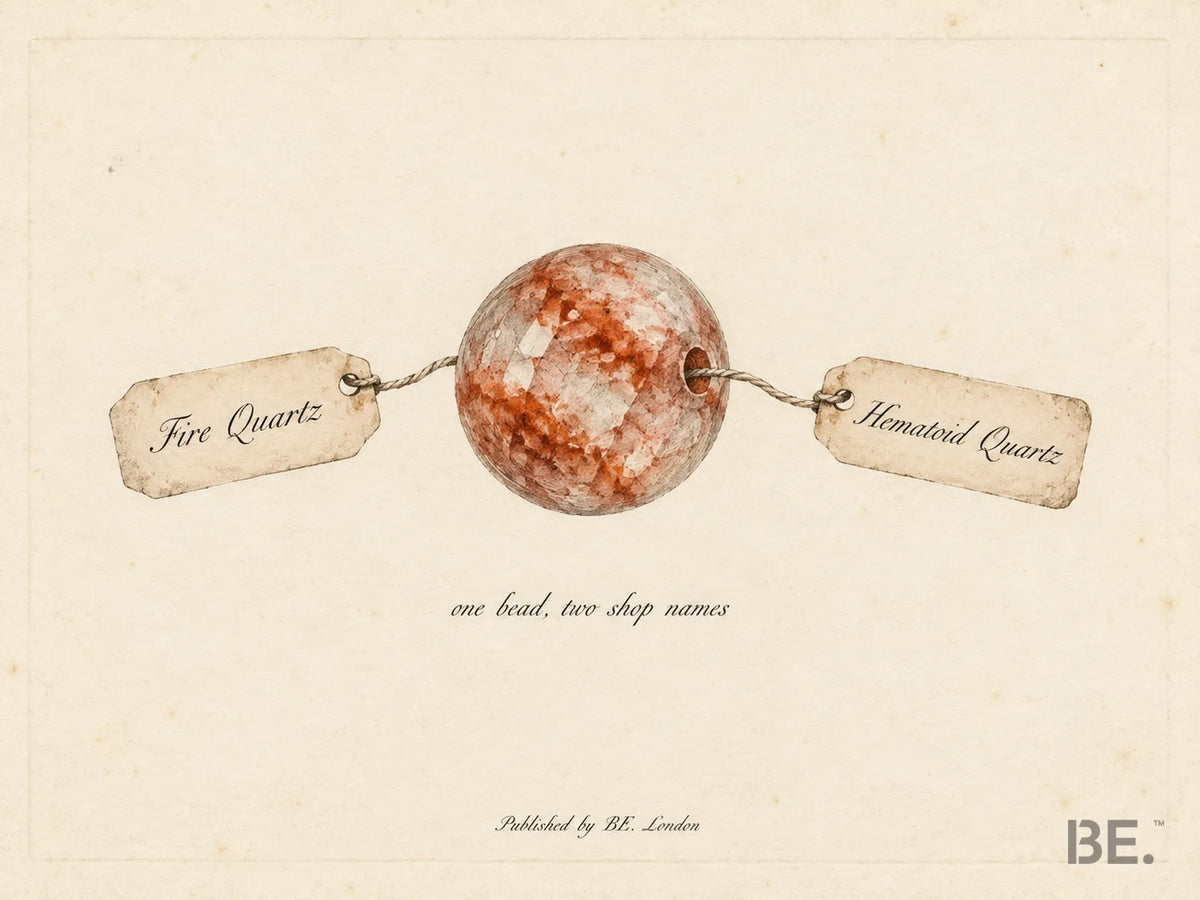
In one paragraph Fire quartz and hematoid quartz are the same stone — macrocrystalline quartz (SiO₂) containing inclusions of iron oxide, primarily hematite (Fe₂O₃) and/or goethite (FeOOH), that produce red, orange, or yellow internal colouration. “Fire quartz” is a trade name applied to the same mineral that geologists and mineralogists call hematoid quartz (or ferruginous quartz). There is no chemical, structural, or geological difference between them.

Search for “fire quartz” and you will find sellers presenting it as a distinct variety — sometimes priced higher than “regular” hematoid quartz, sometimes described with different properties, occasionally listed as a separate mineral entirely. This is a naming problem, not a geological one. The red inclusions inside both are iron oxide. The host crystal in both is SiO₂. The formation mechanism is identical. One name entered the market because it sounded more dramatic than the mineralogical term.

This guide clarifies the naming confusion, explains what the iron oxide inclusions actually are, and gives you the markers to assess quality regardless of which label a seller uses.

Hematoid quartz specimen showing red iron oxide (hematite) inclusions within clear SiO₂
Hematoid quartz (also sold as “fire quartz”): iron oxide inclusions (Fe₂O₃) within macrocrystalline quartz (SiO₂). The red colouration is hematite. Image: Wikimedia Commons.

What this stone actually is (one stone, multiple names)

The mineral is quartz — silicon dioxide (SiO₂) — with iron oxide inclusions trapped during crystal growth. The iron oxide occurs in several forms: hematite (Fe₂O₃, producing red-to-deep-crimson colouration), goethite (FeOOH, producing yellow-to-brown), and occasionally lepidocrocite (γ-FeOOH, producing orange-red). All are iron oxyhydroxides at different oxidation and hydration states.

The inclusions are syngenetic — they formed simultaneously with the quartz host during hydrothermal growth, typically at 150–350 °C in iron-rich siliceous fluids. Iron-saturated groundwater carrying dissolved Fe²⁺ enters the growing crystal’s lattice environment, oxidises to Fe³⁺, and precipitates as microscopic platelets or wisps of hematite that become permanently enclosed as the quartz continues to crystallise around them.

The result is the same stone whether you call it “fire quartz,” “hematoid quartz,” “ferruginous quartz,” “iron quartz,” or “red phantom quartz” (when the iron forms distinct growth layers). The chemistry is identical. The formation is identical. Only the commercial label differs.

The naming table: same stone, different shelf

Name used What it actually refers to Context where you’ll see it
Fire quartz SiO₂ + Fe₂O₃ inclusions (hematite-included quartz) New-age/metaphysical retail; Etsy; Amazon listings
Hematoid quartz Same mineral, same inclusions Mineralogical community; serious gem dealers; crystal collectors
Ferruginous quartz Same — “ferruginous” means iron-bearing Academic/geological literature; museum labels
Red hematoid Hematoid with dominant red (hematite) vs yellow (goethite) Bead/jewellery wholesale suppliers distinguishing sub-types
Strawberry quartz Usually the same stone; sometimes applied to lepidocrocite-included quartz Fashion jewellery; mass-market retail
Red phantom quartz Hematoid where iron forms visible phantom growth layers Collector market; high-end specimen dealers

What determines the colour variation

Colour presented Iron mineral responsible What it tells you about formation
Deep crimson red Hematite (Fe₂O₃) — well-crystallised platelets High-temperature, oxidising formation conditions; iron fully dehydrated
Orange-red Lepidocrocite (γ-FeOOH) or mixed hematite/goethite Moderate temperature; some retained hydroxyl; transitional chemistry
Yellow to amber Goethite (FeOOH) — hydrated iron oxide Lower temperature; iron retained water in its crystal structure
Dark brownish-red Dense hematite + possible magnetite (Fe₃O₄) traces High iron concentration; may show weak magnetic response
Wispy pink/peach Dispersed microscopic hematite platelets (very fine) Low iron concentration; the “strawberry quartz” presentation

Where it forms

Origin Typical character What to look for
Minas Gerais, Brazil Classic deep red hematoid; high clarity host; often with visible phantom layers Intense crimson wisps in water-clear quartz; premium collector material
Madagascar Variable red-to-orange; often used in commercial bead production Good colour saturation; check for evenness across bead lots
Guangdong, China Often deep red with high iron concentration; sometimes approaching opaque Strong colour but verify transparency is maintained; avoid over-saturated pieces
Morocco (Atlas Mountains) Orange-red to yellow; goethite-dominant inclusions Warmer, more amber tones; attractive but different from Brazilian crimson
Kazakhstan Light pink to peach; very fine dispersed hematite Delicate “strawberry” presentation; high clarity; sought by collectors for subtlety

Reading a hematoid quartz strand

  • Iron distribution pattern. Quality specimens show flowing, organic patterns of red — wisps, ribbons, clouds — within clear quartz. Uniform, flat colour suggests the stone is dyed quartz or reconstructed material, not natural iron oxide inclusions.
  • Host transparency. The clear portions of each bead should be genuinely transparent. Milky or cloudy host quartz reduces the visual contrast that gives hematoid its appeal.
  • Colour consistency across the strand. Natural lots show variation, but all beads should be in the same hue family (all red-dominant or all orange-dominant). Mixing deep red with pale pink suggests assembled lots from different parcels.
  • Surface polish quality. Iron oxide inclusions near the surface can create micro-texture differences during polishing. Check for consistent high-gloss finish across both clear and iron-rich zones of each bead.
  • Red vs brown under strong light. Backlight each bead: genuine hematite transmits a clear, warm red. Dyed or coated material often shows muddy brown or flat colour that doesn’t respond to light direction.
BE.
The Hematoid Quartz Strand Bracelet — Iron Oxide
SHOP NOW

Trade names for the same stone, decoded

  • Fire quartz. Pure marketing name. No geological basis for a separate category. Typically applied to specimens with more dramatic red colouration to justify higher pricing.
  • Harlequin quartz. Hematoid with flat, plate-like hematite inclusions that create a “confetti” or “sparkle” effect under light. Same mineral, specific inclusion morphology.
  • Koi quartz. Trade name used when the iron patterns resemble fish swimming in clear water. Aesthetic description, not a mineralogical one.
  • Tangerine quartz. Usually surface-coated iron oxide (not internal inclusions) — a different phenomenon from true hematoid. The orange is on the outside, not inside.
  • Blood quartz. Informal name for deeply saturated red hematoid; used in some Asian wholesale markets.
BE.
The Hematoid Quartz Strand Bracelet — Iron & Silica
SHOP NOW

Caring for hematoid quartz

Standard quartz care applies — Mohs 7, excellent durability, safe in water, resistant to household chemicals. The iron oxide inclusions are fully encased within the quartz and cannot oxidise further, rust, or change colour. Unlike surface-coated iron minerals, internal hematite is permanently sealed. No special precautions are needed beyond avoiding hard impacts and storing separately from harder gemstones. The colour is completely stable over time — it has already been stable for millions of years underground.

How BE. grades hematoid quartz

Every hematoid strand undergoes the Crystal 4T evaluation: Transparency (clear zones must be genuinely transparent, not milky), Tone (iron colour saturation and warmth measured against a master reference), Texture (flow pattern of the inclusions — organic, layered, or dispersed), and Traceable origin (lot documentation from the source deposit). Each strand ships with a Stone Origin Card noting the specific iron oxide mineralogy present and the formation context. BE. labels this stone “hematoid quartz” — the mineralogical name — regardless of whatever trade names the market applies to identical material.

BE.
The Hematoid Quartz Strand Bracelet — Iron Pigment
SHOP NOW

Frequently asked questions

Q1. Is fire quartz a different crystal from hematoid quartz?

No. They are the same mineral — quartz (SiO₂) with iron oxide (hematite/goethite) inclusions. “Fire quartz” is a trade name applied for marketing purposes. The chemistry, formation mechanism, and physical properties are identical.

Q2. Why do some sellers charge more for “fire quartz” than “hematoid quartz”?

Naming premium. A more evocative name creates perceived value. Some sellers legitimately reserve “fire quartz” for particularly vivid specimens, but there is no standardised distinction. Quality should be assessed by visual inspection, not by which label is used.

Q3. Is the red colour permanent?

Yes. The iron oxide inclusions are sealed inside the quartz crystal and cannot oxidise, dissolve, or change. The colour has been stable for millions of years in the earth; it will not change during your lifetime. Unlike dyed stones, there is nothing to fade or leach out.

Q4. Can hematoid quartz be dyed or faked?

Yes. Low-quality clear quartz can be surface-dyed or fracture-filled with red colourING. Genuine hematoid shows organic, flowing internal patterns visible from all angles. Dyed material shows colour concentrated in fractures, with flat, uniform appearance that does not shift with light direction.

Q5. What is strawberry quartz — is it the same thing?

“Strawberry quartz” is usually the same mineral (iron-included quartz) with very fine, dispersed hematite or lepidocrocite creating a delicate pink-to-red appearance. Some sellers use it specifically for lepidocrocite-included material from Kazakhstan. There is no formal mineralogical distinction.

Q6. Is hematoid quartz magnetic?

Most specimens are not detectably magnetic because the iron oxide is dispersed as microscopic inclusions within non-magnetic quartz. Very densely included pieces with magnetite (Fe₃O₄) traces may show extremely weak magnetic response, but this is rare and not a reliable identification test.

References