
Can Crystal Jewellery Help With Anxiety? Evidence Guide
No crystal is proven to treat anxiety. This evidence-led guide separates personal meaning and routine from medical claims, with official sources for support.
In this field note
“Which crystal helps with anxiety?” sounds like a product question, but it contains a health claim. The direct answer is that no crystal has been established as a treatment for anxiety.
That does not make a person’s attachment to an object unreal. It means we must separate what can be observed—the colour, temperature, weight, polish and routine of wearing a bracelet—from what has not been demonstrated: a stone-specific therapeutic effect.
Can crystal jewellery treat anxiety?
No reliable clinical evidence shows that crystal jewellery treats anxiety disorders. The National Institute of Mental Health describes anxiety disorders as conditions that can persist, worsen and interfere with work, school and relationships. Evidence-based care may include psychotherapy, medication or both, depending on the person and diagnosis.
The U.S. National Center for Complementary and Integrative Health reviews a range of complementary approaches for anxiety. Even for approaches that have been studied, it repeatedly notes limits in evidence and distinguishes coping with anxiety from treating an anxiety disorder. Crystal jewellery is not listed as an established treatment.
Why might a bracelet still feel helpful?
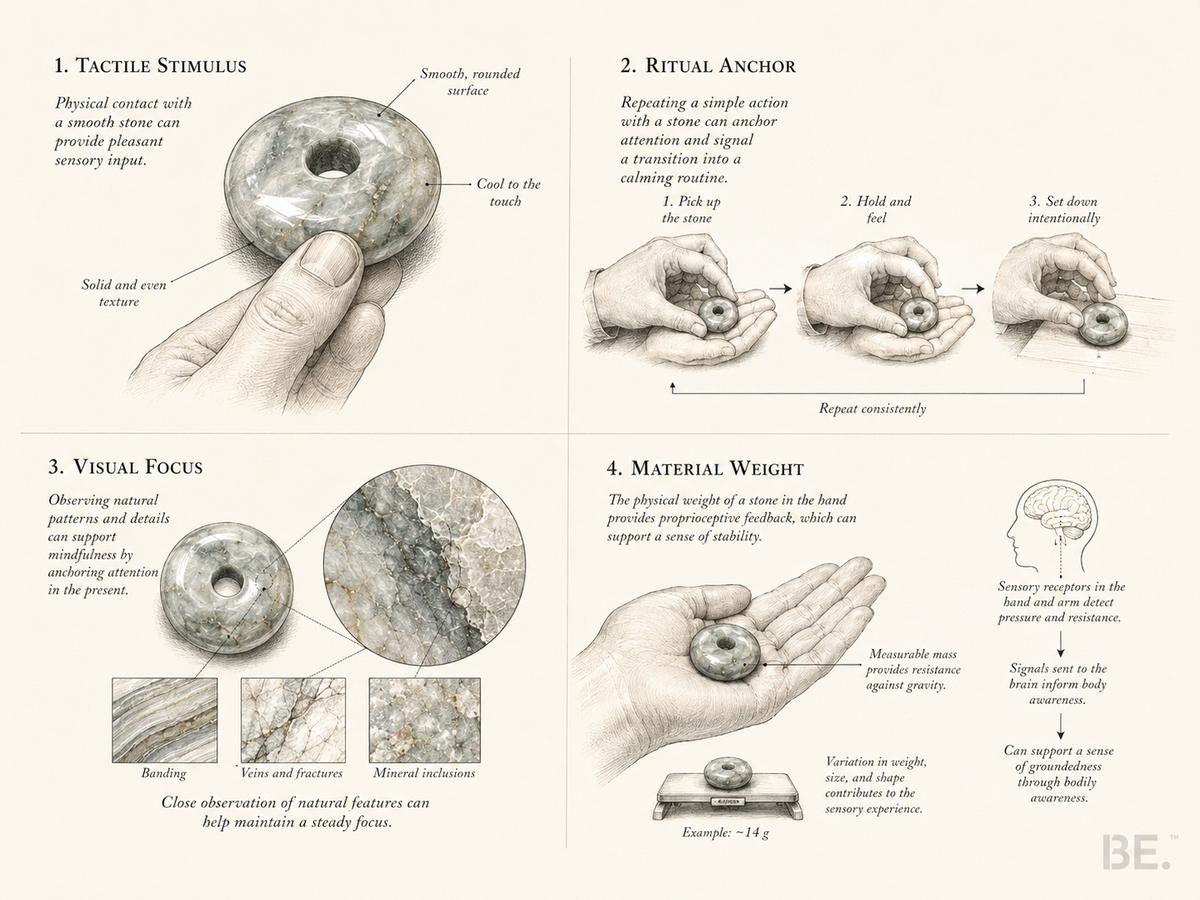
An object can be part of a routine. Someone may touch a bracelet as a reminder to pause, notice their surroundings or return attention to a chosen action. Its colour and weight may also be personally pleasing. These are descriptions of use and experience, not proof that the mineral changes anxiety.
BE. does not assign medical properties to amethyst, rose quartz, aquamarine or any other stone. Two people can wear the same material and report different experiences. That variability is one reason not to convert personal meaning into a treatment claim.
What can be said about the material?
Geology gives us specific, testable statements. Quartz has a defined crystal structure and hardness; haematite has a different density and lustre; colour can come from trace elements, inclusions or structural effects. Those properties help identify and compare a stone. They do not establish a mental-health benefit.
This boundary is useful rather than limiting: it lets a piece be valued for material character, design and personal association without turning it into an unproven health product.
How can you use a personal object without making a health claim?
- Describe it as a personal reminder, routine or aesthetic choice.
- Avoid saying a specific mineral “treats,” “balances,” “heals” or “reduces” anxiety.
- Do not delay professional help or change prescribed treatment because of a crystal.
- Use evidence-based self-help information from recognised health services when appropriate.
- If anxiety is persistent, worsening or disrupting daily life, contact a qualified healthcare professional.
For BE.’s broader editorial position, read Why BE. Avoids Crystal Claims.
When should you seek help for anxiety?
Seek professional help when anxiety is difficult to control, persists, worsens or interferes with daily activities and relationships. NIMH and the NHS provide information on symptoms, treatment and how to find support. In an immediate crisis or life-threatening situation, use the emergency or crisis services available where you are.
Frequently asked questions
Q1.Which crystal is best for anxiety?
No crystal has been established as a treatment for anxiety. Choose jewellery for its material, design or personal meaning—not as a substitute for healthcare.
Q2.Do amethyst or rose quartz reduce anxiety?
There is no reliable clinical evidence that either mineral reduces or treats anxiety. Reports of calm are personal experiences and should not be presented as a stone-specific medical effect.
Q3.Can a bracelet be a grounding reminder?
It can be used as a personal cue to pause or redirect attention. That describes a chosen routine with an object; it does not show that the crystal itself treats anxiety.
Q4.Can crystals replace therapy or medication?
No. Do not delay professional care or change prescribed treatment because of crystal jewellery. Speak with a qualified healthcare professional about persistent or disruptive anxiety.
References
Field Notes.
One stone at a time: its geology, and how to read quality. The Stone Buying Checklist comes with your first email.
By subscribing you agree to receive emails from BE. Unsubscribe anytime.
Sent. Check your inbox.