
Why Crystals Are Geological Treasures (Beyond the Hype)
A material-first reframe of crystals as geological treasures — what makes them rare, how they form, and why the geology is more interesting than the mythology.
In this field note
The word “treasure” gets applied to crystals too easily. Influencer culture treats it as a feeling word; the gem trade uses it as a marketing one. Neither tells you what is actually rare about the rock in your hand. The geological answer is more interesting: every clear, well-formed crystal is a near-statistical accident, and the conditions that made it can be reconstructed from the stone itself.
This article walks through the four reasons crystals are geologically rare — lattice perfection, fluid chemistry, the pressure-temperature window, and time — then looks at three famous specimens that demonstrate each constraint at extreme scale. The point is not to debunk the romance. It is to ground it in something more durable than vibes.
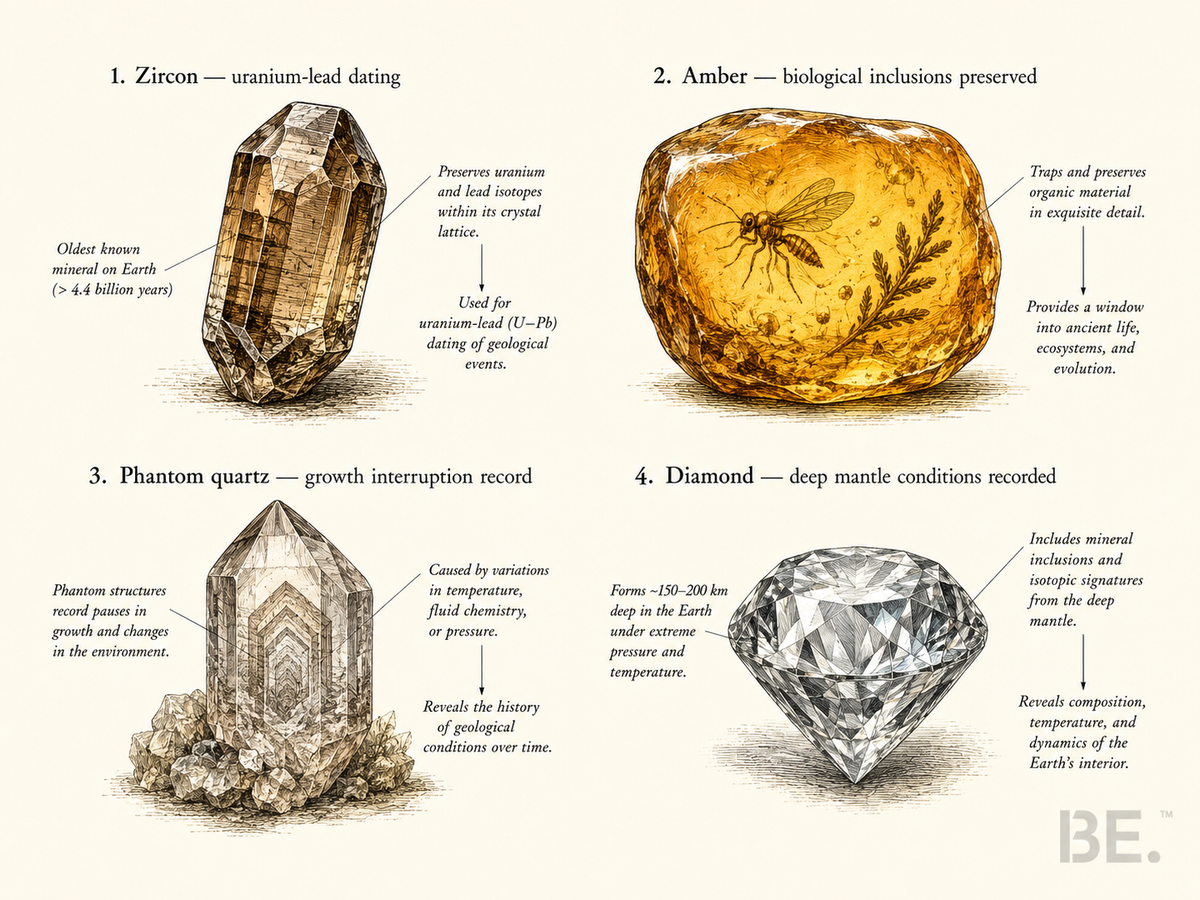
What rarity actually means in mineralogy
A crystal is a solid in which atoms occupy a repeating three-dimensional lattice. Quartz is among Earth’s most abundant minerals — silica makes up roughly 12 per cent of the continental crust — yet most of that silica exists as cryptocrystalline or amorphous material: chert, flint, glass, microcrystalline aggregates too small to see. A clear, faceted, gem-grade quartz crystal large enough to cut is statistically unusual within the same chemistry.
Rarity in mineralogy is not about how much of an element exists. It is about how often that element gets to organise itself into a perfect, undisturbed lattice large enough to be visible. Four conditions have to align.
The four conditions that make a crystal possible
| Condition | What it requires | Why most rock fails it |
|---|---|---|
| Lattice perfection | Atoms arriving slowly enough to occupy correct sites | Rapid cooling traps defects; volcanic glass is silica that never got the chance to order itself |
| Fluid chemistry | The right ions dissolved in the right concentration | Most groundwater carries iron, calcium and silica together; only specific separations grow single-species crystals |
| Pressure–temperature window | Conditions stable within a narrow species-specific range | Mantle pressures destroy quartz; surface pressures destroy diamond — stability windows are narrow |
| Unbroken time | Millions of years without seismic interruption or fluid change | Earthquakes, fluid composition shifts and uplift events break growth surfaces and end the crystal |
Three specimens that show the constraints at extreme
Famous specimens are useful precisely because they make the constraints visible. Each of the three below survived a condition that usually fails.
| Specimen | What makes it extreme | Geological constraint demonstrated |
|---|---|---|
| Cullinan diamond (South Africa, 1905) | 3,106 carats rough — still the largest gem-quality diamond ever recovered | Mantle pressure stability + intact transport to the surface via kimberlite |
| Cueva de los Cristales, Naica (Mexico) | Selenite (gypsum) crystals up to 12 metres long | 500,000 years of stable hot groundwater within ~1°C of the gypsum-anhydrite transition |
| Bolivian ametrine (Anahí mine) | Single quartz crystals zoned half amethyst, half citrine | Iron oxidation state change mid-growth without recrystallisation — only one deposit globally produces it |
Reading a crystal as a geological record
- Termination geometry. Sharp, undamaged terminations mean the crystal stopped growing without mechanical disruption. Re-healed tips signal a seismic interruption followed by a second growth phase.
- Phantom inclusions. Ghost outlines inside a clear crystal record interruptions — a layer of chlorite, hematite or fluid bubbles got pinned in when growth paused, then continued.
- Colour zoning. Banded colour traces shifts in fluid chemistry. Bolivian ametrine zoning records an oxygen pulse partway through growth that flipped iron from Fe2+ to Fe3+.
- Twinning planes. Reflective internal planes are old fracture surfaces where the lattice rebuilt itself in a mirror orientation — evidence of stress survived rather than failed.
- Surface etching. Pits and triangular markings on the polished face record acidic fluid that worked over the crystal after it stopped growing.
Why cultural significance and material truth can coexist
- Cultural significance is real. Crystals have appeared in burial sites from the Neolithic onward and in dynastic Chinese, Mesoamerican and Egyptian ceremony. The fact that humans noticed them across continents is itself data about their visual impact.
- Material truth is separable. Whether quartz “holds memory” is a metaphysical claim; whether quartz holds a piezoelectric charge under deformation is a measurable one. Both can be discussed, but only one is verifiable.
- Geological treasure language stays honest. Calling a crystal a treasure because of its formation conditions, deposit history and material rarity makes a claim that can be checked. Calling it a treasure because of “high vibration” cannot.
- Provenance is the modern test. Whether a piece is genuinely geologically interesting depends on whether the deposit, locality and growth conditions are known. Without provenance, treasure is a marketing word.
- Beauty is its own argument. A well-grown crystal does not need supernatural framing to be remarkable. The lattice is the remarkable thing.
How BE. thinks about “treasure” language
BE. evaluates every strand against the in-house Crystal 4T standard — Transparency, Tone, Texture and Treasure — and ships each piece with a Stone Origin Record noting species, source country and region (and the specific deposit where the upstream supplier has disclosed it), and the visual reasoning behind the call. “Treasure” only earns its place on a card when the conditions that made the crystal can be named. Otherwise, we let the stone speak for itself.
Frequently asked questions
Q1.Are crystals actually rare?
The elements are not rare; perfect lattices are. Silica is everywhere, but a clear, well-terminated quartz crystal large enough to facet represents a narrow set of conditions — right fluid, right temperature, undisturbed time — that most silica never experiences.
Q2.How long does a crystal take to form?
From seconds to billions of years, depending on species and setting: diamond can take 1–3 billion years in the mantle. Gem quartz typically requires millions of years in a hydrothermal vein. Cave aragonite forms in thousands. Ice crystals form in seconds. “Slow” is relative to chemistry.
Q3.What is the world’s largest crystal?
The selenite crystals in the Cueva de los Cristales at Naica, Mexico reach up to 12 metres in length — the largest natural crystals ever found. They grew over 500,000 years in stable, hot, mineral-saturated groundwater.
Q4.Why is Bolivian ametrine considered geologically unusual?
The Anahí mine in Bolivia is the only commercial source of natural ametrine — single quartz crystals zoned half amethyst, half citrine. The colour boundary records an oxidation-state change in iron mid-growth, a one-pass event that cannot be replicated by treatment.
Q5.Does cultural significance count as part of a crystal’s value?
It does in human terms but not in mineralogical ones. Archaeological evidence of crystals in burial contexts is documented; metaphysical claims about energy or vibration are not. Both can be discussed, but only one is testable.
Q6.How can I tell a geologically interesting crystal from a generic one?
Look for known provenance, visible growth structure (phantoms, zoning, twinning), and uniform polish on a clean lattice. A bead with no traceable origin and no internal features is a commodity, regardless of the trade name on the label.
References
- Mindat — Quartz mineral data
- GIA Gem Encyclopedia
- Wikipedia — Cave of the Crystals (Naica)
- Wikipedia — Ametrine and the Anahí mine
- Klein, C. & Dutrow, B. (2007). Manual of Mineral Science, 23rd ed. Wiley.
- Hazen, R. M. (2012). The Story of Earth. Penguin.
Field Notes.
One stone at a time: its geology, and how to read quality. The Stone Buying Checklist comes with your first email.
By subscribing you agree to receive emails from BE. Unsubscribe anytime.
Sent. Check your inbox.