
Is Crystal Jewellery a Luxury? What Makes a Bracelet High-End
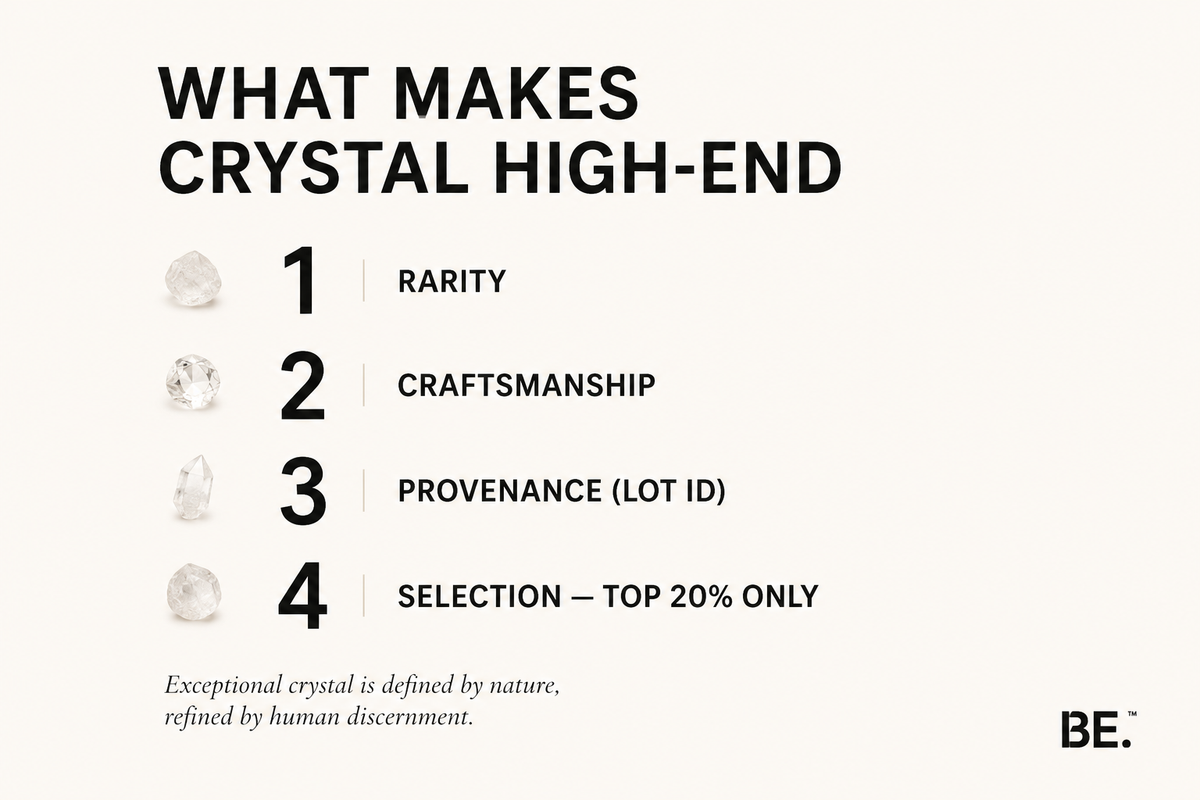
Crystal jewellery's luxury isn't a logo or a trend — it's rarity, craftsmanship, provenance and selection. What separates a high-end bracelet from a cheap one.
In this field note
The honest answer to “is it luxury?” is: it can be, and most of it isn’t — and the gap is readable. A dyed, mass-strung, undocumented strand is a fashion accessory. A graded, hand-matched, lot-numbered natural strand is closer to fine jewellery.
The price range is huge — and that’s the point
The single most striking thing about crystal jewellery is how wide its price range is. A strand with sparse, coarse rutile needles and one with dense, fine, evenly distributed gold needles are both “rutilated quartz” — but the second is far scarcer and can be many times more valuable. The same is true of amethyst (pale lavender vs deep even Bolivian violet) and natural vs heat-treated citrine. That gap is real material rarity, not a markup invented at checkout. A high ceiling exists because top-grade natural material is genuinely scarce — which is exactly what makes the category capable of luxury, not just fashion.
What “luxury” actually means in materials
Strip away the marketing and luxury rests on four things — and crystal jewellery can be measured against all four.
| Pillar | What it means | How a bracelet earns it |
|---|---|---|
| Rarity | Genuinely scarce, not just branded | A deep, even, untreated high grade is uncommon |
| Craftsmanship | Skilled hand-work, not volume | Hand-matched beads, centred drilling, considered stringing |
| Provenance | Documented and traceable | Lot ID plus an origin record, like a certificate |
| Permanence | Built to last and be maintained | Re-stringable construction, durable stones |
Craftsmanship: the work you don’t see
Two strands of identically graded beads can still differ because of the work around the stone: whether the beads are matched in tone and size, whether the drill holes are centred and clean, and whether the strand is strung to be re-strung rather than glued shut. Mass production skips all three — it sorts roughly, drills fast, and treats the strand as disposable. Hand-finishing is slow, and it is part of what you pay for in a high-end piece.
Provenance: the part most crystal sellers skip
Fine jewellery carries paperwork — origin, treatment disclosure, grading. Most crystal jewellery carries none, which is exactly why the category struggles to be taken seriously as luxury. A stone with a Lot ID and a record of its origin, treatment status and colour mechanism does what a diamond certificate does: it makes value verifiable rather than asserted. Traceability is itself a luxury signal — the difference between “trust me” and “here is the documentation”.
Permanence vs disposability
A genuinely high-end piece is built to last and be maintained. Elastic cord is a wear part; a quality strand is built to be re-strung, not thrown away, with stones durable enough for years of wear. Disposability is the opposite of luxury — the cheap strand is designed to be replaced, the considered one to be kept.
How BE. approaches it — selection before grading
BE. adds a step most sellers skip: selection before grading. Only the top tier of available market material — roughly the top 20% — is admitted into the studio in the first place, and only then is it graded on the Crystal 4T standard (Transparency, Tone, Texture and Treasure). In practice this means anything you buy from BE. has already been pre-selected from the best of what the market offers — even the entry point is drawn from top-tier material, not random stock. Each strand then ships with a Stone Origin Record carrying a Lot ID, origin, treatment status and colour mechanism. The position is deliberately unglamorous: not “this is luxury because we say so”, but “here is the selection, the rarity, the craftsmanship and the documentation — judge for yourself”.
Frequently asked questions
Q1.Is crystal jewellery a luxury?
It can be. The category spans disposable fashion strands and documented, hand-finished, high-grade pieces. What makes a piece high-end is rarity, craftsmanship, provenance and selection — not branding or trend.
Q2.Why do crystal bracelet prices vary so much?
Mostly grade and scarcity. Two strands of the same species can differ many times over because one is a far rarer grade. The gap is material, not markup.
Q3.What makes a crystal bracelet “high-end”?
Genuinely scarce material that’s been selected from the top of the market, hand-matched and cleanly cut, documented (Lot ID, origin, treatment), and built to be re-strung.
Q4.Is an expensive crystal bracelet worth it?
If the price reflects a rarer grade, real hand-work and proper documentation, you’re paying for verifiable quality. If it reflects only branding or hype, you’re not.
Q5.Does a certificate or origin card matter?
Yes — it separates “trust me” from verifiable value, the same way paperwork works in fine jewellery. Traceability is a core luxury signal.
Q6.Is crystal jewellery taken seriously as fine jewellery?
Increasingly, when it’s selected, graded and documented like fine jewellery. The undocumented, mass-produced end is what holds the category back — not the material.
References
- GIA — Gemstone grading & disclosure
- Mindat — Mineral rarity and formation
- Webster, R. Gems: Their Sources, Descriptions and Identification, 5th ed. Butterworth-Heinemann.
- BE. Crystal 4T Grading System
- BE. High-End vs Mass-Market Crystal Bracelets
Field Notes.
One stone at a time: its geology, and how to read quality. The Stone Buying Checklist comes with your first email.
By subscribing you agree to receive emails from BE. Unsubscribe anytime.
Sent. Check your inbox.