
Quartz Family Tree: 9 Crystals That Share One Formula
Amethyst, citrine, smoky and rose quartz are all the same mineral. A family tree of nine quartz varieties, one formula, and the trace that separates each from the next.
In this field note
The quartz family is one mineral, silicon dioxide, in nine common varieties. Amethyst, citrine and smoky quartz take their colour from traces inside the crystal itself: iron in amethyst, varied trace elements and defects in citrine, aluminium and natural radiation in smoky quartz. Rose quartz is pink from microscopic mineral fibres, and rutilated, hematoid and phantom quartz show other minerals trapped inside.
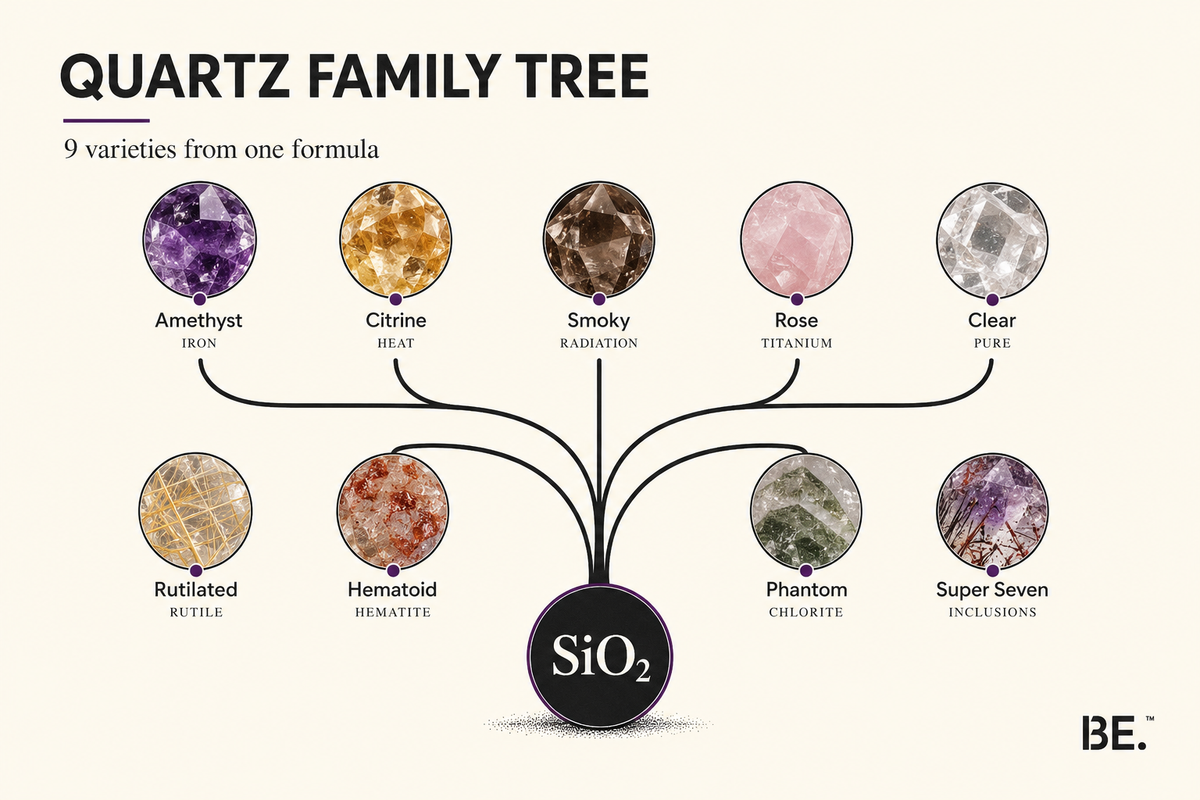
One formula, one hardness
Every variety below is silicon dioxide in the same trigonal lattice, at Mohs 7, with no cleavage. That shared backbone is why they all wear similarly and take the same care. Quartz also splits into two structural branches: macrocrystalline (visible crystals, everything in this guide) and cryptocrystalline (microscopic crystals: agate, chalcedony, jasper). BE. works in the macrocrystalline branch.
The nine branches
| Variety | Main differentiating evidence | Result |
|---|---|---|
| Clear Quartz | No visible colour cause | Colourless, transparent; the baseline. |
| Amethyst | Iron + natural radiation | Violet colour centre. |
| Citrine | Trace elements and defects; some is heated amethyst | Yellow to golden-orange. |
| Smoky Quartz | Radiation-induced colour centres in aluminium-bearing quartz; dose history and stability are not universal | Grey, brown to near-black. |
| Rose Quartz | Colour-bearing nanofibres related to dumortierite in studied massive material; transparent pink quartz differs | Soft, cloudy pink. |
| Rutilated Quartz | Rutile (TiO2) needles | Golden threads suspended inside. |
| Hematoid Quartz | Iron-oxide inclusions, often hematite | Red, rust and gold veils. |
| Phantom Quartz | Earlier growth surfaces marked by inclusions such as chlorite | Ghostly inner outlines (green phantoms). |
| Super Seven | Colour zones and inclusions | Quartz with inclusions of other minerals; the mix varies. |
Two footnotes that resolve common confusion: blue needle quartz is clear quartz with dumortierite inclusions (another inclusion branch), and prasiolite (“green amethyst”) is heat-altered amethyst, a colour-centre branch of the same species.
Reading the tree
- Colour centres vs inclusions. Amethyst, citrine and smoky get colour from the lattice itself; rutilated, hematoid and phantom quartz get it from trapped minerals.
- Heat moves between branches. Heating amethyst makes citrine or prasiolite. The atoms are the same; the conditions differ.
- Clarity is an observation, not a type certificate. Many lattice-coloured varieties are transparent and many inclusion-bearing materials show structure, but thickness, fractures, aggregate habit and treatment can blur that pattern.
- Hardness is constant. All sit at Mohs 7, so any quartz bracelet shares the same durability baseline.
- Names are branches, not trees. “Fire quartz” or “Venus hair” are leaves on the hematoid and rutilated branches.
Trade names, decoded
- “Green amethyst.” Prasiolite, heat-altered amethyst, still quartz.
- “Fire quartz.” Hematoid quartz, with iron-oxide inclusions.
- “Venus hair / angel hair.” Fine rutilated quartz.
- “Smoky topaz.” A misnomer. It is smoky quartz, and no topaz is involved.
- “Cherry quartz.” Usually manufactured glass, not a quartz variety at all.
How BE. grades quartz
Across every branch, BE. reads each strand against the Crystal 4T framework: Transparency, Tone, Texture, Treasure, and records the variety, the colour mechanism and the source on a Stone Origin Record. The family tree is the map; the card is the specific coordinate for your stone.
Frequently asked questions
Q1.Are amethyst and citrine the same mineral?
Yes, both are quartz (SiO2). Amethyst is violet from iron and radiation; heating it shifts the colour centre to citrine’s yellow-orange. Some commercial citrine is heated amethyst.
Q2.Macrocrystalline vs cryptocrystalline quartz?
Macrocrystalline has visible crystals (amethyst, citrine, clear). Cryptocrystalline (agate, chalcedony, jasper) is microscopic crystals packed together. Both are SiO2.
Q3.Why are there so many quartz varieties?
Quartz is abundant, but one SiO2 formula can host different defects, inclusions, aggregate textures and treatments. Those mechanisms require separate evidence; appearance cannot be read back to one universal variable.
Q4.Is rose quartz coloured by iron?
Not mainly. Its pink comes largely from microscopic borosilicate fibres dispersed through the crystal, which is why rose quartz is usually cloudy.
Q5.Do all quartz varieties have the same hardness?
Essentially yes: all macrocrystalline quartz is Mohs 7, so they share scratch resistance and care. Inclusions can create local weak points, but the host hardness is constant.
Q6.Is Super Seven really seven minerals?
Super Seven is a trade name for quartz with colour zones and inclusions of other minerals. Sellers traditionally list seven components, and three of them, amethyst, smoky quartz and clear quartz, are colour varieties of quartz itself. Which inclusions appear varies from piece to piece.
References
- Quartz (Wikipedia)
- Mindat: Quartz mineral data
- Quartz (Mindat.org)
- Rossman, G. R. (1994). Colored Varieties of the Silica Minerals, Reviews in Mineralogy 29.
- Deer, Howie & Zussman (2013). An Introduction to the Rock-Forming Minerals, 3rd ed.
Field Notes.
One stone at a time: its geology, and how to read quality. The Stone Buying Checklist comes with your first email.
By subscribing you agree to receive emails from BE. Unsubscribe anytime.
Sent. Check your inbox.