
High-End vs Mass-Market Crystal Bracelets: A Material Reading
The price gap between mass-market and high-end crystal bracelets is set by six material variables: raw cost, yield, polish, sorting, origin, brand model.
In this field note
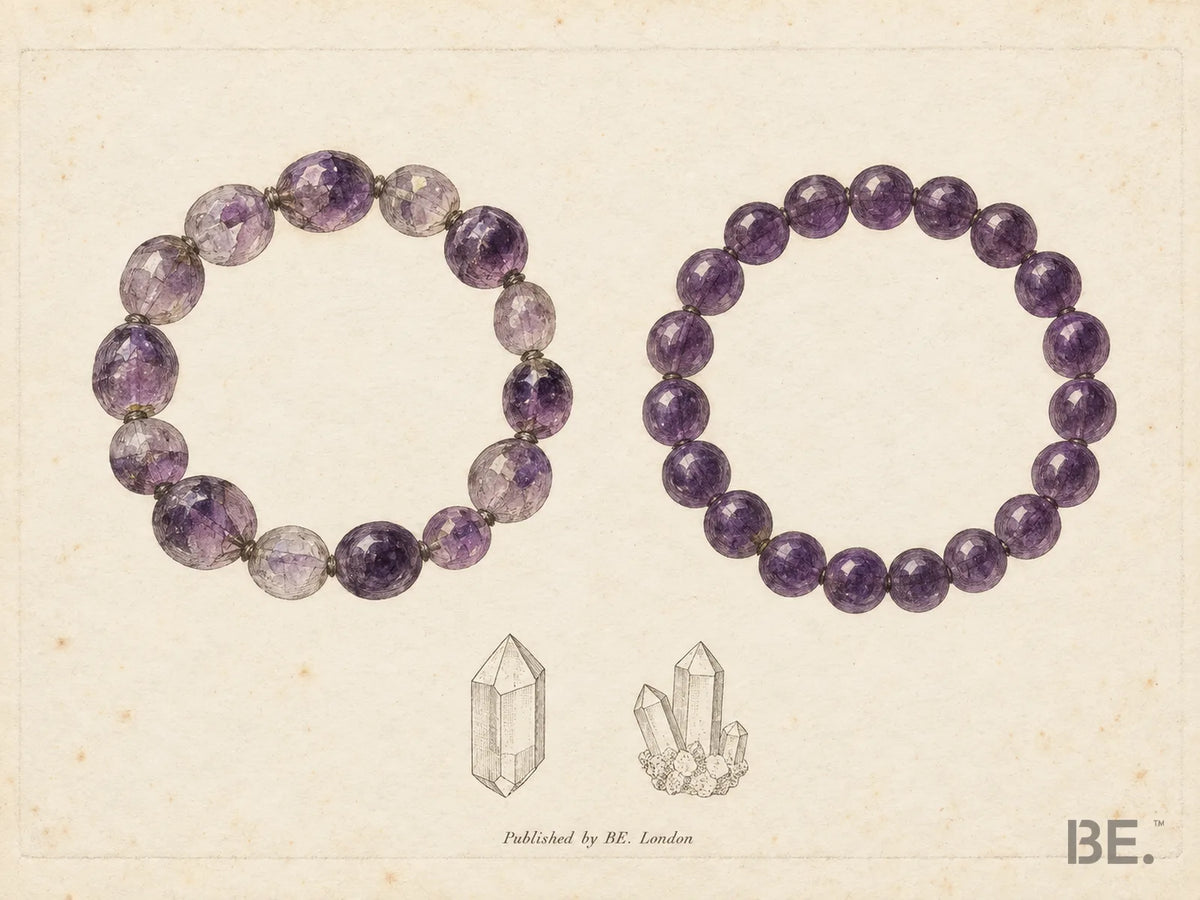
Two 8 mm amethyst bracelets sit side by side. One is priced at €30 in a high-street wellness shop. The other is priced at €500 in a studio that grades every strand. Both are amethyst. Both are 8 mm. From across a table you can already tell which is which: one strand is a single, even violet from clasp to clasp, the other drifts from pale lilac to near-grey bead by bead. This article explains where that difference comes from and how to check for it.
The two are made in different ways, from different material, for different occasions. A bracelet you will wear for years, or give to someone who matters, is a different purchase from a piece added to a holiday stack. The sections below walk through the material first, then the making, then how to read a product page before you spend €300 or more.
Two crystal jewellery markets, side by side
The category splits into two production models. Both sell natural stone. They part ways at the very first step, which stone is bought, and stay apart from there.
| Dimension | Mass-market segment | High-end segment |
|---|---|---|
| Rough selected | Mixed parcels bought by the kilo | Colour-graded rough chosen piece by piece or lot by lot |
| Sorting | Beads strung as they come off the machine | Every bead checked; off-tone and flawed beads removed |
| Colour match | Varies bead to bead along the strand | One tone from clasp to clasp |
| Material verification | Trade identification at the wholesaler | Stone-by-stone gemmological check at the studio |
| Origin and treatment record | Rarely stated | Country and region published; treatment stated on the product page |
| Finish | Polished in bulk, standard drilling | Mirror polish on every bead; drill holes inspected |
| Wearing life | A season or two before it looks tired | Years of daily wear with the same colour and surface |
Read down the right-hand column and the price makes sense before any number appears. Each row is a decision someone made to keep the better stone and let the rest go.
What "high-end" means in this category
In watches or signed silver, high-end usually means a recognisable maker's mark and a long history. Crystal jewellery has neither. Most strands are unsigned and no house has a century behind it. So the word has to point at the material itself.
In this category a high-end strand is one where the stone is better to begin with and every bead has been chosen. Amethyst from the same country arrives in every shade from pale lilac to deep violet, from glassy to cloudy, with and without cracks and colour zoning. A graded strand takes the top of that range and keeps only the beads that match. A mass-market strand takes the parcel as it comes. BE. scores this with Crystal 4T™: Transparency, Tone, Texture and Treasure, each from 1 to 5. A bead scoring below 3 in any material reading is rejected, and the lowest material score sets the tier.
The six material variables driving the price gap
Six things separate a €30 strand from a €500 one. Each of them is visible, or checkable, before you buy.
- Rough quality. Deep, evenly coloured amethyst from Bolivia and top-grade rose quartz trade at several times the price of bulk rough, because there is far less of it. The strand starts from better stone, and that shows in the colour on your wrist.
- Cutting yield. Cutting round beads discards 70 to 90 percent of the rough. Holding every bead to the same tone and clarity discards more again. A strand cut to one colour needs a far larger piece of good rough than its finished weight suggests.
- Polish. Bulk beads are polished together to a standard finish. On a graded strand each bead is checked and any chipped or dull bead is replaced. The result reads as an unbroken line of mirror surfaces when the strand catches light.
- Colour and inclusion sorting. Sorting means looking at every bead against its neighbours: tone, transparency, cracks, cloudy patches. For rutilated quartz or phantom quartz it also means choosing beads whose inclusions read well together. This is slow, skilled work, and it is the difference you notice first.
- Origin and treatment record. Publishing country and region, and stating whether the stone is untreated, heated or irradiated, requires the rough to stay traceable from purchase through cutting to stringing. Few strands come with this record. The ones that do can be checked, and the record travels with the piece if it is passed on.
- Years of wear. A strand of well-sorted, well-polished stone looks the same in year five as on day one. Mixed parcels lose their surface faster, and colour that was uneven at the start becomes more obvious as the polish wears. The price buys the years.
Put the six together and the two bracelets are different objects that happen to share a stone name and a bead size. One was made to be sold quickly. The other was made to be worn for a long time.
What you can see from across a table
You do not need a loupe or a macro lens. At the distance you would sit from someone at dinner, four things give a strand away.
- Colour drift. Run your eye along the strand. A sorted strand holds one tone the whole way round. An unsorted strand steps up and down in shade, and often has a bead or two that clearly came from a different parcel.
- Transparency. Hold it to the light. Graded amethyst, citrine or clear quartz lets light through evenly. Cloudy beads, milky patches and internal cracks show as dull spots along the strand.
- Surface. Turn the wrist. A mirror polish throws back a sharp highlight on every bead. A tumbled finish gives a softer, uneven shine and shows scratches sooner.
- How it sits. Well-matched beads with clean drill holes lie flat and turn together on the wrist. Uneven beads twist and catch on each other.
When a graded strand is the right choice
Some purchases call for the better strand from the start:
- A gift for family or a close friend. A gift is judged twice: when the box opens, and every time the piece is worn afterwards. A graded strand with its origin record holds up on both occasions. A €30 to €60 strand is not a gift for a birthday, an anniversary or a thank-you that carries weight; it reads as an afterthought the moment the box opens.
- Your main piece, worn daily. A strand worn on its own, day after day, is looked at more than any other piece you own. Colour drift and dull beads are visible every time you reach for a cup.
- Collecting. A documented strand can be photographed, compared and passed on with its record. It keeps a place in a collection in a way an unsorted strand cannot.
- Buying for the material. If you care what the stone is, where it came from and whether it was treated, only one of the two segments can answer those questions.
How to verify high-end claims before you spend €300 or more
A high price on its own proves little. Four checks before you pay:
- Does the product page name the chemistry, Mohs hardness and crystal system? If the description is all mood and no mineralogy, nobody has looked closely at the stone.
- Is treatment stated? A seller who grades stone will say whether it is untreated, heated or irradiated. Look for the word on the page, and ask if it is missing.
- Is origin published to country and region? "Imported" tells you nothing. A country and region can be checked against what that locality is known to produce.
- Is the brand investing in the category for the long run? Look for a published grading standard, a record system that follows each piece, long-form writing about the stones themselves, and a range that stays consistent from season to season. Those take years to build and are hard to fake.
BE.'s position
BE. (thebeworld.com) grades every strand with Crystal 4T™ (Transparency, Tone, Texture, Treasure, each scored 1 to 5) and publishes the result on a Stone Origin Record that names country and region, states treatment and carries the lot number. Strands run from €179 upward. The four series (Anchor, Flow, Prism, Void) are set out on the Geological Codex; the studio's beginnings are on Our Story.
Every strand in the BE. collection ships with a Stone Origin Record that states its lot and its four Crystal 4T™ readings.
Frequently asked questions
Q1.Is a €30 crystal bracelet fake?
Often it is real stone, at the bottom of the quality range for that stone. Glass, resin or dyed material is a real possibility at this price, because nobody has checked each bead. If the page names no chemistry and no treatment, assume nothing has been verified.
Q2.Why is one 8 mm amethyst €30 and another €500?
They are the same mineral and a different stone. The €500 strand started as top-colour rough, lost most of that rough to cutting for matched beads, was sorted bead by bead, mirror polished, and comes with an origin and treatment record. The €30 strand skipped every one of those steps.
Q3.How do I know if a high-end brand is high-end or just expensive?
Four checks: chemistry and Mohs hardness on the product page, treatment stated, origin to country and region, and signs the brand is building for the long run (a published grading standard, a record system, writing about the stones). A brand that passes all four has done the work the price implies.
Q4.Is a €30 to €60 crystal bracelet a suitable gift?
Not as a real gift. For family, a close friend or any occasion the recipient will remember, choose a graded strand. The difference is visible when the box opens and stays visible every time it is worn.
Q5.What is the most common reason buyers stop wearing a bracelet?
They wear it once or twice and stop. The colour looks uneven next to better pieces, the polish dulls, and the strand feels dated within a season. A well-made strand does the opposite: it is worn for years and looks the same at the end of them.
Q6.How long should a good crystal bracelet last?
Quartz-family stones sit at 7 on the Mohs scale, harder than a steel knife blade, so a well-polished bead keeps its surface for decades. What wears out is the cord, and a cord can be restrung. Buy the stone once and expect to keep it.
References
- GIA Gem Encyclopedia: quality factors and treatment
- Gem-A: gemmology reference
- BE. Crystal 4T grading system
- BE. Journal: Are expensive crystal bracelets worth it
- Mindat: mineral database
- Schumann, W. (2009). Gemstones of the World, 4th ed. Sterling.
Field Notes.
One stone at a time: its geology, and how to read quality. The Stone Buying Checklist comes with your first email.
By subscribing you agree to receive emails from BE. Unsubscribe anytime.
Sent. Check your inbox.