
Crystal Bracelet for Women: A Material-First Buying Guide
A material-first guide to choosing a crystal bracelet for women — bead size, stones, sizing and stacking — judged by the material, not the marketing.
In this field note
A crystal bracelet does not behave differently because it is worn by a woman, so a buying guide should not pretend otherwise. What actually changes with a finer or smaller wrist is scale and how pieces layer: a smaller bead reads refined, a translucent stone catches light, and a considered stack does more than any single statement piece. Those are material and proportion questions, and they have clear answers.
This guide reads women’s strands the way BE. reads any stone, by what the material is, how it is finished, and how it sits on the wrist, with the colour and styling that tend to suit a finer wrist.
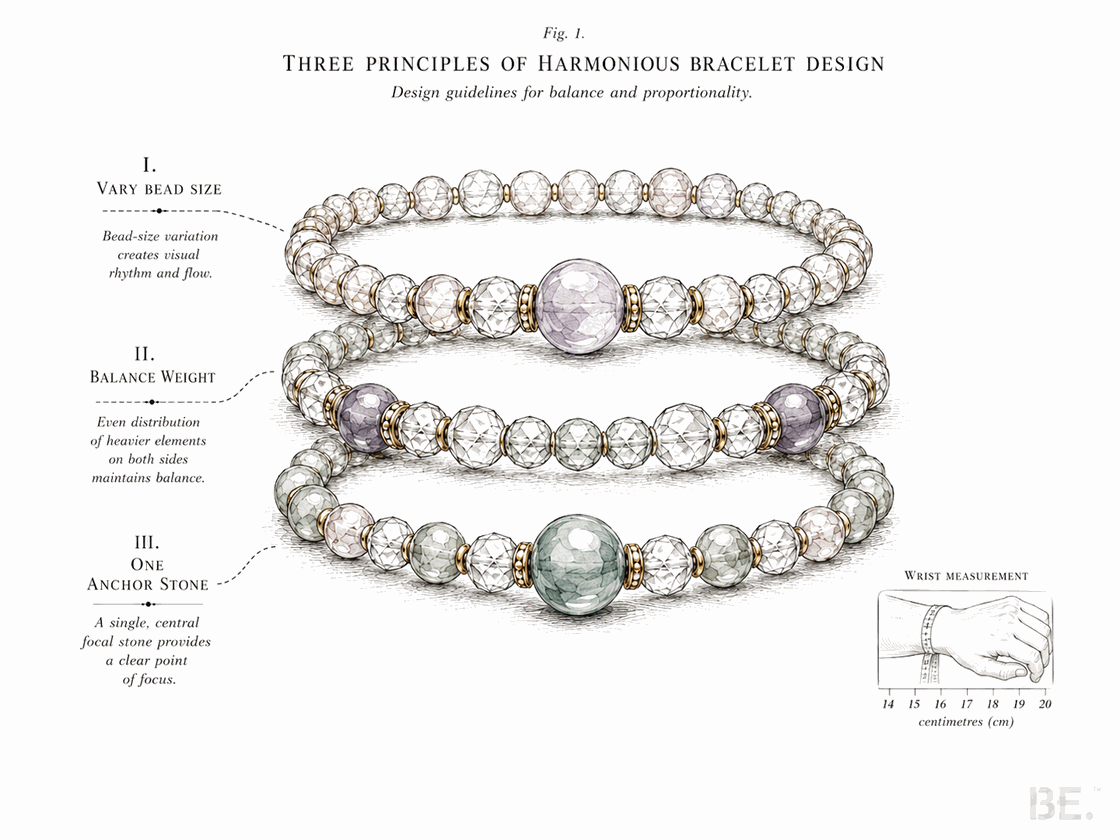
What you are actually choosing
Strip away the marketing and a crystal bracelet is a string of polished mineral beads. Its quality is set by the mineral, its clarity or colour, the bead size, the finish, and the fit. For a finer wrist the brief is usually elegance and the ability to layer: a refined bead, a translucent or softly coloured stone, and a length that sits cleanly. None of that depends on the stone being “for women”. A woman who wants a bold 10 mm obsidian should wear exactly that. It is about the look you want, not a rule.
Stones that suit a finer wrist
| Stone | Look | Why it works |
|---|---|---|
| Rose Quartz | Soft translucent pink | Classic, gentle, reads well in fine beads; a natural gift choice |
| Amethyst (6 mm) | Violet, pale to deep | Versatile and refined in a smaller bead; pairs with almost anything |
| Moonstone | White with blue adularescent sheen | Optical movement that catches the light; elegant and distinctive |
| Clear Quartz | Water-clear | Neutral, pairs with everything; ideal stacking spacer |
The work is being done by colour, translucence and scale. No property a stone is said to confer comes into it. Choose the material you find beautiful and that suits how you want to wear it.
Bead size and sizing
Bead size sets the character. A 6 mm bead reads fine and elegant and is ideal for stacking; 8 mm is the everyday middle; 10 mm makes a deliberate statement. On a smaller wrist a finer bead usually looks better proportioned, but the choice is about the look you want.
For fit, wrap a soft tape or strip of paper just below the wrist bone, read the circumference, and add roughly 1 to 1.5 cm for comfort. If you are between sizes, size up: a strand can sit slightly loose comfortably, but a tight one will not be worn.
Stacking: three rules
- Vary the bead size. Mixing 6 and 8 mm strands adds rhythm; identical beads can read flat.
- Balance the visual weight. Pair a translucent pale strand with a deeper one so neither overwhelms.
- Anchor with one stone. Let a single statement strand lead and keep the rest quiet.
- Mind the tones. Cool with cool, warm with warm, or use clear quartz as a neutral bridge.
- Keep it wearable. A stack should still sit comfortably; too many fixed-length strands fight each other.
Reading a strand before you buy
- Bead matching. Even colour and size across the strand; lurching tone signals mixed rough.
- Polish. A glassy, even finish; pitting means rushed work.
- Drill holes. Clean, centred holes protect the cord.
- Treatment honesty. A seller who discloses dyeing or heating is one to trust.
- Sheen, for moonstone. The blue should move with the light, not look painted on.
Caring for the strand
Match care to the material. Quartz-family stones (rose quartz, amethyst, clear quartz) sit at Mohs 7 and handle daily wear, though amethyst should be kept out of long, direct sunlight. Moonstone is softer (around Mohs 6) and needs gentler handling. Store strands separately so they do not scratch one another, keep them out of the shower and pool, and wipe with a soft damp cloth.
How BE. grades it
BE. grades every strand on the Crystal 4T framework (Transparency, Tone, Texture and Treasure), and ships each with a Stone Origin Record recording the material and any treatment. For styling and gifting, see our guides to stacking crystal bracelets and choosing a crystal gift; for the stones themselves, our amethyst and moonstone guides.
Frequently asked questions
Q1.What bead size suits a woman's wrist?
6 mm and 8 mm beads are the most versatile: 6 mm reads fine and elegant, 8 mm is the everyday middle, and 10 mm makes a bolder statement. Choose by the look you want and your wrist size.
Q2.How do I measure my wrist?
Wrap a soft tape or strip of paper just below the wrist bone, read the circumference in centimetres, and add about 1 to 1.5 cm for comfort.
Q3.Which crystals make the best gift?
Choose by colour and material: rose quartz for soft pink, amethyst for violet, moonstone for its blue sheen. A documented, well-finished strand makes a considered gift.
Q4.How do I stack crystal bracelets?
Vary the bead size, balance the visual weight, and anchor the stack with one statement stone. Mixing materials is fine as long as the tones work together.
Q5.Which crystals are best for daily wear?
Quartz-family stones at Mohs 7, such as rose quartz, amethyst and clear quartz, are robust for daily wear. Moonstone is softer and needs a little more care.
Q6.How do I judge the quality of a strand?
Look for even colour and bead matching, a clean polish, centred drill holes, and honest disclosure of any treatment.
References
- Gem-A: The Gemmological Association of Great Britain
- GIA Gem Encyclopedia
- Read, P. G. (2005). Gemmology, 3rd ed. Butterworth-Heinemann.
Field Notes.
One stone at a time: its geology, and how to read quality. The Stone Buying Checklist comes with your first email.
By subscribing you agree to receive emails from BE. Unsubscribe anytime.
Sent. Check your inbox.