
Crystal Gift Guide: Choosing by Material, Style and Occasion
A gift guide for crystal jewellery — choosing by recipient style, material weight, bead size and occasion, without resorting to metaphysical promises.
In this field note
The mistake most crystal gift guides make is starting from the giver’s intention — “give amethyst for calm,” “give citrine for joy” — rather than the recipient’s wardrobe. Crystal jewellery is jewellery first; it lives or dies on whether it gets worn. A beautiful piece chosen for a meaning the recipient does not hold sits in a drawer.
This guide reverses the order. Start with how the recipient already dresses, the wrist size they actually have, and the occasions they actually attend. Match the stone to those facts. The meanings, if they matter, follow comfortably afterward — they should never lead. For a recipient-specific route, see how to choose a crystal bracelet for her. When the recipient is a child, fit, clasp security and supervision come before the stone.
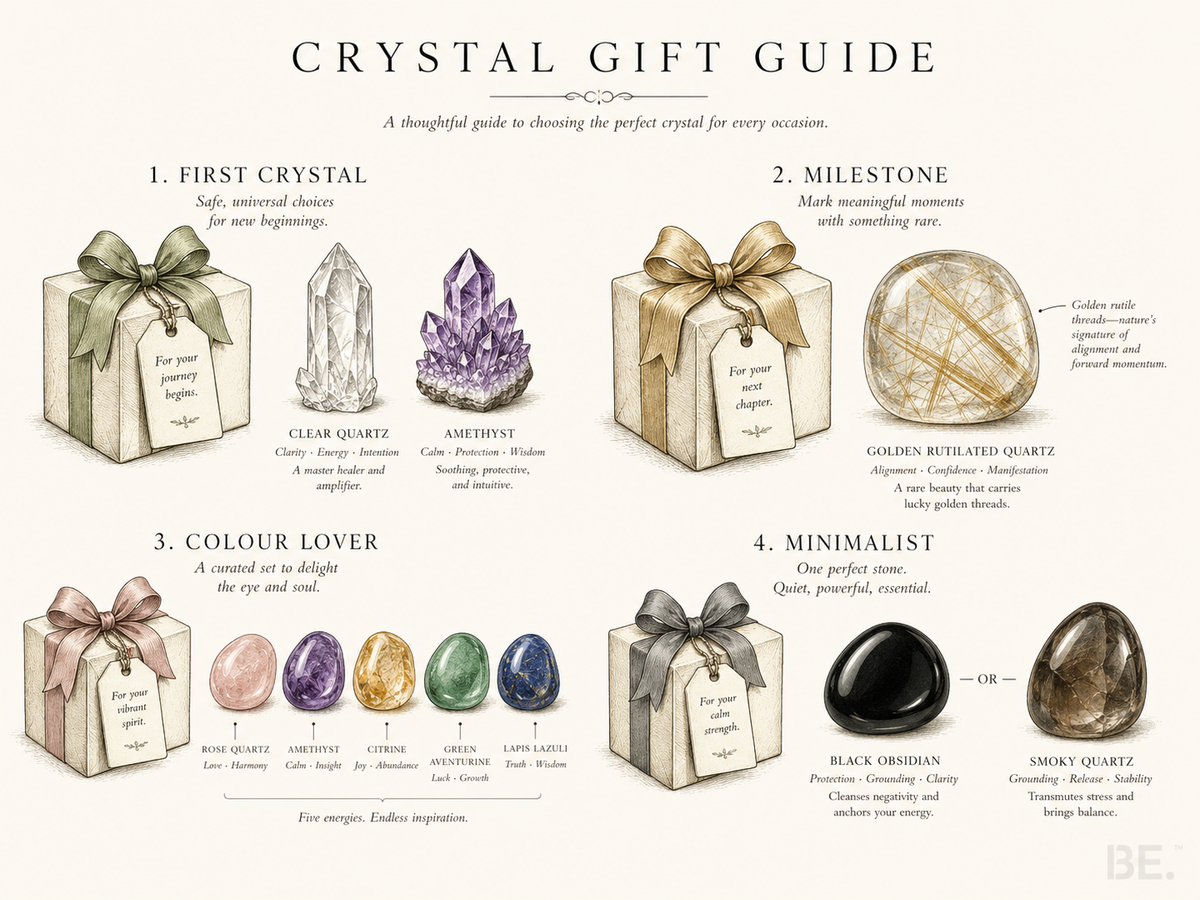
Step one: read the recipient’s existing palette
Before you choose a stone, look at the recipient’s existing jewellery and clothing. Three palettes recur across most wardrobes:
- Warm-neutral wardrobe. Camel, cream, tan, soft brown, ivory, brushed gold. Stones that read well: smoky quartz, citrine, golden rutilated quartz, carnelian, tigereye.
- Cool-neutral wardrobe. Grey, navy, black, charcoal, silver, white gold. Stones that read well: clear quartz, amethyst, lapis lazuli, sodalite, blue lace agate, moonstone.
- Earthy / textural wardrobe. Olive, terracotta, rust, deep green, raw linen. Stones that read well: aventurine, jasper, malachite, agate, garnet, smoky quartz.
This is not a strict rule — cool wardrobes carry warm stones beautifully as accents — but it gets the gift to a wearable starting point.
Step two: choose by occasion
| Occasion | Stone suggestion | Why |
|---|---|---|
| Everyday strand | Clear quartz, smoky quartz | Neutral, layers with anything, daily wear-resistant at Mohs 7. |
| Birthday | Their birthstone (modern or traditional) | Personal anchor; lets them carry a marker without it being thematic. |
| Anniversary | Matched pair, or a single piece with a stone tied to the meeting year | Quiet specificity; reads as considered rather than generic. |
| Graduation / new chapter | Clear quartz, citrine | Bright, optimistic colours without colour-loading the wardrobe. |
| Housewarming / new role | Smoky quartz, jasper, agate | Earth tones; reads grounded; suits home or office settings. |
| Self-gift | Whichever stone has been catching the eye for months | The piece that the buyer keeps thinking about is the right gift. |
Step three: choose by personality, not by mood
It is tempting to give amethyst to someone who seems stressed, or citrine to someone who seems sad. This is the gift equivalent of unsolicited advice — the recipient receives the diagnosis as much as the present. A more generous approach is to match the stone to how the recipient dresses themselves:
- The minimalist. Clear quartz, smoky quartz or a single faceted stone strand. Quiet, structural, easy to integrate.
- The maximalist. A statement strand at 10mm — amethyst, rose quartz, or a multi-stone composition. Stands up to existing layered jewellery.
- The classicist. Their birthstone, or a traditional pairing — amethyst, garnet, lapis. Recognised stones in a recognised format.
- The collector. A rarer material — rutilated quartz, lepidolite, dendritic agate. Something they will not already own.
- The first-time wearer. Clear quartz or amethyst at 8mm. Easy entry; layers with everything; teaches the wrist to carry weight.
Step four: get the size right
The single most common gift-jewellery error is the wrong wrist size. Bracelets that are too tight feel like obligation; bracelets that are too loose get lost on the wrist or fall off. For pregnancy or postpartum gifts, allow for temporary wrist-size changes and one-handed removal. Two ways to handle it:
If you can measure discreetly, find an existing bracelet they wear and measure its inner circumference. Add nothing — that is already their preferred fit. If you cannot, choose a stretch-cord strand at the most common adult fit (17–18cm for most adults; 15–16cm for slim wrists; 19–20cm for wider wrists). Stretch cord allows roughly 1cm of give in either direction without losing shape.
Bead size is the second variable. 8mm is the safe default and the easiest to wear. 6mm reads quiet and suits petite hands or layering wearers. 10mm reads as a statement and works for recipients who already wear bold jewellery.
Price tiers and what they buy
Crystal bracelet prices are driven by stone quality, bead size, origin and finish. A working frame for the three common tiers:
Entry tier. Single strand, 8mm, common stone (clear quartz, amethyst, smoky quartz, jasper). Suits a casual gift, a colleague exchange, a first piece. The stone will be respectable but not exceptional.
Mid tier. 8mm or 10mm, premium material (Bolivian amethyst, gold rutilated quartz, gem-grade citrine), graded for clarity and colour consistency. Suits anniversaries, birthdays, considered self-gifts. The strand will photograph well and last decades with reasonable care.
Heirloom tier. Rare materials (deep purple Bolivian amethyst from Anahí, gold rutile from Novo Horizonte, fine-quality Burmese jadeite), 10mm or larger, matched across the strand. Suits milestone occasions — the kind of gift that becomes a family object over time.
Five reliable gift defaults
- A clear quartz strand. Works for almost everyone, layers with anything, photographs well in any light.
- The recipient’s birthstone. Personal without being heavy-handed; reads as considered.
- A matched pair. Same stone, same size, one for the giver and one for the recipient. Quietly relational.
- A small starter stack. Two or three strands in a coherent palette (e.g. clear quartz + smoky quartz + amethyst), giving the recipient a complete look in one gift.
- A rare material the recipient does not already own. For collectors; the gift becomes a new entry in their existing collection rather than a duplicate.
Frequently asked questions
Q1.Is it appropriate to give crystal jewellery to someone who does not believe in crystals?
Yes — if it is chosen as jewellery first. A well-cut amethyst strand is a beautiful object on its own visual terms. The stone meaning is optional context, not the gift itself.
Q2.Should I share the stone’s traditional associations when giving the gift?
Only if you know the recipient is interested. Otherwise, present the piece as jewellery and let any cultural or historical context surface naturally if they ask.
Q3.What if I do not know their wrist size?
Choose a stretch-cord strand at the most common adult fit (17–18cm). These accommodate roughly a centimetre of variation in either direction. If they need a different size, most makers offer resizing or exchanges.
Q4.Are men’s and women’s crystal gifts different?
Not categorically. Wrist size and palette matter more than gender. Larger wrists tend to suit 10mm strands; cooler wardrobes tend to suit clear quartz and smoky quartz; warmer wardrobes tend to suit citrine and rutilated quartz.
Q5.How do I gift-wrap crystal jewellery?
A small structured box with cotton or fabric padding prevents the beads from rubbing during transport. Avoid loose tissue paper, which can let the bracelet shift and scratch its own surface.
Q6.What if they already own that stone?
Most collectors welcome variants of the same mineral — a 10mm to complement their 8mm, a different origin, or a different finish (faceted vs polished). The same stone in a different register is rarely a duplicate.
References
- GIA Gem Encyclopedia
- American Gem Society — Birthstones
- Wikipedia — Birthstone
- Mindat — mineral reference
- Webster, R. (2002). Gems: Their Sources, Descriptions and Identification, 5th ed. Butterworth-Heinemann.
- Schumann, W. (2009). Gemstones of the World, 4th ed. Sterling.
Field Notes.
One stone at a time: its geology, and how to read quality. The Stone Buying Checklist comes with your first email.
By subscribing you agree to receive emails from BE. Unsubscribe anytime.
Sent. Check your inbox.