
Blue Smoky Quartz Guide: Quartz Host, Smoky Field & Blue Appearance
Blue smoky quartz is a trade description for quartz-family material with a smoky field and blue appearance. Learn what can be observed, what remains unassigned, and what evidence to request.
In this field note
That boundary matters because "blue quartz" is not one mechanism. Published cases include scattering by nano-scale inclusions and blue mineral inclusions such as dumortierite or elbaite. Those studies are useful comparisons, not proof for this strand.
What Blue Smoky Quartz Means Here
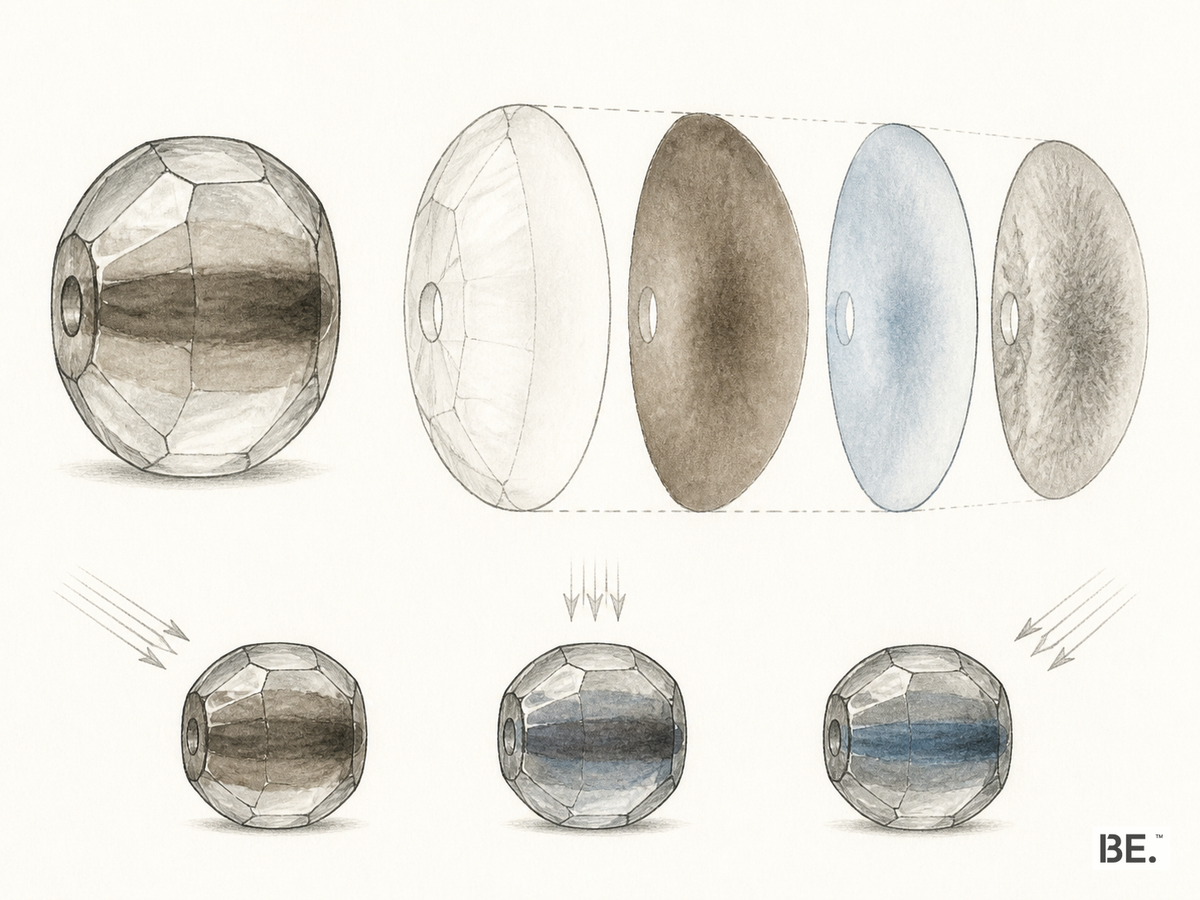
In this article, "blue smoky quartz" is a trade and observation name, not a solved mineral mechanism. The stone is read first as quartz. Then the smoky field is read as a smoky-quartz type observation. The blue is recorded as an optical appearance that needs its own evidence before it can be assigned to Rayleigh scattering, Tyndall scattering, dumortierite, elbaite, or another cause.
The earlier version of this article treated the blue as if the mechanism were already known. This rewrite corrects that. BE. can describe what is visible in the material; it should not turn a plausible optical explanation into a confirmed diagnosis.
| Layer | What can be said | What stays open |
|---|---|---|
| Quartz host | Quartz-family material; SiO2 at stone-type level. | Deposit, growth history and treatment history require product-level records. |
| Smoky field | Smoky quartz is associated with colour centres in quartz, commonly involving aluminium-related defects and irradiation. | Natural versus laboratory irradiation cannot be settled by appearance alone. |
| Blue appearance | The strand presents a blue cast that remains visually distinct from the smoky field. | The BE. lot is not assigned to Tyndall, Rayleigh, dumortierite, elbaite or any named inclusion without analysis. |
| Visible internal texture | Clouds, veils, planes or fine internal marks may change how light reads through a bead. | Observation under normal light does not identify particle size, mineral species or mechanism. |
Why The Old "Sky Blue" Explanation Was Too Strong
It is tempting to explain every pale blue in quartz through the same language used for the sky. Some blue quartz has indeed been discussed through light scattering by very small inclusions. But a mechanism becomes article-safe only when the specimen being sold has evidence for that mechanism.
For Blue Smoky Quartz, the correction is simple: keep the comparison as a possible family of explanations, not as the identity of the BE. strand. The article can say that scattering-coloured blue quartz exists. It should not say that this lot is blue for that reason.
What Can Make Quartz Look Blue
Blue in quartz can come from different routes. In rock-forming blue quartz studied by Seifert and co-authors, nano-particulate inclusions were used to explain a blue colour through Rayleigh scattering. In gem laboratory reporting, GIA has documented blue quartz appearances related to dumortierite inclusions and, in a separate 2025 case, elbaite inclusions.
Those examples show why the word "blue" is not enough. One quartz can look blue because light is scattered by unresolved small inclusions. Another can look blue because blue mineral inclusions are present. A product page or journal article should not choose among those causes unless the evidence chooses first.
How To Observe The Strand
- Turn one bead slowly. Look for whether the blue strengthens, weakens or shifts as the angle changes. That behaviour is useful for description, not a mechanism proof.
- Separate body colour from light path. The smoky field may sit through the bead while the blue appears along a particular viewing path or face.
- Check for named inclusions carefully. Needles, veils or clouds can be visible without being identifiable. A named inclusion needs microscopy or analytical support.
- Do not infer treatment from colour alone. Smoky quartz colour can involve irradiation-related colour centres, and natural and laboratory histories may overlap in appearance.
Blue Smoky Quartz, Blue Smoke, Smoky Quartz And Blue Needle Quartz
Blue Smoky Quartz and Blue Smoke are the names BE. uses around the current product and its optical reading. Smoky quartz is the broader quartz colour variety tied to brown-grey colour-centre behaviour. Blue Needle Quartz is a separate article owner and should not be merged into this page merely because both names contain "blue."
This routing prevents one article from claiming every blue quartz intent. Blue Smoky Quartz owns the question of a smoky quartz-family material with blue appearance. Blue Needle Quartz owns needle-forward material. Smoky Quartz owns the broader brown-grey quartz intent.
A quartz-family strand selected for a readable smoky field and blue appearance. Mechanism remains unassigned until product-level evidence confirms more.
VIEW THE BLUE SMOKE STRANDLab And Seller Evidence Boundary
A responsible product record can include visual observations, supplier disclosures, treatment records, microscopy and laboratory testing. Each does a different job. Visual observation can say what the bead does in light. Supplier records can tell what was disclosed for the lot. Laboratory work can identify a mineral inclusion or optical cause when the method is strong enough.
Until that stronger evidence exists for this lot, the cleanest language is also the most accurate: quartz-family material, smoky field, blue appearance, mechanism unassigned.
Blue smoky quartz strands are listed in the BE. collection, and every strand ships with a Stone Origin Record that states its lot, its four Crystal 4T™ readings and what those readings do not claim.
Frequently asked questions
Q1.What is blue smoky quartz?
Here it means quartz-family material with a smoky brown-grey field and a blue appearance. The name is useful for the product and observation, but it is not a confirmed mechanism diagnosis.
Q2.Why is blue smoky quartz blue?
The blue cause of the current BE. lot is unassigned. Published blue-quartz cases include scattering-related colour and blue mineral inclusions, but those examples cannot be transferred to this strand without evidence.
Q3.Is blue smoky quartz natural?
Quartz, smoky colour centres and blue quartz appearances all occur in nature, but a specific product's origin, treatment and mechanism must be supported by product-level records. Appearance alone is not enough.
Q4.Is blue smoky quartz the same as blue needle quartz?
No. Blue Needle Quartz is a separate article owner for needle-forward material. Blue Smoky Quartz keeps the smoky field and blue appearance together as the main observation.
Q5.What is the difference between blue smoky quartz and smoky quartz?
Smoky quartz names the brown-grey quartz colour variety. Blue Smoky Quartz adds a blue appearance that must be described separately from the smoky field.
Q6.Does BE. claim this lot is Tyndall or Rayleigh blue quartz?
No. This rewrite removes that confirmed claim. Scattering-coloured blue quartz is a documented comparison, but the BE. lot remains mechanism-unassigned.
References
Field Notes.
One stone at a time: its geology, and how to read quality. The Stone Buying Checklist comes with your first email.
By subscribing you agree to receive emails from BE. Unsubscribe anytime.
Sent. Check your inbox.